Static magnets for reducing pain: systematic review and meta-analysis of randomized trials
- PMID: 17893349
- PMCID: PMC1976658
- DOI: 10.1503/cmaj.061344
Static magnets for reducing pain: systematic review and meta-analysis of randomized trials
Abstract
Background: Static magnets are marketed with claims of effectiveness for reducing pain, although evidence of scientific principles or biological mechanisms to support such claims is limited. We performed a systematic review and meta-analysis to assess the clinical evidence from randomized trials of static magnets for treating pain.
Methods: Systematic literature searches were conducted from inception to March 2007 for the following data sources: MEDLINE, EMBASE, AMED (Allied and Complementary Medicine Database), CINAHL, Scopus, the Cochrane Library and the UK National Research Register. All randomized clinical trials of static magnets for treating pain from any cause were considered. Trials were included only if they involved a placebo control or a weak magnet as the control, with pain as an outcome measure. The mean change in pain, as measured on a 100-mm visual analogue scale, was defined as the primary outcome and was used to assess the difference between static magnets and placebo.
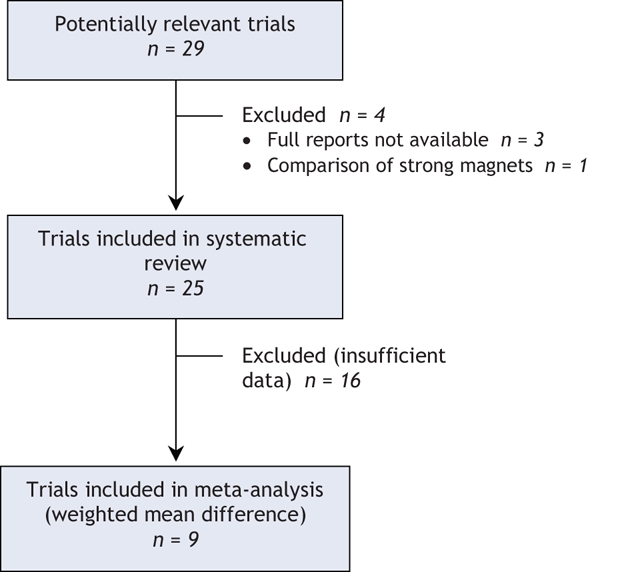
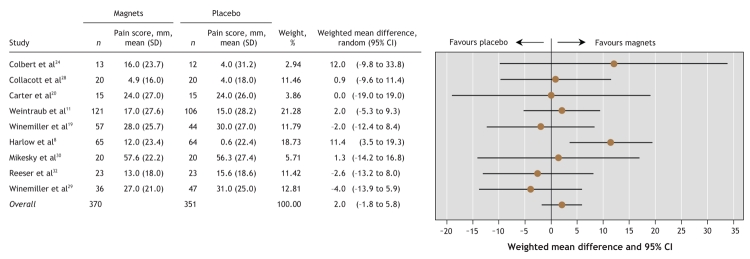
Results: Twenty-nine potentially relevant trials were identified. Nine randomized placebo-controlled trials assessing pain with a visual analogue scale were included in the main meta-analysis; analysis of these trials suggested no significant difference in pain reduction (weighted mean difference [on a 100-mm visual analogue scale] 2.1 mm, 95% confidence interval -1.8 to 5.9 mm, p = 0.29). This result was corroborated by sensitivity analyses excluding trials of acute effects and conditions other than musculoskeletal conditions. Analysis of trials that assessed pain with different scales suggested significant heterogeneity among the trials, which means that pooling these data is unreliable.
Interpretation: The evidence does not support the use of static magnets for pain relief, and therefore magnets cannot be recommended as an effective treatment. For osteoarthritis, the evidence is insufficient to exclude a clinically important benefit, which creates an opportunity for further investigation.
Figures
Comment in
-
Controls in studies of magnetism.CMAJ. 2008 Jan 29;178(3):327; author reply 327. doi: 10.1503/cmaj.1070158. CMAJ. 2008. PMID: 18227459 Free PMC article. No abstract available.
-
Review: evidence does not support use of static magnets for pain.Evid Based Nurs. 2008 Apr;11(2):49. doi: 10.1136/ebn.11.2.49. Evid Based Nurs. 2008. PMID: 18364419 No abstract available.
References
-
- Ernst E, Pittler MH, Wider B, et al. Complementary and alternative therapies for pain management. London: Mosby/Elsevier; 2007.
-
- Magnets and magnet materials. Norwalk (CT): BCC Research; 2006. Available for purchase through Market Research.com (www.marketresearch.com/product/display.asp?productid=1354460&xs=r).
-
- Rao JK, Mihaliak K, Kroenke K, et al. Use of complementary therapies for arthritis among patients of rheumatologists. Ann Intern Med 1999;131:409-16. - PubMed
-
- Lednev VV. Possible mechanism of weak magnetic fields on biological systems. Bioelectromagnetics 1991;12:71-5. - PubMed
-
- Trock DH. Electromagnetic fields and magnets: investigational treatment for musculoskeletal disorders. Rheum Dis Clin North Am 2000;26:51-62. - PubMed
Publication types
MeSH terms
LinkOut - more resources
Full Text Sources
Medical