


Beta-amyloid burden is not associated with rates of brain atrophy
- PMID: 17894374
- PMCID: PMC2735194
- DOI: 10.1002/ana.21223
Beta-amyloid burden is not associated with rates of brain atrophy
Abstract
Objective: To test the hypothesis that beta-amyloid (Abeta) burden is associated with rates of brain atrophy.
Methods: Forty-five subjects who had been prospectively studied, died, and had an autopsy diagnosis of low, intermediate, or high probability of Alzheimer's disease who had two volumetric head magnetic resonance imaging scans were identified. Compact and total (compact + diffuse) Abeta burden was measured using a computerized image analyzer with software program to detect the proportion of gray matter occupied by Abeta. Visual ratings of Abeta burden were also performed. The boundary shift integral was used to calculate change over time in whole-brain and ventricular volume. All boundary shift integral results were annualized by adjusting for scan interval. Demographics, cognitive measures, clinical diagnoses, apolipoprotein E genotype, neurofibrillary tangle (NFT) pathology, and vascular lesion burden were determined.
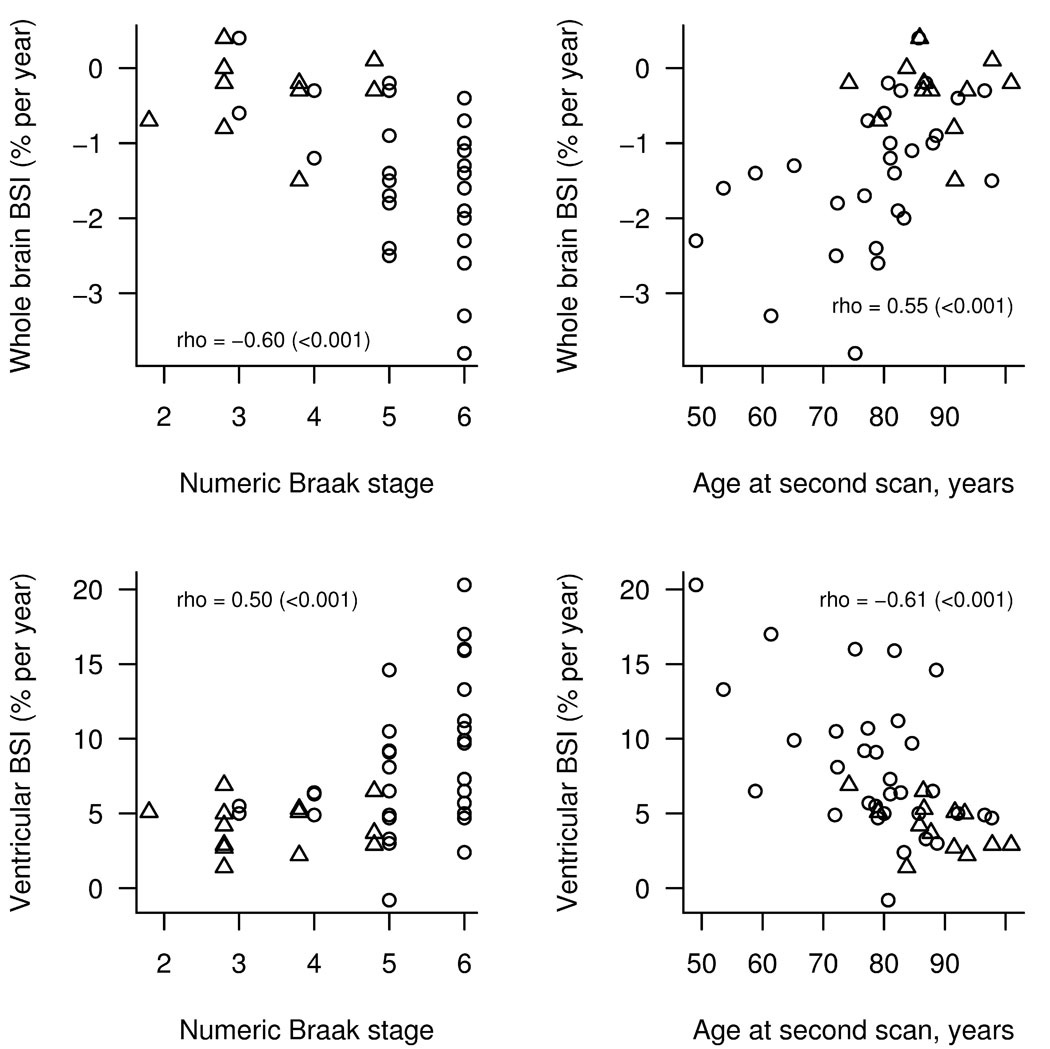
Results: There was no correlation between compact or total Abeta burden, or visual Abeta ratings, and rates of brain loss or ventricular expansion in all subjects. However, significant correlations were observed between rates of brain loss and age, Braak NFT stage, and change over time in cognitive measures. These features also correlated with rates of ventricular expansion. The rates of brain loss and ventricular expansion were greater in demented compared with nondemented subjects.
Interpretation: These findings suggest that rate of brain volume loss is not determined by the amount of insoluble Abeta in the gray matter.
Conflict of interest statement
Conflict of interest statement: There is no conflict of interest
Figures
References
-
- Wimo A, Winblad B, Jonsson L. An estimate of the total worldwide societal costs of dementia in 2005. Alzheimer's and Dementia. 2007;3:81–91. - PubMed
-
- Hardy JA, Higgins GA. Alzheimer's disease: the amyloid cascade hypothesis. Science. 1992;256:184–185. - PubMed
-
- Schenk D, Barbour R, Dunn W, et al. Immunization with amyloid-beta attenuates Alzheimer-disease-like pathology in the PDAPP mouse. Nature. 1999;400:173–177. - PubMed
-
- Gilman S, Koller M, Black RS, et al. Clinical effects of A{beta} immunization (AN1792) in patients with AD in an interrupted trial. Neurology. 2005 - PubMed
Publication types
MeSH terms
Substances
Grants and funding
LinkOut - more resources
Full Text Sources
Other Literature Sources
Medical
