


Compromised CD4+ CD25(high) regulatory T-cell function in patients with relapsing-remitting multiple sclerosis is correlated with a reduced frequency of FOXP3-positive cells and reduced FOXP3 expression at the single-cell level
- PMID: 17897326
- PMCID: PMC2433271
- DOI: 10.1111/j.1365-2567.2007.02690.x
Compromised CD4+ CD25(high) regulatory T-cell function in patients with relapsing-remitting multiple sclerosis is correlated with a reduced frequency of FOXP3-positive cells and reduced FOXP3 expression at the single-cell level
Abstract
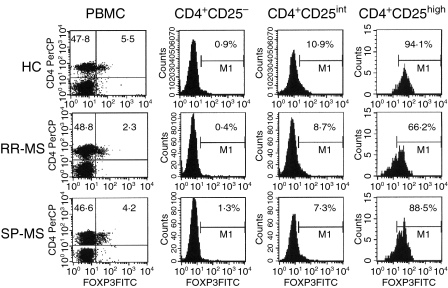
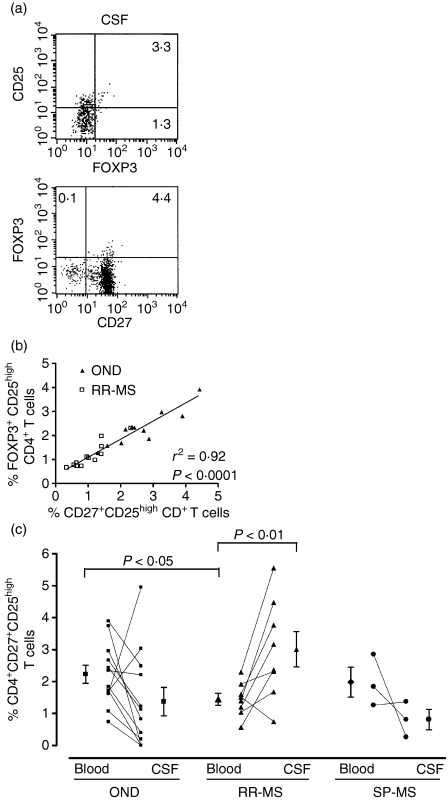
CD4+ CD25(high) regulatory T cells (Tregs) of patients with relapsing-remitting (RR) multiple sclerosis (MS), in contrast to those of patients with secondary progressive (SP) MS, show a reduced suppressive function. In this study, we analysed forkhead box P3 (FOXP3) at the single-cell level in MS patients and controls (healthy individuals and patients with other neurological diseases) by means of intracellular flow cytometry. Our data revealed a reduced number of peripheral blood CD4+ CD25(high) FOXP3+ T cells and lower FOXP3 protein expression per cell in RR-MS patients than in SP-MS patients and control individuals, which was correlated with the suppressive capacity of Tregs in these patients. Interestingly, interferon (IFN)-beta-treated RR-MS patients showed restored numbers of FOXP3+ Tregs. Furthermore, a higher percentage of CD4+ CD25(high) FOXP3+ Tregs in RR-MS patients, as compared with controls and SP-MS patients, expressed CD103 and CD49d, adhesion molecules involved in T-cell recruitment towards inflamed tissues. This was consistent with a significantly increased number of CD27+ CD25(high) CD4+ T cells in the cerebrospinal fluid (CSF), as compared with peripheral blood, in RR-MS patients. Taken together, these data show aberrant FOXP3 expression at the single-cell level correlated with Treg dysfunction in RR-MS patients. Our results also suggest that Tregs accumulate in the CSF of RR-MS patients, in an attempt to down-regulate local inflammation in the central nervous system.
Figures

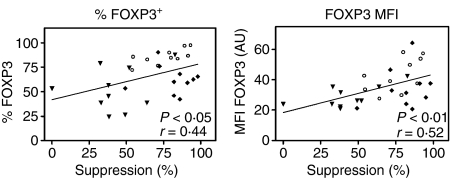
 ), 10 patients with secondary progressive multiple sclerosis (SP-MS; ♦) and 10 healthy controls (HCs; ○) were plotted against the percentage of CD4+ CD25high T cells positive for FOXP3, and FOXP3 mean fluorescence intensity (MFI). Suppression values represent percentages of inhibition of proliferation (5,6-carboxy fluorescein diacetate succinimidyl ester (CFSE)) of CD4+ CD25– T cells (Tresp) by CD4+ CD25high T cells (Tregs) as measured in coculture experiments at a 1 : 1 (Tresp:Treg) ratio. r and P values were calculated using Spearman's correlation tests.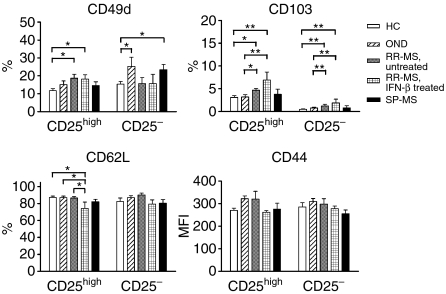
References
-
- Baecher-Allan C, Hafler DA. Human regulatory T cells and their role in autoimmune disease. Immunol Rev. 2006;212:203–16. - PubMed
-
- Sakaguchi S. Naturally arising Foxp3-expressing CD25+CD4+ regulatory T cells in immunological tolerance to self and non-self. Nat Immunol. 2005;6:345–52. - PubMed
-
- Hori S, Nomura T, Sakaguchi S. Control of regulatory T cell development by the transcription factor Foxp3. Science. 2003;299:1057–61. - PubMed
-
- Fontenot JD, Gavin MA, Rudensky AY. Foxp3 programs the development and function of CD4+CD25+ regulatory T cells. Nat Immunol. 2003;4:330–6. - PubMed
-
- Ziegler SF. FOXP3: of mice and men. Annu Rev Immunol. 2006;24:209–26. - PubMed
Publication types
MeSH terms
Substances
LinkOut - more resources
Full Text Sources
Other Literature Sources
Medical
Research Materials
