. 2007 Sep 26:7:174.
doi: 10.1186/1471-2148-7-174.

Origin and distribution of epipolythiodioxopiperazine (ETP) gene clusters in filamentous ascomycetes

Affiliations

Origin and distribution of epipolythiodioxopiperazine (ETP) gene clusters in filamentous ascomycetes

Nicola J Patron et al. BMC Evol Biol. .

Abstract

Background: Genes responsible for biosynthesis of fungal secondary metabolites are usually tightly clustered in the genome and co-regulated with metabolite production. Epipolythiodioxopiperazines (ETPs) are a class of secondary metabolite toxins produced by disparate ascomycete fungi and implicated in several animal and plant diseases. Gene clusters responsible for their production have previously been defined in only two fungi. Fungal genome sequence data have been surveyed for the presence of putative ETP clusters and cluster data have been generated from several fungal taxa where genome sequences are not available. Phylogenetic analysis of cluster genes has been used to investigate the assembly and heredity of these gene clusters.

Results: Putative ETP gene clusters are present in 14 ascomycete taxa, but absent in numerous other ascomycetes examined. These clusters are discontinuously distributed in ascomycete lineages. Gene content is not absolutely fixed, however, common genes are identified and phylogenies of six of these are separately inferred. In each phylogeny almost all cluster genes form monophyletic clades with non-cluster fungal paralogues being the nearest outgroups. This relatedness of cluster genes suggests that a progenitor ETP gene cluster assembled within an ancestral taxon. Within each of the cluster clades, the cluster genes group together in consistent subclades, however, these relationships do not always reflect the phylogeny of ascomycetes. Micro-synteny of several of the genes within the clusters provides further support for these subclades.

Conclusion: ETP gene clusters appear to have a single origin and have been inherited relatively intact rather than assembling independently in the different ascomycete lineages. This progenitor cluster has given rise to a small number of distinct phylogenetic classes of clusters that are represented in a discontinuous pattern throughout ascomycetes. The disjunct heredity of these clusters is discussed with consideration to multiple instances of independent cluster loss and lateral transfer of gene clusters between lineages.


Figures
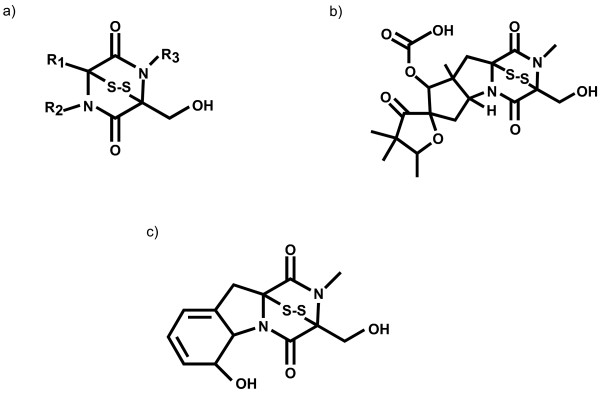
Figure 1
Figure 1
Structures of a/the core moiety of an epipolythiodioxopiperazine (ETP); b/sirodesmin PL; c/gliotoxin.
Figure 2
Figure 2
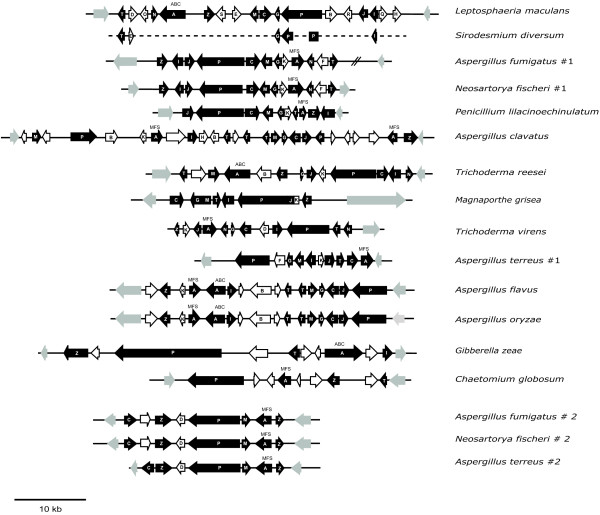
Putative ETP biosynthetic gene clusters in ascomycetes. Genes (white text on black background) include those with best matches to non-ribosomal peptide synthetase (P), thioredoxin reductase (T), methyl transferases (M and N), glutathione S-transferase (G) and cytochrome P450 monooxygenase (C), ACCS (I), dipeptidase (J), as well as a transcriptional regulator (Z) and a transporter (A – Multi Facilitator Superfamily (MFS) or ABC). In addition genes with predicted roles in modification of the side chains of the core ETP moiety are noted (see Table 1). Genes with no lettering are either hypothetical or have no strong matches to ETP cluster genes. Genes shaded in grey are predicted to flank the cluster and encode proteins with best matches to proteins with no potential roles in ETP biosynthesis. The cluster in T. virens might be incomplete as a gene common to ETP cluster was at one end of a single cosmid clone. In M. grisea G and M, and P, J and K are annotated as fused genes. The arrangement of genes in S. diversum is based on the sirodesmin PL cluster in L. maculans; the dashed line represents unsequenced regions. '#2' after taxon name indicates that this is the second cluster found in that species.
Figure 3
Figure 3
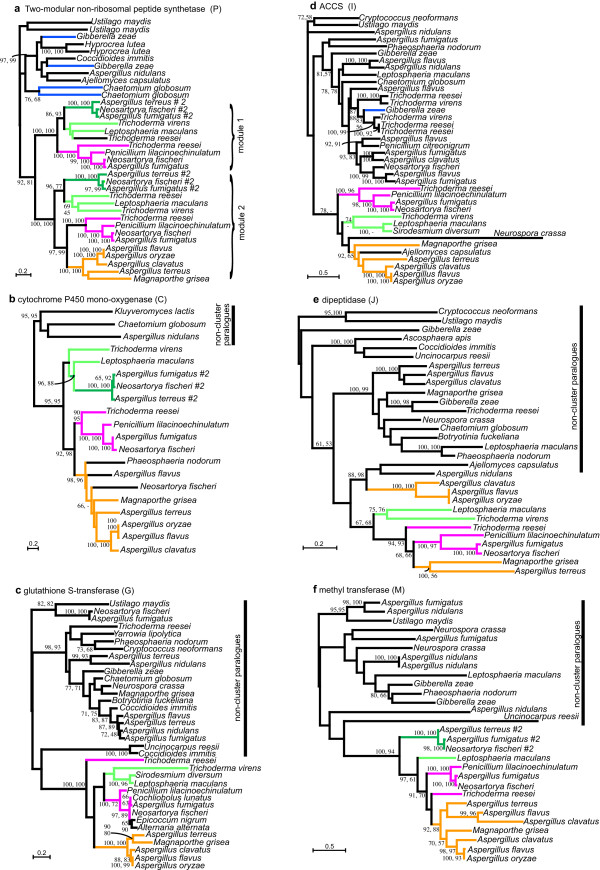
Phylogenetic relationships between individual proteins encoded in ETP gene clusters. (a) Two module non-ribosomal peptide synthetase P; (b) cytochrome P450 monooxygenase C; (c) glutathione S-transferase G; (d) ACCS I; (e), dipeptidase J; (f) O-methyl transferase M. Numbers at nodes are bootstrap support values from (left to right or top to bottom) PhyML and WEIGHBOR. Proteins encoded within clusters are on coloured branches, and non-cluster paralogues are on black branches. Consistent cluster relationships across the six proteins are indicated by orange (subclade I), pink (subclade II) and light and dark green (subclades IIIA and IIIB, respectively). Proteins encoded in clusters outside of the main cluster clade are on blue branches. '#2' after taxon name indicates that this is the second cluster found in that species, as per Figure 2.
Figure 4
Figure 4
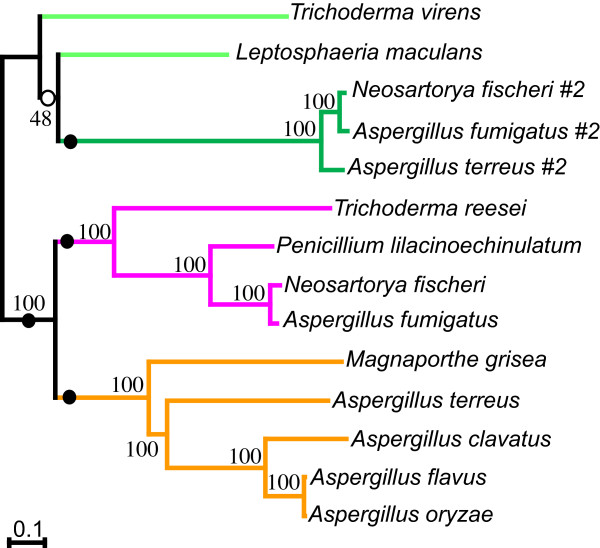
Maximum likelihood phylogeny inferred from six concatenated proteins encoded in ETP gene clusters. Numbers at nodes are bootstrap supports obtained from PhyML. Filled circles indicate that Approximate Unbiased (AU) tests rejected alternate topologies that disrupt these nodes (p < 0.003 in all cases). Open circle indicates that disruption of this node was not rejected. '#2' after taxon name indicates that this is the second cluster found in that species, as per Figure 2.
Figure 5
Figure 5
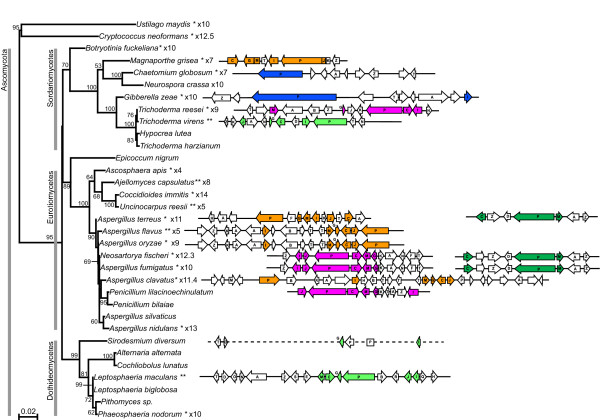
Phylogenetic relationships between ascomycetes derived from 18S ribosomal DNA sequences showing the presence and subclade type of ETP-like gene clusters. Numbers at nodes are bootstrap supports obtained from phyML. Cluster genes are coloured according to position within the phylogeny (identical colours to the branches in Fig. 3). The state of completeness of genome sequencing programs is shown where: * indicates that the genome is in assembly; ** indicates genome sequencing is in progress; xN indicates present coverage of the genome sequence, other information about the genome sequences is given in Additional file 1. Cluster details are as described in Fig. 2.
Figure 6
Figure 6
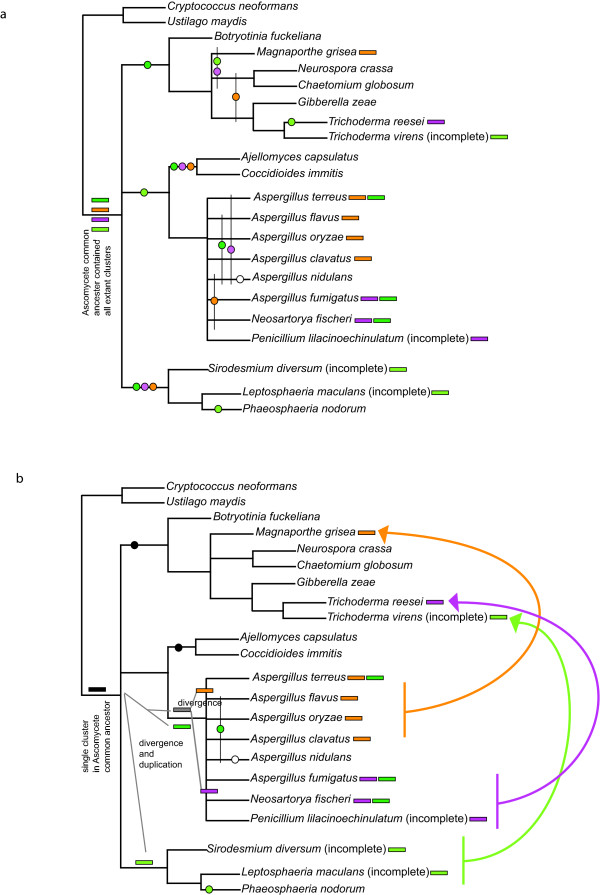
Possible patterns of inheritance and loss of ETP-like clusters in ascomycetes. Possible patterns of cluster inheritance and loss are mapped onto a conservative ascomycete phylogeny based on the 18S rDNA phylogeny (Fig. 5) with poorly supported nodes (<70 bootstraps) collapsed. Only taxa known to contain ETP clusters, or for which there is greater than X4 genomic sequence coverage are included to avoid falsely designating cluster loss events. Rectangles show presence and subclade type of cluster in a lineage (colours are as Fig. 3, black and grey indicate ancestral clusters). Circles indicate lineage-specific cluster loss events, where colours indicates subclade type loss, black indicates loss of all clusters, and open circle indicates loss of a cluster of unknown subclade type. Two possible scenarios are compared: (a) vertical inheritance only with the minimal number (17) of cluster losses; and (b) cluster divergence and spread by lateral transfer (arrows).

References

    1. Keller NP, Turner G, Bennett JW. Fungal secondary metabolism - from biochemistry to genomics. Nat Rev Microbiol. 2005;3:937–947. doi: 10.1038/nrmicro1286. - DOI - PubMed
    1. Gardiner DM, Waring P, Howlett BJ. The epipolythiodioxopiperazine (ETP) class of fungal toxins: distribution, mode of action, functions and biosynthesis. Microbiol. 2005;151:1021–1032. doi: 10.1099/mic.0.27847-0. - DOI - PubMed
    1. Gardiner DM, Cozijnsen AJ, Wilson LM, Pedras MS, Howlett BJ. The sirodesmin biosynthetic gene cluster of the plant pathogenic fungus Leptosphaeria maculans. Mol Microbiol. 2004;53:1307–1318. doi: 10.1111/j.1365-2958.2004.04215.x. - DOI - PubMed
    1. Gardiner DM, Howlett BJ. Bioinformatic and expression analysis of the putative gliotoxin biosynthetic gene cluster of Aspergillus fumigatus. FEMS Microbiol Lett. 2005;248:241–248. doi: 10.1016/j.femsle.2005.05.046. - DOI - PubMed
    1. Balibar CJ, Walsh CT. GliP, a multimodular nonribosomal peptide synthetase in Aspergillus fumigatus, makes the diketopiperazine scaffold of gliotoxin. Biochem. 2006;45:15029–15038. doi: 10.1021/bi061845b. - DOI - PubMed

Publication types

Associated data

LinkOut - more resources