. 2007 Oct 2;104(40):15876-81.
doi: 10.1073/pnas.0705653104. Epub 2007 Sep 26.

Social cheating in Pseudomonas aeruginosa quorum sensing

Affiliations

Social cheating in Pseudomonas aeruginosa quorum sensing

Kelsi M Sandoz et al. Proc Natl Acad Sci U S A. .

Abstract

In a process termed quorum sensing, bacteria use diffusible chemical signals to coordinate cell density-dependent gene expression. In the human pathogen Pseudomonas aeruginosa, quorum sensing controls hundreds of genes, many of which encode extracellular virulence factors. Quorum sensing is required for P. aeruginosa virulence in animal models. Curiously, quorum sensing-deficient variants, most of which carry a mutation in the gene encoding the central quorum sensing regulator lasR, are frequently isolated from acute and chronic infections. The mechanism for their emergence is not known. Here we provide experimental evidence suggesting that these lasR mutants are social cheaters that cease production of quorum-controlled factors and take advantage of their production by the group. We detected an emerging subpopulation of lasR mutants after approximately 100 generations of in vitro evolution of the P. aeruginosa wild-type strain under culture conditions that require quorum sensing for growth. Under such conditions, quorum sensing appears to impose a metabolic burden on the proliferating bacterial cell, because quorum-controlled genes not normally induced until cessation of growth were highly expressed early in growth, and a defined lasR mutant showed a growth advantage when cocultured with the parent strain. The emergence of quorum-sensing-deficient variants in certain environments is therefore an indicator of high quorum sensing activity of the bacterial population as a whole. It does not necessarily indicate that quorum sensing is insignificant, as has previously been suggested. Thus, novel antivirulence strategies aimed at disrupting bacterial communication may be particularly effective in such clinical settings.


Conflict of interest statement

The authors declare no conflict of interest.

Figures
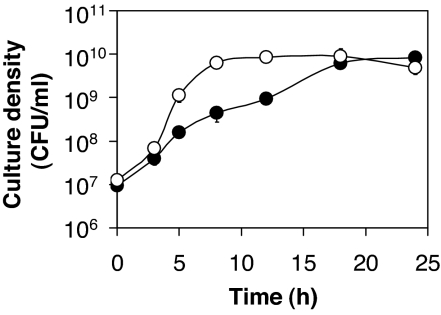
Fig. 1.
Fig. 1.
Growth of P. aeruginosa. P. aeruginosa PAO1 was grown in M9 minimal medium supplemented with 1% (wt/vol) caseinate (filled circles) and 0.5% (wt/vol) CAA (open circles). Bacteria were inoculated from 24-h cultures grown in the same media. Depicted are representative growth curves during day 3 of subculturing.
Fig. 2.
Fig. 2.
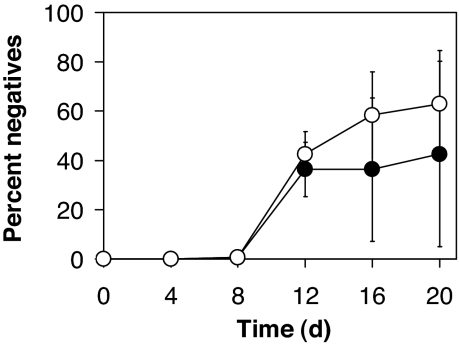
In vitro evolution of P. aeruginosa. Shown are the percentages of Nuh-negative (open circles) and protease-negative (filled circles) variants during 20 days of P. aeruginosa PAO1 growth in M9 minimal medium supplemented with 1% (wt/vol) caseinate. Cultures were subcultured into fresh medium every 24 h.
Fig. 3.
Fig. 3.
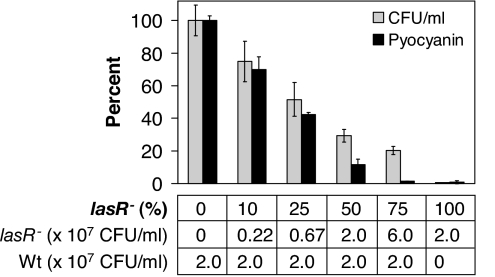
Cheater-load. Cocultures of a defined unmarked P. aeruginosa lasR mutant and its parent were grown in M9 minimal medium supplemented with 1% (wt/vol) caseinate. Shown are percentage growth (light bars) and percentage pyocyanin production (dark bars) after 24 h of coculture compared with a PAO1 pure culture. As indicated, the inoculum size of the PAO1 parent (in coculture and by itself) was kept constant at 2 × 10⁷ CFU/ml, and increasing amounts of lasR mutant cells were added as “cheater-load.”
Fig. 4.
Fig. 4.
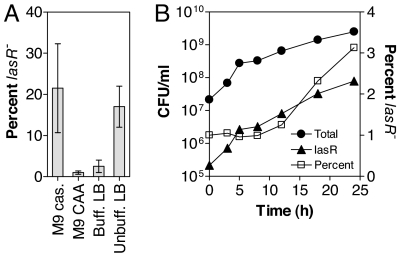
Enrichment cocultures. P. aeruginosa cocultures were inoculated with a PAO1 parent to lasR mutant ratio of 100:1. The inoculum size of the PAO1 parent was 2 × 10⁷ CFU/ml. (A) Enrichment after growth of the wild type and the unmarked lasR mutant for three consecutive 24-h cycles in the indicated media. (B) Growth of the wild type and the lasR::TcR mutant during one 24-h cycle. Shown are CFU/ml of the lasR mutant and of the entire culture as determined by plating on selective and nonselective media (Left), and the percentage of lasR mutant cells (Right). Enrichment was significant (P < 0.05) for 12-, 18-, and 24-h time points, as determined by Student's t test. Error bars are too small to be seen.
Fig. 5.
Fig. 5.
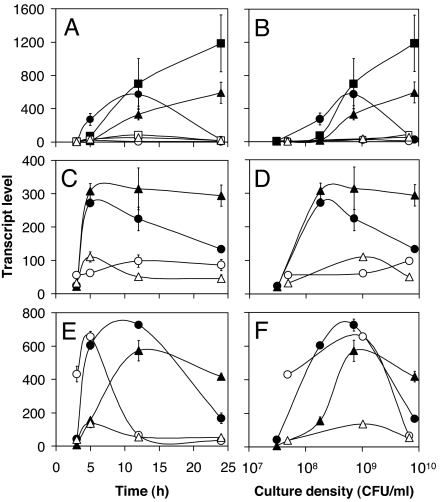
QS gene expression. Transcription of selected genes during P. aeruginosa PAO1 growth in M9 minimal medium supplemented with 1% (wt/vol) caseinate (filled symbols) and 0.5% (wt/vol) CAA (open symbols) was measured by real-time PCR. Transcript levels are given in picograms of a genomic DNA standard and were plotted versus time (Left) and culture density (Right). (A and B) aprA (circles), lasA (squares), and rhlA (triangles). (C and D) lasR (circles) and rhlR (triangles). (E and F) lasI (circles) and rhlI (triangles). Measurements were made during day 3 of subculturing.

References

    1. Fuqua C, Greenberg EP. Nat Rev Mol Cell Biol. 2002;3:685–695. - PubMed
    1. Juhas M, Eberl L, Tummler B. Environ Microbiol. 2005;7:459–471. - PubMed
    1. Schuster M, Greenberg EP. Int J Med Microbiol. 2006;296:73–81. - PubMed
    1. Smith RS, Iglewski BH. Curr Opin Microbiol. 2003;6:56–60. - PubMed
    1. Pesci EC, Pearson JP, Seed PC, Iglewski BH. J Bacteriol. 1997;179:3127–3132. - PMC - PubMed

Publication types