


Neurons in the ventral spinal cord are more depressed by isoflurane, halothane, and propofol than are neurons in the dorsal spinal cord
- PMID: 17898382
- PMCID: PMC2693417
- DOI: 10.1213/01.ane.0000280483.17854.56
Neurons in the ventral spinal cord are more depressed by isoflurane, halothane, and propofol than are neurons in the dorsal spinal cord
Abstract
Background: Volatile anesthetics act primarily in the spinal cord to produce immobility but their exact site of action is unclear. Between 0.8 and 1.2 minimum alveolar anesthetic concentration (MAC), isoflurane does not depress neurons in the dorsal horn, suggesting that it acts at a more ventral site within the spinal cord such as in premotor interneurons and motoneurons. We hypothesized that isoflurane, halothane, and propofol would exert a greater depressant effect on nociceptive responses of ventral horn neurons when compared with dorsal horn neurons.
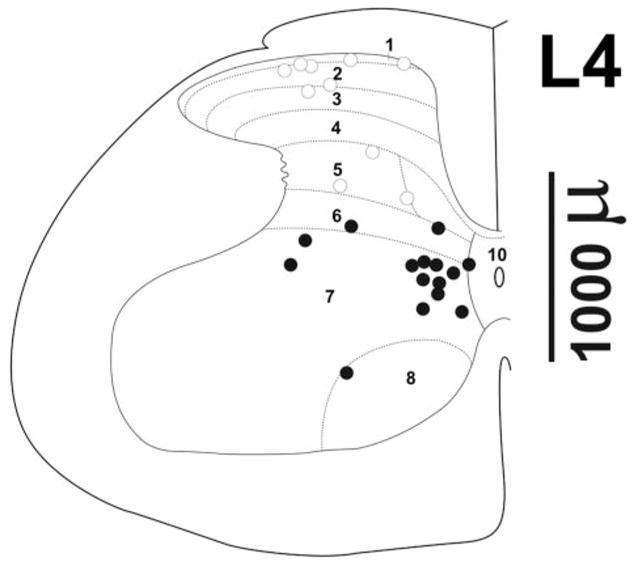
Methods: Rats were anesthetized with isoflurane or halothane and responses of dorsal (<1200 microm deep) and ventral (>1200 microm) lumbar neurons to noxious mechanical stimulation of the hindpaw were determined at 0.8 and 1.2 MAC. In a third group anesthetized with isoflurane at 0.8 MAC, we administered 5 mg/kg propofol while recording responses from dorsal horn or ventral horn neurons.
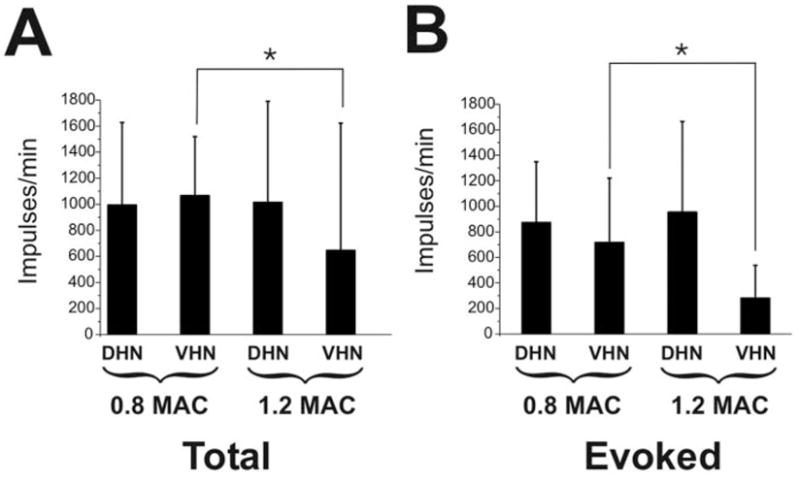
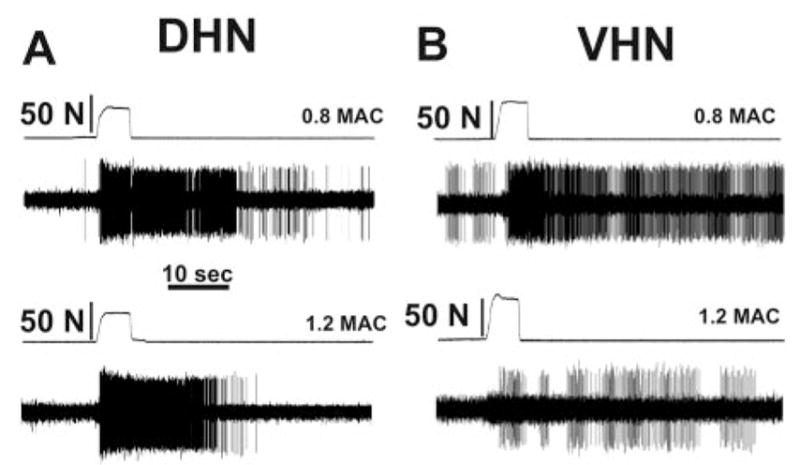
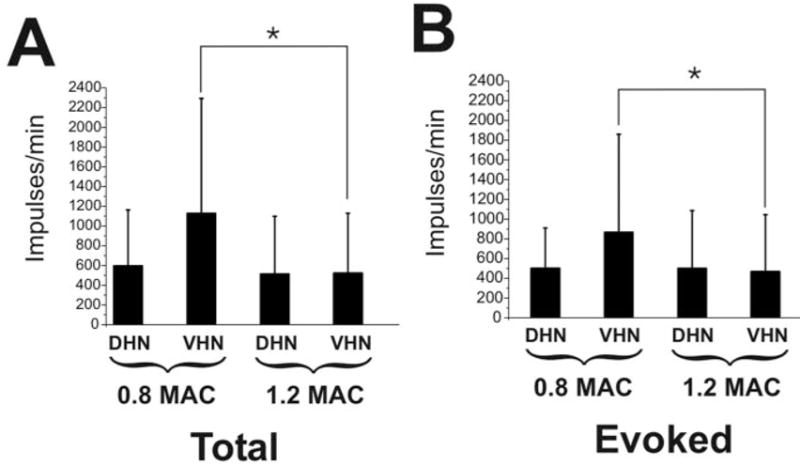
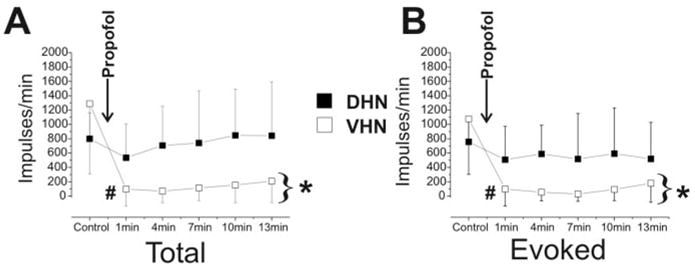
Results: Dorsal horn neuronal responses were not significantly affected when either isoflurane or halothane was increased from 0.8 to 1.2 MAC; propofol also had no significant effect. On the other hand, with increased isoflurane or halothane concentration, responses of ventral horn neurons were depressed by 60% and 45%, respectively. Propofol profoundly depressed (>90%) ventral horn neurons.
Conclusions: These data suggest that, in the peri-MAC range, isoflurane, halothane, and propofol have little or no effect on neuronal responses to noxious mechanical stimulation in the spinal dorsal horn but depress such responses in the ventral horn. Immobility produced in the 0.8-1.2 MAC range by these anesthetics appears to result from a depressant action in the ventral horn.
Figures
References
-
- Antognini JF, Carstens E. In vivo characterization of clinical anaesthesia and its components. Br J Anaesth. 2002;89:156–66. - PubMed
-
- Antognini JF, Carstens E, Atherley R. Does the immobilizing effect of thiopental in brain exceed that of halothane? Anesthesiology. 2002;96:980–6. - PubMed
-
- Antognini JF, Schwartz K. Exaggerated anesthetic requirements in the preferentially anesthetized brain. Anesthesiology. 1993;79:1244 –9. - PubMed
-
- Rampil IJ, Mason P, Singh H. Anesthetic potency (MAC) is independent of forebrain structures in the rat. Anesthesiology. 1993;78:707–12. - PubMed
-
- Rampil IJ. Anesthetic potency is not altered after hypothermic spinal cord transection in rats. Anesthesiology. 1994;80:606–10. - PubMed
MeSH terms
Substances
Grants and funding
LinkOut - more resources
Full Text Sources
Other Literature Sources
