


Within-subject comparison of the psychopharmacological profiles of oral oxycodone and oral morphine in non-drug-abusing volunteers
- PMID: 17899018
- PMCID: PMC2562738
- DOI: 10.1007/s00213-007-0937-2
Within-subject comparison of the psychopharmacological profiles of oral oxycodone and oral morphine in non-drug-abusing volunteers
Erratum in
- Psychopharmacology (Berl). 2008 Jan;196(1):117
Abstract
Rationale: Nonmedical use and abuse of prescription opioids is a significant problem in the USA. Little attention has been paid to assessing the relative psychopharmacological profile (including abuse liability-related effects) of specific prescription opioids.
Objectives: The aim of this study is to directly compare the psychopharmacological profile of two oral opioids within the same subject.
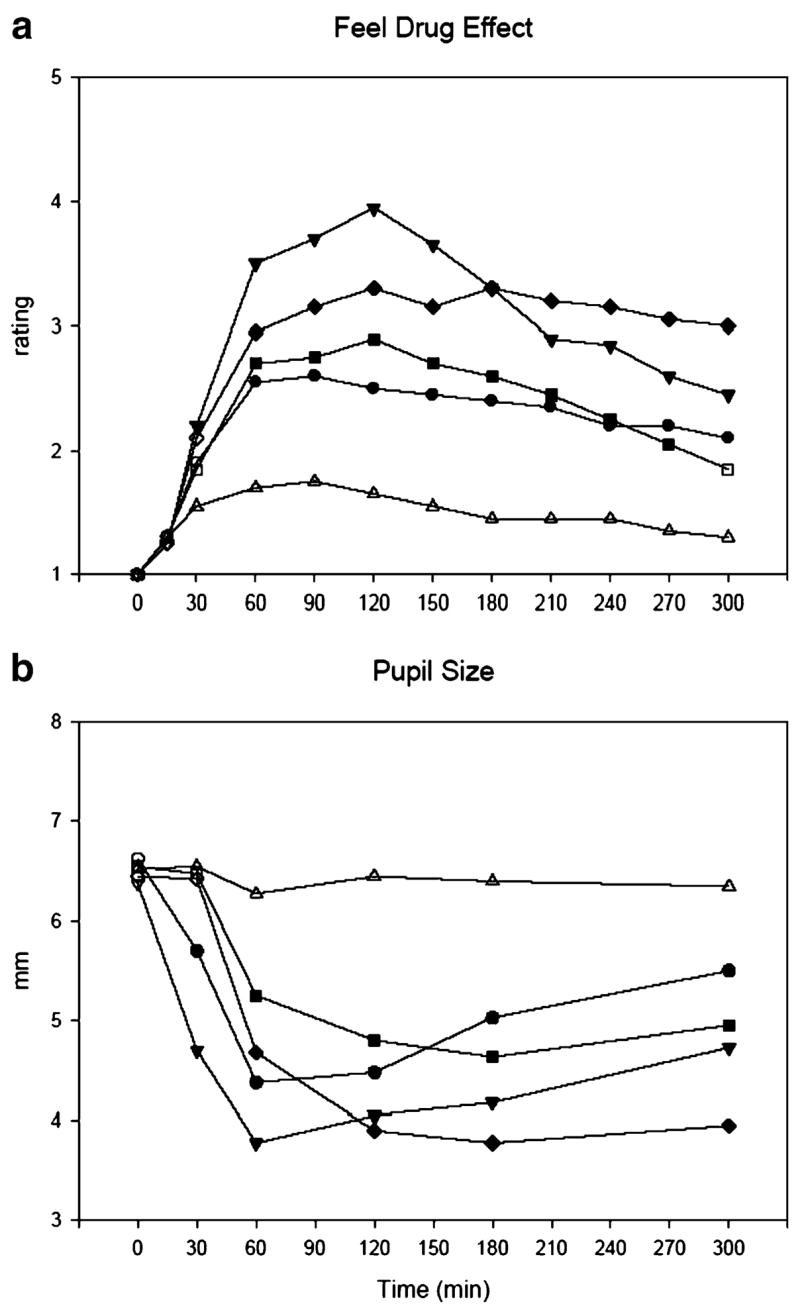
Methods: A randomized, placebo-controlled, crossover study was done in which 20 non-drug-abusing volunteers ingested 10 and 20 mg of oxycodone, 30 and 60 mg of morphine, and placebo in separate sessions. Drug doses were equated on an objective measure of opiate effects: miosis. Subjective, psychomotor, reinforcing, and physiological effects of the opioids were assessed.
Results: In general, the two opioids at equimiotic doses produced similar prototypic opiate-like effects and psychomotor impairment of similar magnitude. However, several effects were found only with 20 mg oxycodone. Both drugs produced abuse liability-related subjective effects but also dysphoric effects, particularly with 60 mg morphine. Neither drug at either dose functioned as a reinforcer, as measured by the Multiple Choice Procedure. Relative potency ratios indicated an average oxycodone/morphine [corrected] ratio of 1:3 [corrected]
Conclusions: The psychopharmacological profile of oxycodone and morphine at equimiotic doses had many similarities; however, differences were found in producing abuse liability-related and dysphoric effects. In the medical community, it is commonly accepted that oral oxycodone is 1.5 to 2 times as potent as oral morphine in producing analgesia; using this ratio, although patients may experience similar degrees of pain relief, those receiving oxycodone may be experiencing stronger and potentially different psychopharmacological effects.
Figures
References
-
- American Psychiatric Association. Diagnostic and statistical manual of mental disorders DSM-IV-TR (Text Revision) American Psychiatric Association; Washington DC: 2000.
-
- Baddeley AD. A three-minute reasoning test based on grammatical transformation. Psychon Sci. 1968;10:341–342.
-
- Beardsley PM, Aceto MD, Cook CD, Bowman ER, Newman JL, Harris LS. Discriminative stimulus, reinforcing, physical dependence, and antinociceptive effects of oxycodone in mice, rats, and rhesus monkeys. Exp Clin Psychopharmacol. 2004;12:163–172. - PubMed
-
- Benziger DP, Miotto J, Grandy RP, Thomas GB, Swanton RE, Fitzmartin RD. A pharmacokinetic/pharmacodynamic study of controlled-release oxycodone. J Pain Symptom Manage. 1997;13:75–82. - PubMed
-
- Bigelow GE. Human drug abuse liability assessment: opioids and analgesics. Br J Addict. 1991;86:1615–1628. - PubMed
Publication types
MeSH terms
Substances
Grants and funding
LinkOut - more resources
Full Text Sources
Medical
