


doi: 10.1007/s00426-007-0126-2.
Epub 2007 Sep 26.
Evidence for attentional processing in spatial localization
Affiliations
- PMID: 17899176
- PMCID: PMC2367386
- DOI: 10.1007/s00426-007-0126-2
Item in Clipboard
Evidence for attentional processing in spatial localization
Psychol Res.
2008 Jul.
Abstract
Using a dual-task methodology, this study examined the involvement of selective attention in spatial localization. Thirty participants located a single, briefly presented, peripheral target stimulus, appearing in one of 50 positions on either side of a central fixation point, with or without the requirement to identify a simultaneously presented central distractor stimulus. Results revealed a robust interference effect in localization performance at short target durations that depended on the number of the to-be-identified distractor items. This outcome provides convergent support for the role of the attentional system in spatial localization.
Figures
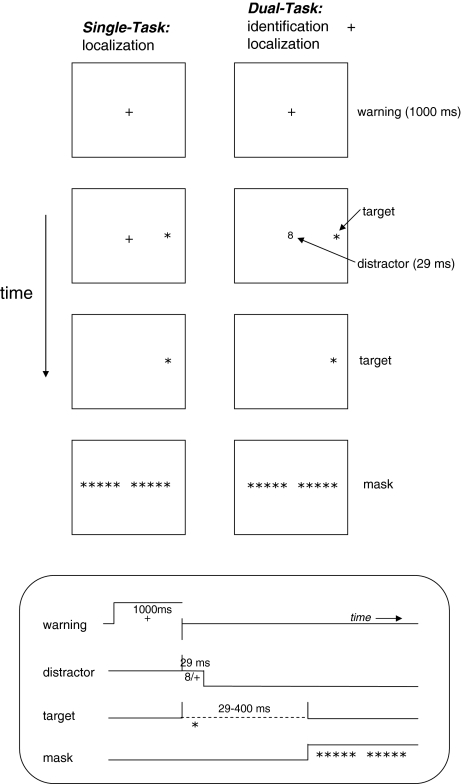
Schematic representation of the visual stimuli (upper part) and trial sequence (lower part) in the single- and dual-task conditions. Note that the key difference between single- and dual-task conditions is the appearance of the central distractor stimulus in the dual-task condition, containing 1, 2, or 3 to-be-identified digits (for the 1-, 2-, and 3-distractor groups, respectively). In the single-task condition there is no distractor stimulus; here the neutral fixation sign (+) continues to be visible for the same duration as the distractor stimulus (i.e., 29 ms)
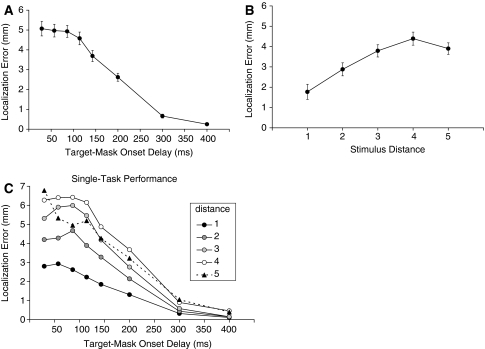
Mean localization error in the single-task condition for all participants (that is, averaged over all three distractor groups; n = 29) as a function of a target-mask onset delay; b target distance; and c as a function of both target-mask onset delay and target distance. Error bars are standard error
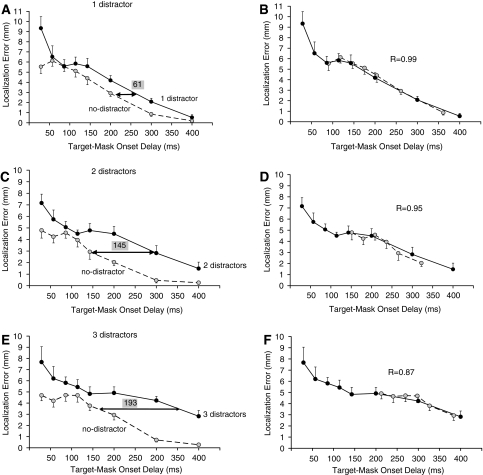
The left panels show mean localization error as a function of target-mask onset delay in single- and dual-task conditions for the 1-, 2-, and 3-distractor groups (a, c, and e, respectively). The right panels show the results of the fitting procedure for the 1-, 2-, and 3-distractor groups (b, d, and f, respectively)
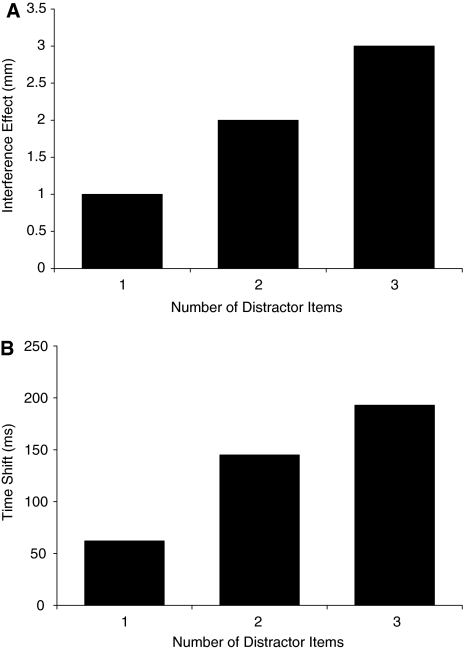
a Mean difference in localization error between the single- and dual-task conditions as a function of the number of distractor items in the distractor stimulus (i.e., the 1-, 2-, and 3-distractor groups) averaged over target-mask onset delay; b the optimal time shift (τ) necessary to produce the best fit between the localization performance functions of the single-task and dual-task conditions as a function of the number of distractor items in the distractor stimulus
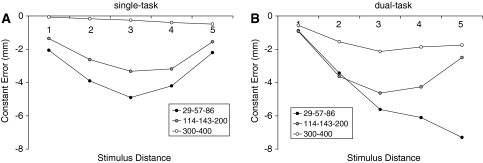
Systematic mislocalization in terms of constant error (mm) as a function of stimulus distance and stimulus duration (target-mask-onset delay) in a single-task and b dual-task conditions. The eight levels of stimulus duration are shown in three lines that group together the shortest (29, 57, and 86 ms), intermediate (114, 143, and 200 ms), and longest (300 and 400 ms) stimulus durations. Negative values represent undershoots
References
MeSH terms
LinkOut - more resources
Full Text Sources
