


The role of dead-end in germ-cell tumor development
- PMID: 17905939
- PMCID: PMC2518318
- DOI: 10.1196/annals.1411.006
The role of dead-end in germ-cell tumor development
Abstract
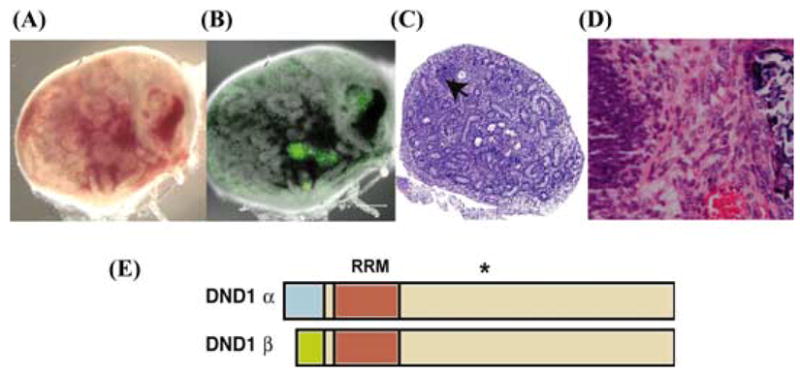
Testicular germ-cell tumors occur in human males of all age groups, from infants to men over 50 years old. Most commonly, germ-cell tumors (generally known as testicular cancer) occur in young males between the ages of 15 to 35 years. The tumor tissues are usually histologically diverse, and testicular tumors that occur in the different age groups tend to be of specific histological subtypes. Most germ-cell tumors originate from primordial germ cells during embryonic development, although the progression and eventual detection of the disease occurs decades later in humans. Mouse strains spontaneously develop a specific subtype of testicular germ-cell tumors, the type I germ-cell tumors, and these tumors are similar to the germ-cell tumors (or teratomas) that occur in human infants. Some mouse strains, such as the 129-Ter strain, have extremely high germ-cell tumor incidences, making such strains ideal for genetic and biological studies of germ cell-tumor development. Here a brief overview of the recently identified genetic defect in the Ter strain, inactivation of the dead-end (Dnd1) gene, and the ongoing studies on Dnd1 to understand its role in germ-cell and germ cell-tumor development, are provided.
Figures
References
-
- Stevens LC. Experimental production of testicular teratomas in mice of strains 129, A/He, and their F1hybrids. J Natl Cancer Inst. 1970;44:923–929. - PubMed
-
- Stevens LC, Hummel KP. A description of spontaneous congenital testicular teratomas in strain 129 mice. J Natl Cancer Inst. 1957;18:719–747. - PubMed
-
- Stevens LC. Origin of testicular teratomas from primordial germ cells in mice. J Natl Cancer Inst. 1967;38:549–552. - PubMed
-
- Stevens LC. A new inbred subline of mice (129/terSv) with a high incidence of spontaneous congenital testicular teratomas. J Natl Cancer Inst. 1973;50:235–242. - PubMed
Publication types
MeSH terms
Substances
Grants and funding
LinkOut - more resources
Full Text Sources
Medical
