Differential involvement of the basolateral amygdala, orbitofrontal cortex, and nucleus accumbens core in the acquisition and use of reward expectancies
- PMID: 17907822
- PMCID: PMC2375535
- DOI: 10.1037/0735-7044.121.5.896
Differential involvement of the basolateral amygdala, orbitofrontal cortex, and nucleus accumbens core in the acquisition and use of reward expectancies
Abstract
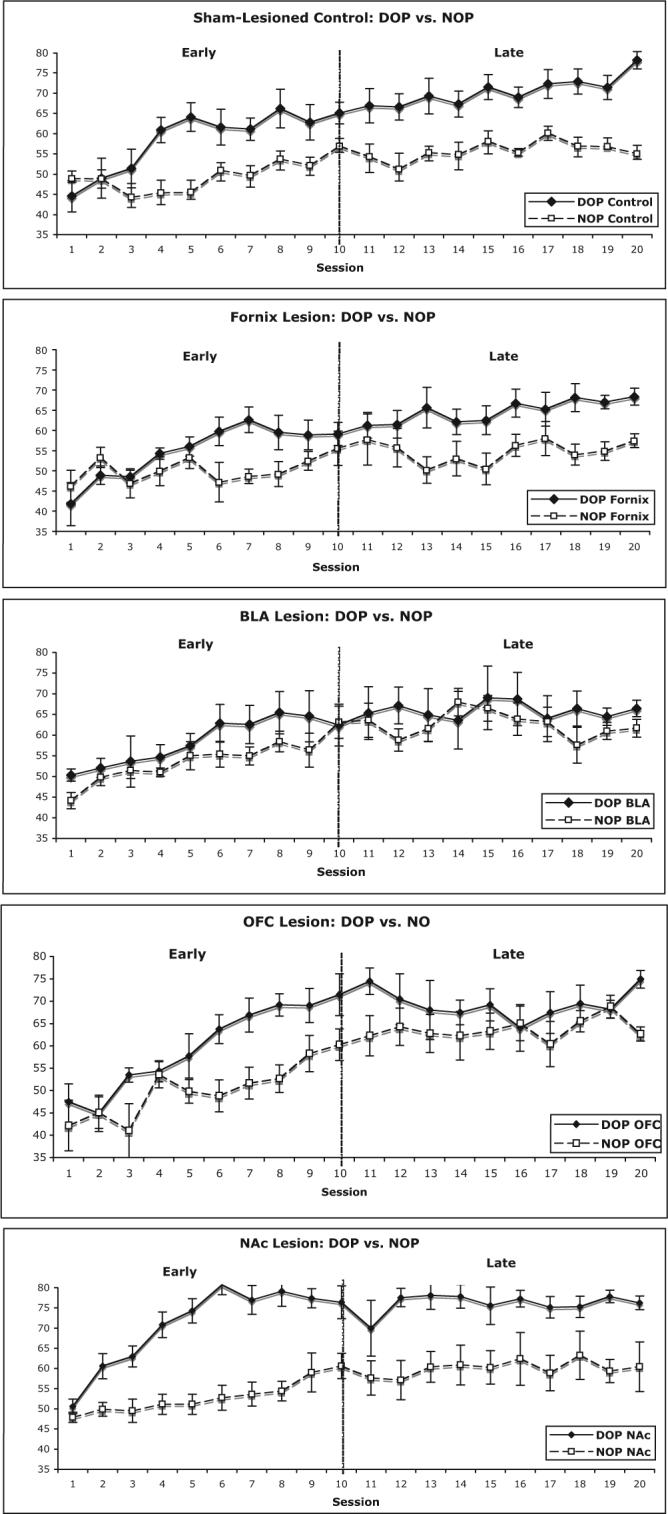
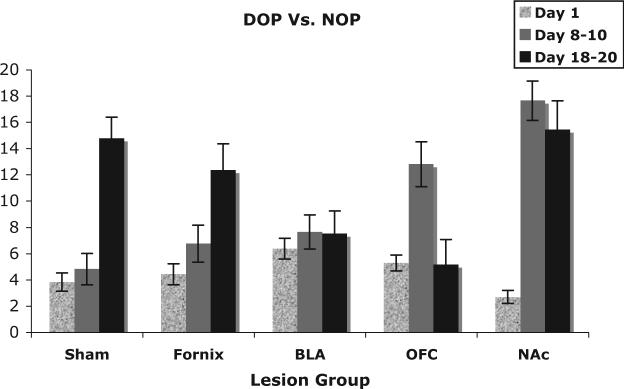
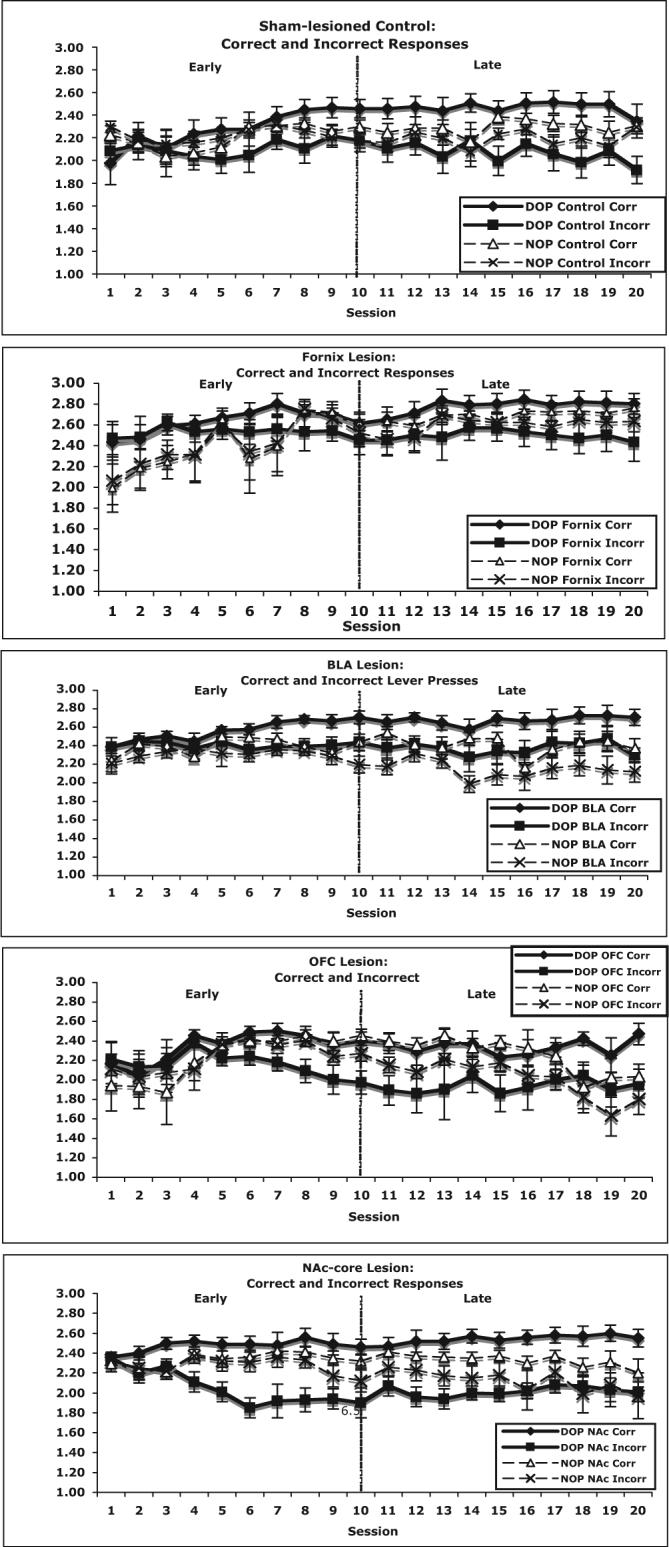
In this study, the authors tested the hypothesis that the basolateral amygdala (BLA), orbitofrontal cortex (OFC), nucleus accumbens core (NA-core), and the extended hippocampus mediate different aspects of the development-maintenance of unique reward expectancies produced by the differential outcomes procedure (DOP). Rats were trained with either DOP or a nondifferential outcomes procedure (NOP) on a simple discrimination task. Fornix lesions did not affect either version of the task, demonstrating that the extended hippocampal system has no role in stimulus-outcome (S-O) associations. In contrast, in the DOP condition, BLA lesions impaired performance throughout training, OFC lesions impaired choice accuracy only in the later maintenance phase, and NA-core lesions resulted in enhanced learning. These results suggest that BLA and OFC are important for establishment (BLA) and behavioral maintenance (OFC) of S-O associations, whereas the NA-core is not needed and can in fact impede using multiple S-O associations. No impairments were observed in the NOP condition, demonstrating that these structures are not critical to stimulus-response learning.
(PsycINFO Database Record (c) 2007 APA, all rights reserved).
Figures
References
-
- Aggleton JP, Keith AB, Rawlins JNP, Hunt PR, Sahgal A. Removal of the hippocampus and transection of the fornix produce comparable deficits on delayed non-matching to position by rats. Behavioural Brain Research. 1992;52:61–71. - PubMed
-
- Aggleton JP, Saunders RC. The amygdala—What's happened in the last decade? In: Aggleton JP, editor. The amygdala: A functional analysis. 2nd ed. Oxford University Press; New York: 2000. pp. 1–31.
-
- Balleine BW, Killcross S. Effects of ibotenic acid lesions of the nucleus accumbens on instrumental action. Behavioural Brain Research. 1994;65:181–193. - PubMed
-
- Barbas H. Connections underlying the synthesis of cognition, memory, and emotion in primate prefrontal cortices. Brain Research Bulletin. 2000;52:319–330. - PubMed
-
- Baxter MG, Murray EA. The amygdala and reward. Nature Reviews Neuroscience. 2002;3:563–573. - PubMed