


Intact automatic imitation of human and robot actions in autism spectrum disorders
- PMID: 17911053
- PMCID: PMC2291158
- DOI: 10.1098/rspb.2007.1019
Intact automatic imitation of human and robot actions in autism spectrum disorders
Abstract
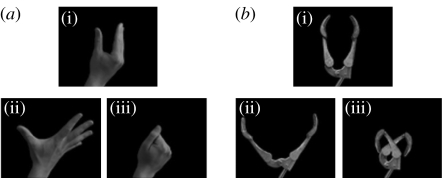
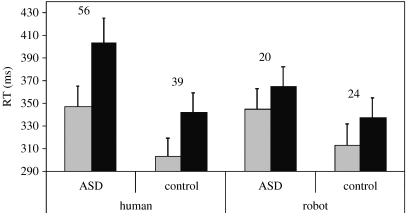
The existence of a specialized imitation module in humans is hotly debated. Studies suggesting a specific imitation impairment in individuals with autism spectrum disorders (ASD) support a modular view. However, the voluntary imitation tasks used in these studies (which require socio-cognitive abilities in addition to imitation for successful performance) cannot support claims of a specific impairment. Accordingly, an automatic imitation paradigm (a 'cleaner' measure of imitative ability) was used to assess the imitative ability of 16 adults with ASD and 16 non-autistic matched control participants. Participants performed a prespecified hand action in response to observed hand actions performed either by a human or a robotic hand. On compatible trials the stimulus and response actions matched, while on incompatible trials the two actions did not match. Replicating previous findings, the Control group showed an automatic imitation effect: responses on compatible trials were faster than those on incompatible trials. This effect was greater when responses were made to human than to robotic actions ('animacy bias'). The ASD group also showed an automatic imitation effect and a larger animacy bias than the Control group. We discuss these findings with reference to the literature on imitation in ASD and theories of imitation.
Figures
References
-
- American Psychiatric Association. American Psychiatric Association; Washington, DC: 1994. Diagnostic and statistical manual of mental disorders.
-
- Avikainen S, Kulomaki T, Hari R. Normal movement reading in Asperger subjects. Neuroreport. 1999;10:3467–3470. doi:10.1097/00001756-199911260-00001 - DOI - PubMed
-
- Bird G, Catmur C, Silani G, Frith C, Frith U. Attention does not modulate neural responses to social stimuli in autism spectrum disorders. Neuroimage. 2006;31:1614–1624. doi:10.1016/j.neuroimage.2006.02.037 - DOI - PubMed
-
- Brass M, Heyes C.M. Imitation: is cognitive neuroscience solving the correspondence problem? Trends Cogn. Sci. 2005;9:489–495. doi:10.1016/j.tics.2005.08.007 - DOI - PubMed
-
- Brass M, Derrfuss J, Matthes-von Cramon G, von Cramon D.Y. Imitative response tendencies in patients with frontal brain lesions. Neuropsychology. 2003;17:265–271. doi:10.1037/0894-4105.17.2.265 - DOI - PubMed
Publication types
MeSH terms
LinkOut - more resources
Full Text Sources
