


Temporal patterns of self-injurious behavior correlate with stress hormone levels in the developmentally disabled
- PMID: 17913241
- PMCID: PMC2170430
- DOI: 10.1016/j.psychres.2007.04.003
Temporal patterns of self-injurious behavior correlate with stress hormone levels in the developmentally disabled
Abstract
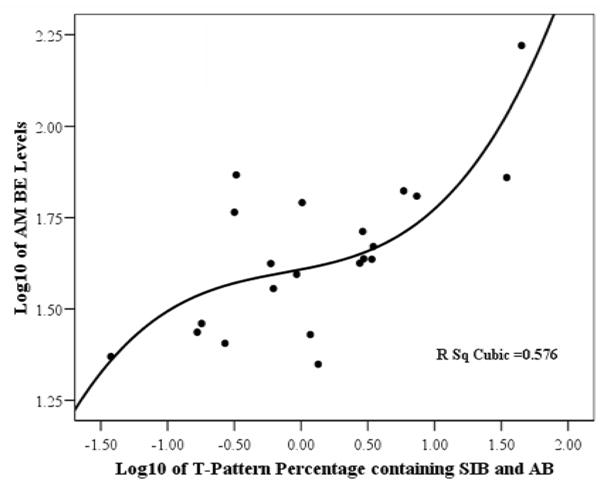
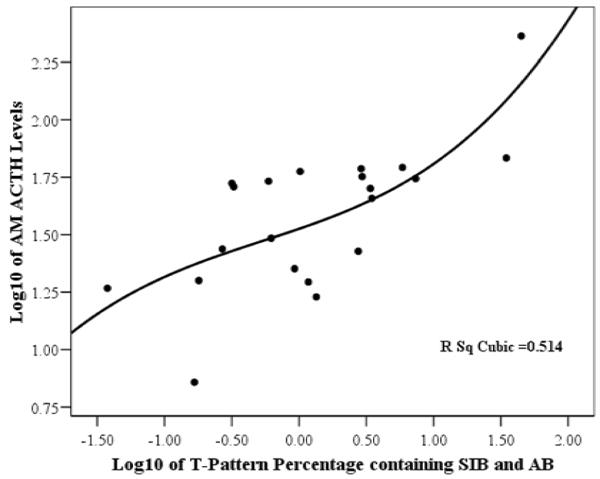
While the origins and developmental course of self-injurious behavior (SIB) remain relatively unknown, recent studies suggest a biological imbalance may potentiate or provoke the contagious recurrence of SIB patterns in individuals with severe developmental disabilities (DD). Evidence from several laboratories indicates that functioning, relations, and processing of a stress-related molecule, proopiomelanocortin (POMC) may be perturbed among certain subgroups of individuals exhibiting SIB. The current investigation employed a unique time-pattern analysis program (THEME) to examine whether recurrent temporal patterns (T-patterns) of SIB were related to morning levels of two POMC-derived hormones: beta-endorphin (betaE) and adrenocorticotropic hormone (ACTH). THEME was used to quantify highly significant (non-random) T-patterns that included SIB within a dataset of in situ observational recordings spanning 8 days ( approximately 40 h) in 25 subjects with DD. Pearson's product-moment analyses revealed highly significant correlations between the percentage of T-patterns containing SIB and basal levels of both betaE and ACTH, which were not found with any other "control" T-patterns. These findings support the hypothesis that the recurrent temporal patterning of SIB represents a unique behavioral phenotype directly related to perturbed levels of POMC-derived stress hormones in certain individuals with severe DD.
Figures
References
-
- Bakeman R, Gottman JM. Observing interaction: An introduction to sequential analysis. 2. Cambridge University Press; Cambridge, UK: 1997.
-
- Bonasera SJ, Schenk KA, Tecott LH. 2006 Neuroscience Meeting Planner. Atlanta, GA: Society for Neuroscience, 2006; 2006. T-pattern sequential analysis to quantify “route tracing” locomotor stereotypic behavior. Program No. 836.3/KK4.
-
- Cazzullo AG, Musetti MC, Musetti L, Bajo S, Sacerdote P, Panerai A. Beta-endorphin levels in peripheral blood mononuclear cells and long-term naltrexone treatment in autistic children. European Neuropsychopharmacology. 1999;9:361–363. - PubMed
-
- Emerson E, Thompson S, Reeves D, Henderson D, Robertson J. Descriptive analysis of multiple response topographies of challenging behavior across two settings. Research in Developmental Disabilities. 1995;16(4):301–329. - PubMed
-
- Gillberg C. Endogenous opioids and opiate antagonists in autism: Brief review of empirical findings and implications for clinicians. Developmental Medicine and Child Neurology. 1995;37:88–92. - PubMed
Publication types
MeSH terms
Substances
Grants and funding
LinkOut - more resources
Full Text Sources
Medical
Miscellaneous
