


fMRI evidence for both generalized and specialized components of attentional control
- PMID: 17916338
- PMCID: PMC2710450
- DOI: 10.1016/j.brainres.2007.07.097
fMRI evidence for both generalized and specialized components of attentional control
Abstract
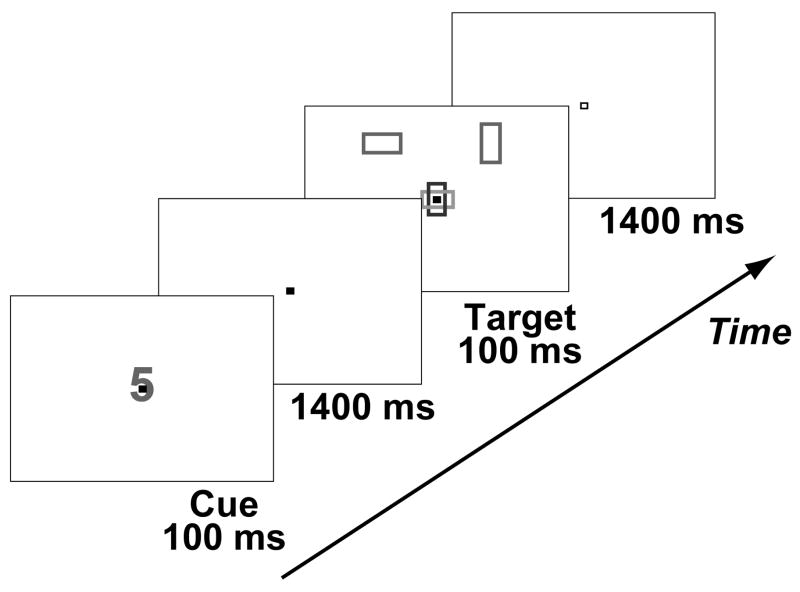
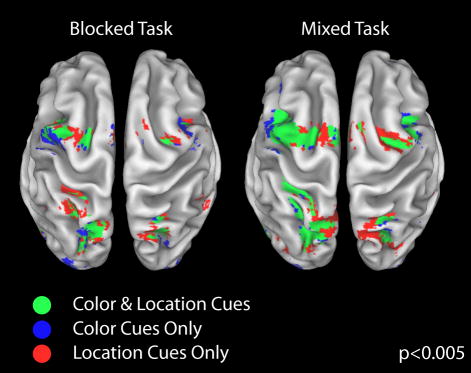
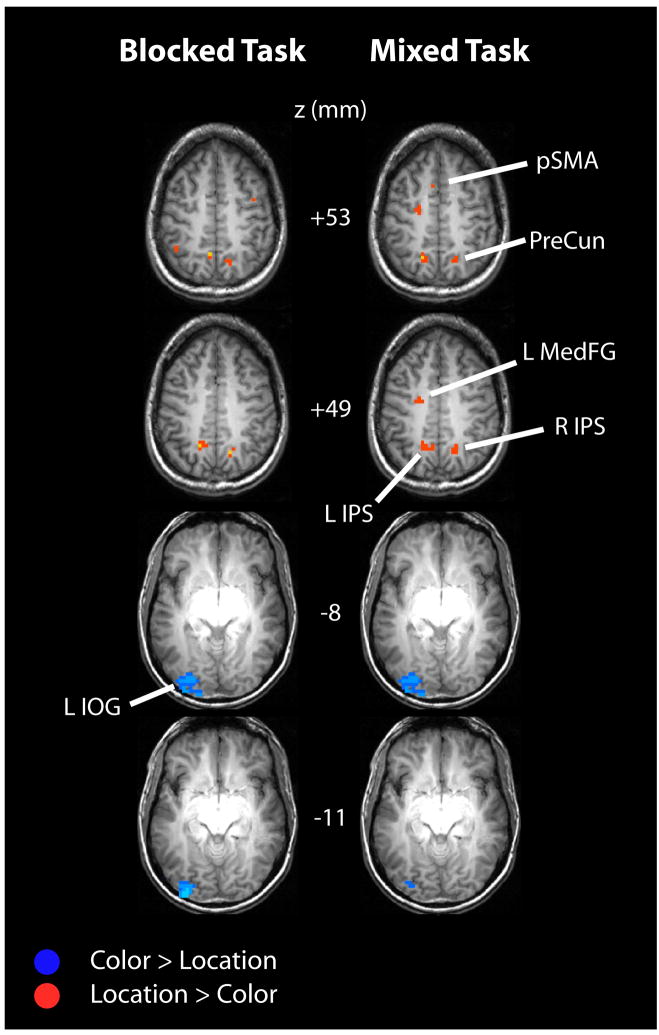
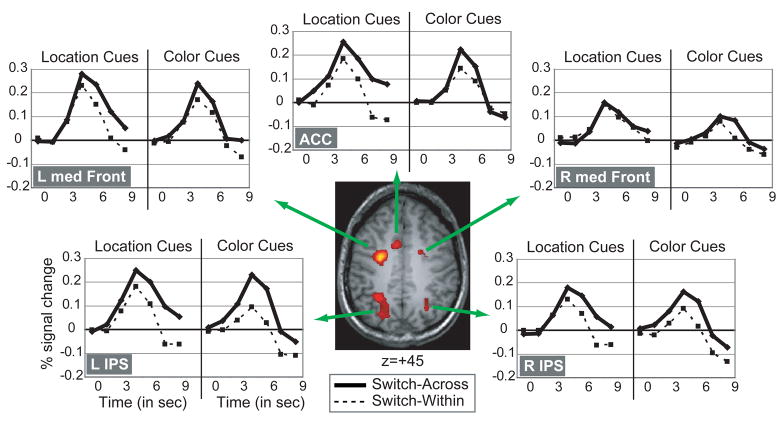
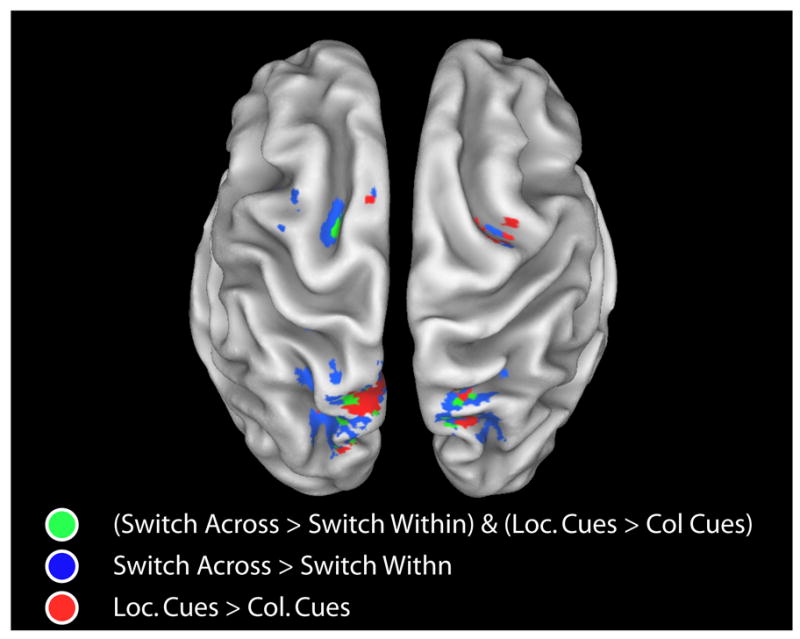
A central question in the study of selective attention is whether top-down attentional control mechanisms are generalized or specialized for the type of information that is to be attended. The current study examined this question using a voluntary orienting task that cued observers to attend to either one of two locations or to one of two colors. Location (spatial) and color (nonspatial) conditions were presented either randomly intermixed within the same block of trials or in separate blocks. Functional magnetic resonance imaging revealed that directing attention to a location or to a color activated a network of overlapping dorsal frontal and parietal areas, previously implicated in attentional control. The pattern of observed overlap was not affected by the intermixed versus blocked presentation of location and color conditions. Although portions of the frontal-parietal network were more active in response to location cues than to color cues, a secondary analysis also revealed that medial dorsal frontal and parietal cortex were specifically engaged in shifting visual attention regardless of the cued dimension (location or color). Together, the present results support the conclusion that attentional control is the combination of a generalized network that works in concert with subregions of the frontoparietal network that are highly specialized for directing attention based on the content of the to-be-attended information.
Figures
References
-
- Awh E, Armstrong KM, Moore T. Visual and oculomotor selection: links, causes and implications for spatial attention. Trends Cogn Sci. 2006;10:124–130. - PubMed
-
- Banich MT, Milham MP, Atchley R, Cohen NJ, Webb A, et al. fMRI studies of Stroop tasks reveal unique roles of anterior and posterior brain systems in attentional selection. J Cogn Neuroscience. 2000;12(6):988–1000. - PubMed
-
- Buckner RL, Goodman J, Burock M, Rotte M, Koutstaal W, Schacter D, Rosen BR, Dale AM. Functional–anatomic correlates of object priming in humans revealed by rapid presentation event-related fMRI. Neuron. 1998;20:285–296. - PubMed
-
- Burock MA, Buckner RL, Woldorff MG, Rosen BR, Dale AM. Randomized event-related experimental designs allow for extremely rapid presentation rates using functional MRI. NeuroReport. 1998;9:3735–3739. - PubMed
Publication types
MeSH terms
Grants and funding
LinkOut - more resources
Full Text Sources
