. 2007 Oct 23;104(43):17198-203.
doi: 10.1073/pnas.0707585104. Epub 2007 Oct 5.

CRF-CRF1 system activation mediates withdrawal-induced increases in nicotine self-administration in nicotine-dependent rats

Affiliations

CRF-CRF1 system activation mediates withdrawal-induced increases in nicotine self-administration in nicotine-dependent rats

Olivier George et al. Proc Natl Acad Sci U S A. .

Abstract

Nicotine, the main psychoactive ingredient of tobacco, induces negative emotional symptoms during abstinence that contribute to a profound craving for nicotine. However, the neurobiological mechanisms underlying how nicotine produces dependence remains poorly understood. We demonstrate one mechanism for both the anxiety-like symptoms of withdrawal and excessive nicotine intake observed after abstinence, through recruitment of the extrahypothalamic stress peptide corticotropin-releasing factor (CRF) system and activation of CRF(1) receptors. Overactivation of the CRF-CRF(1) system may contribute to nicotine dependence and may represent a prominent target for investigating the vulnerability to tobacco addiction.


Conflict of interest statement

The authors declare no conflict of interest.

Figures
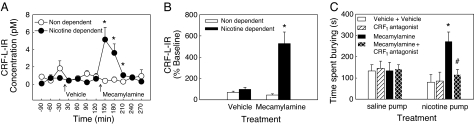
Fig. 1.
Fig. 1.
Effects of mecamylamine-precipitated nicotine withdrawal on extracellular levels of CRF-L-IR in the central nucleus of the amygdala and CRF antagonist blockade of precipitated withdrawal-induced anxiety-like behavior in rats by using the defensive burying test. (A) Effect of mecamylamine (1.5 mg/kg, i.p.) -precipitated withdrawal on extracellular levels of CRF-L-IR in the central nucleus of the amygdala as measured by in vivo microdialysis in chronic nicotine pump-treated (nicotine-dependent, n = 7) and chronic saline pump-treated (nondependent, n = 6) rats (*, P < 0.05 vs. nondependent). (B) CRF-L-IR levels expressed as percentage of baseline (first three samples) during the first four samples after vehicle or mecamylamine injections (*, P < 0.05 vs. vehicle). (C) CRF1 antagonist blockade of precipitated withdrawal-induced anxiety-like behavior in rats by using the defensive burying test. Mecamylamine (1.5 mg/kg, i.p.) injection in nicotine-dependent rats increased the time spent burying (*, P < 0.05 vs. vehicle), an effect blocked by pretreatment with the CRF1 antagonist (MPZP, 4 mg/kg s.c., −1 h) (n = 7–9 per group, #, P < 0.05 vs. mecamylamine). Data represent mean ± SEM.
Fig. 2.
Fig. 2.
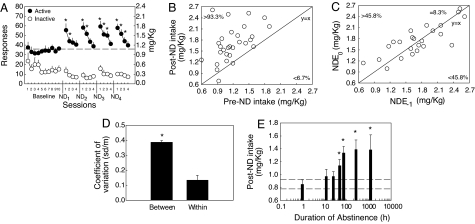
Characterization of the nicotine-deprivation effect. (A) Total (23-h) active and inactive responses after repeated cycles of 72 h of nicotine deprivation (ND), followed by 4 days of self-administration (*, P < 0.05 vs. baseline). (B) Robustness of the nicotine-deprivation effect. Scatter plot of nicotine intakes observed during the first session before (pre-ND) and after (post-ND) each of the four cycles of nicotine deprivation. The numbers represent the percentage of measures above and below the y = x line. (C) Reliability of the nicotine-deprivation effect. Correlation of post-ND nicotine intakes between each of the four cycles (ND(−1) vs. ND(0) = ND1 vs. ND2, ND2 vs. ND3, and ND3 vs. ND4). (D) Coefficient of variation of post-ND intakes between subjects vs. within subjects (*, P < 0.05). (E) Effect of duration of abstinence (h) on active responses during the subsequent 12-h period of nicotine access. (*, P < 0.05 vs. 1 h). Note logarithmic time scale. Dotted lines represent mean ± SEM of the 1-h time point (*, P < 0.05 vs. 1 h). Data represent mean ± SEM.
Fig. 3.
Fig. 3.
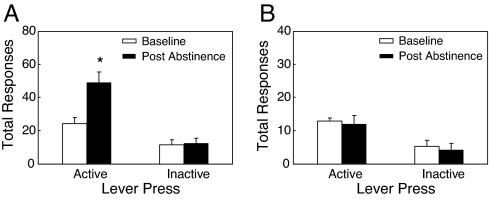
Specificity of the nicotine-deprivation effect. Total responses during the entire session in rats given extended (23 h, n = 7) (A), or limited (1 h, n = 6) (B) access to nicotine before and after 72 h of abstinence (*, P < 0.05 vs. baseline). Data represent mean ± SEM.
Fig. 4.
Fig. 4.
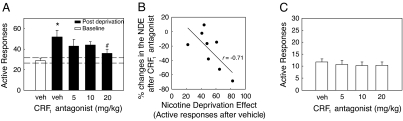
Abstinence-induced escalation of nicotine intake is blocked by a CRF1 receptor antagonist. (A) Effect of a CRF1 antagonist (MPZP, s.c., −1 h) on nicotine self-administration during the active period in rats given extended access to nicotine (*, P < 0.05 vs. baseline; #, P < 0.05 vs. after-abstinence vehicle treatment, n = 8). (B) Correlation between magnitude of the nicotine-deprivation effect and percentage changes in the nicotine-deprivation effect after CRF1 antagonist. The higher the nicotine-deprivation effect, the more effectively the antagonist blocked self-administration of nicotine (r = −0.71, P < 0.05). The x axis represents active responses after vehicle injection, and the y axis represents the reduction in active responses after the highest dose of MPZP (20 mg/kg), in percentage changes compared with active responses after vehicle injection. (C) Lack of effect of the CRF1 receptor antagonist (MPZP, s.c., −1 h) on baseline nicotine self-administration responding in rats given limited access to nicotine (n = 10). Data represent mean ± SEM.

Comment in

  • A neurobiological basis for nicotine withdrawal.
    Grunberg NE. Grunberg NE. Proc Natl Acad Sci U S A. 2007 Nov 13;104(46):17901-2. doi: 10.1073/pnas.0708964104. Epub 2007 Nov 7. Proc Natl Acad Sci U S A. 2007. PMID: 17989218 Free PMC article. No abstract available.

References

    1. Fellows JL, Trosclair A, Adams EK. Morb Mort Rep. 2002;51:300–303.
    1. Henningfield JE, Fant RV, Gitchell J, Shiffman Sl. Ann NY Acad Sci. 2000;909:247–256. - PubMed
    1. Pomerleau CS, Pomerleau OF. Psychopharmacology (Berlin) 1992;108:460–465. - PubMed
    1. Grunberg NE. Addiction. 1994;89:1443–1446. - PubMed
    1. Mansvelder HD, Keath JR, McGehee DS. Neuron. 2002;33:905–919. - PubMed

Publication types

MeSH terms

LinkOut - more resources