


Folic acid supplementation lowers blood arsenic
- PMID: 17921403
- PMCID: PMC2042963
- DOI: 10.1093/ajcn/86.4.1202
Folic acid supplementation lowers blood arsenic
Abstract
Background: Chronic arsenic exposure currently affects >100 million persons worldwide. Methylation of ingested inorganic arsenic (InAs) to monomethylarsonic (MMAs) and dimethylarsinic (DMAs) acids relies on folate-dependent one-carbon metabolism and facilitates urinary arsenic elimination.
Objective: We hypothesized that folic acid supplementation to arsenic-exposed Bangladeshi adults would increase arsenic methylation and thereby lower total blood arsenic.
Design: In this randomized, double-blind, placebo-controlled trial, we evaluated blood concentrations of total arsenic, InAs, MMAs, and DMAs in 130 participants with low plasma folate (<9 nmol/L) before and after 12 wk of supplementation with folic acid (400 microg/d) or placebo.
Results: MMAs in blood was reduced by a mean +/- SE of 22.24 +/- 2.86% in the folic acid supplementation group and by 1.24 +/- 3.59% in the placebe group (P < 0.0001). There was no change in DMAs in blood; DMAs is rapidly excreted in urine as evidenced by an increase in urinary DMAs (P = 0.0099). Total blood arsenic was reduced by 13.62% in the folic acid supplementation group and by 2.49% in the placebo group (P = 0.0199).
Conclusions: Folic acid supplementation to participants with low plasma concentrations of folate lowered blood arsenic concentrations, primarily by decreasing blood MMAs and increasing urinary DMAs. Therapeutic strategies to facilitate arsenic methylation, particularly in populations with folate deficiency or hyperhomocysteinemia or both, may lower blood arsenic concentrations and thereby contribute to the prevention of arsenic-induced illnesses.
Figures
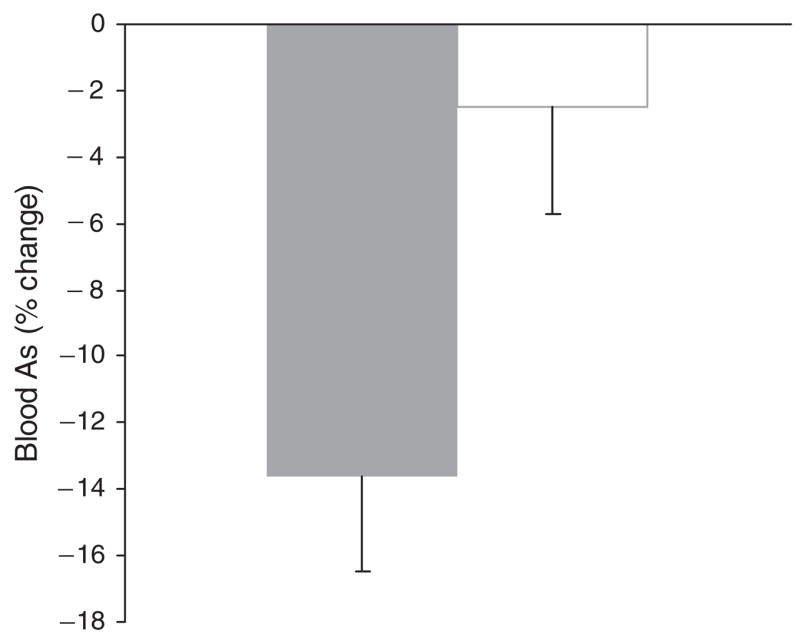
 ) (n = 68) or placebo (□) (n = 62) (P = 0.02).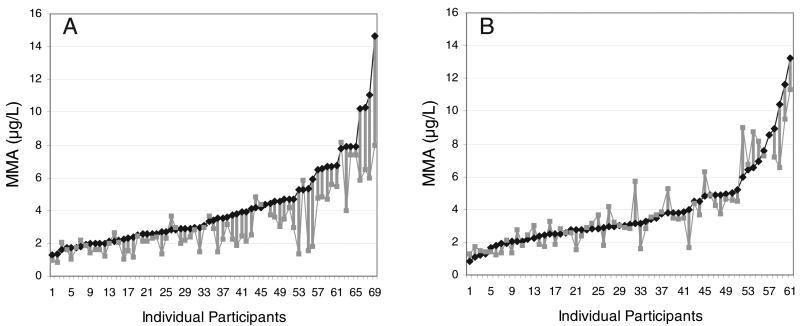
 , each participant’s corresponding blood MMAs after the 12-wk intervention. Rising and falling vertical bars indicate each participant’s increase or decrease, respectively, in blood MMAs from that participant’s baseline.
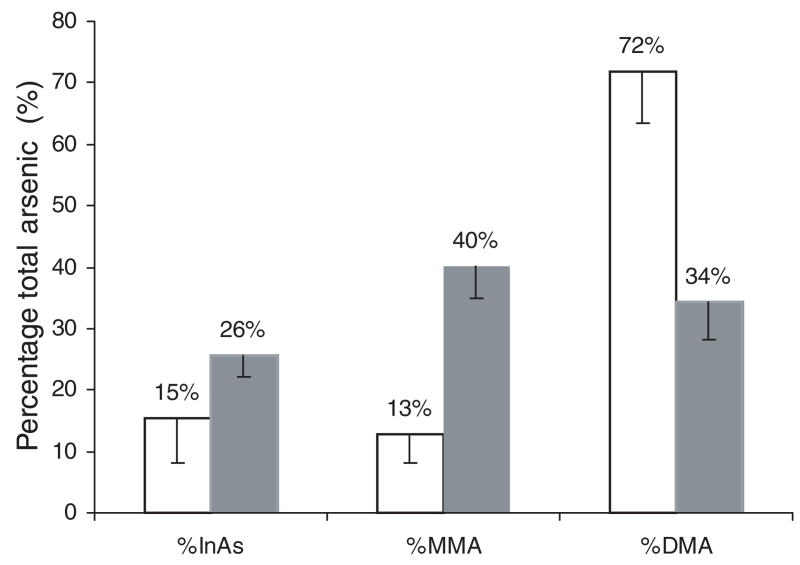 , the percentage of total blood arsenic as InAs, MMAs, and DMAs in blood. Plotted values are the mean ± SD for 130 participants at baseline.
References
-
- Ahmed MF, Ahuja S, Alauddin M, et al. Ensuring safe drinking water in Bangladesh. Science. 2006;314:1687–8. - PubMed
-
- Kinniburgh DG, Smedley PL. Arsenic contamination of groundwater in Bangladesh. Keyworth, United Kingdom: British Geological Survey; 2001. Final Report: BGS Technical Report WC/00/19.
-
- Chiou HY, Huang WI, Su CL, Chang SF, Hsu YH, Chen CJ. Dose-response relationship between prevalence of cerebrovascular disease and ingested inorganic arsenic. Stroke. 1997;28:1717–23. - PubMed
-
- Tseng CH, Chong CK, Tseng CP, et al. Long-term arsenic exposure and ischemic heart disease in arseniasis-hyperendemic villages in Taiwan. Toxicol Lett. 2003;137:15–21. - PubMed
-
- Feldman RG, Niles CA, Kelly-Hayes M, et al. Peripheral neuropathy in arsenic smelter workers. Neurology. 1979;29:939–44. - PubMed
Publication types
MeSH terms
Substances
Grants and funding
LinkOut - more resources
Full Text Sources
Medical
