


Diagnostic stability in very young children with autism spectrum disorders
- PMID: 17924183
- PMCID: PMC3625643
- DOI: 10.1007/s10803-007-0427-8
Diagnostic stability in very young children with autism spectrum disorders
Abstract
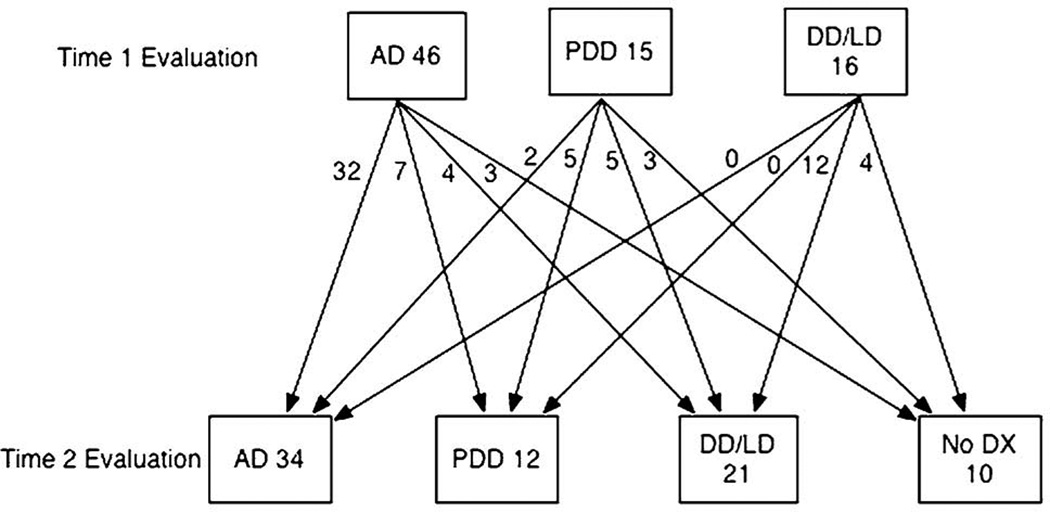
Autism Spectrum Disorders (ASD) diagnosis in very young children may be delayed due to doubts about validity. In this study, 77 children received a diagnostic and developmental evaluation between 16 and 35 months and also between 42 and 82 months. Diagnoses based on clinical judgment, Childhood Autism Rating Scale, and the Autism Diagnostic Observation Schedule were stable over time. Diagnoses made using the Autism Diagnostic Interview were slightly less stable. According to clinical judgment, 15 children (19%) moved off the autism spectrum by the second evaluation; none moved onto the spectrum. Results indicate diagnostic stability at acceptable levels for diagnoses made at age 2. Movement off the spectrum may reflect true improvement based on maturation, intervention, or over-diagnosis at age 2.
Figures
References
-
- American Psychiatric Association. Diagnostic and statistical manual of mental disorders (4th ed., DSM-IV) Washington, DC: Author; 1994.
-
- Baranek GT. Autism during infancy: A retrospective video analysis of sensory-motor and social behaviors at 9–12 months of age. Journal of Autism and Developmental Disorders. 1999;29:213–224. - PubMed
-
- Baron-Cohen S, Allen J, Gillberg C. Can autism be detected at 18 months? The needle, the haystack, and the CHAT. British Journal of Psychiatry. 1992;161:839–843. - PubMed
-
- Baron-Cohen S, Cox A, Baird G, Swettenham J, Nightengale N, Morgan K, Drew A, Charman T. Psychological markers in the detection of autism in infancy in a large population. British Journal of Psychiatry. 1996;168:158–163. - PubMed
-
- Bayley N. The Bayley scales of infant development. 2nd ed. San Antonio, TX: Harcourt Brace; 1993.
Publication types
MeSH terms
Grants and funding
LinkOut - more resources
Full Text Sources
Other Literature Sources
