Evaluation of a neck-bridge device to assist endovascular treatment of wide-neck aneurysms of the anterior circulation
- PMID: 17928379
- PMCID: PMC8119120
- DOI: 10.3174/ajnr.A0767
Evaluation of a neck-bridge device to assist endovascular treatment of wide-neck aneurysms of the anterior circulation
Abstract
Background and purpose: Intracranial aneurysms with a wide-neck or an unfavorable dome-to-neck ratio may be difficult to treat properly and safely. Our aim was to evaluate the TriSpan neck-bridge device to assist coiling of wide-neck bifurcation aneurysms in the anterior circulation.
Materials and methods: In 14 patients, we performed 16 TriSpan-assisted coil embolizations with wide-neck bifurcation aneurysms of the anterior circulation. Eleven procedures were indicated for acutely ruptured aneurysms. Five were performed electively for the following: recurrent aneurysm after coil only (n = 1) or after TriSpan-assisted embolization (n = 2), aneurysm remnant after clipping (n = 1), and aneurysm incidentally found (n = 1). Procedural and clinical complications were recorded. Follow-up angiography was performed, and clinical outcomes were assessed by using the modified Rankin Scale score.
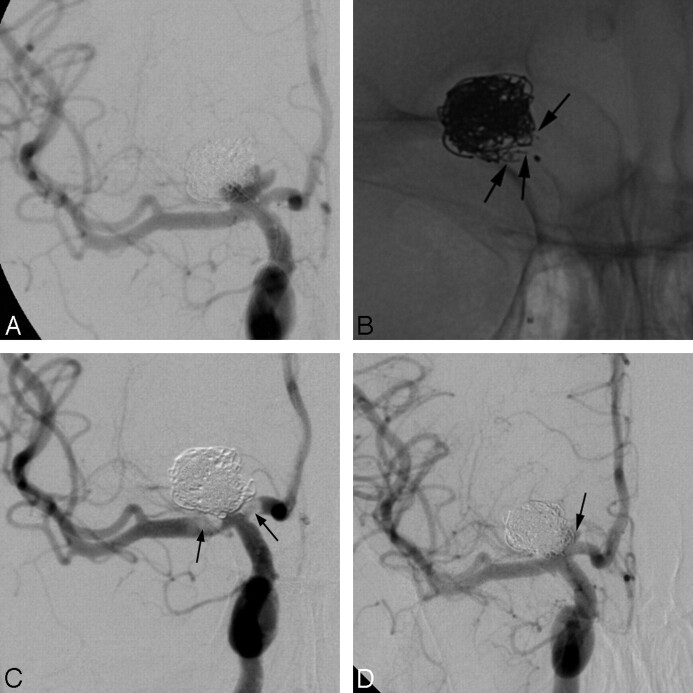
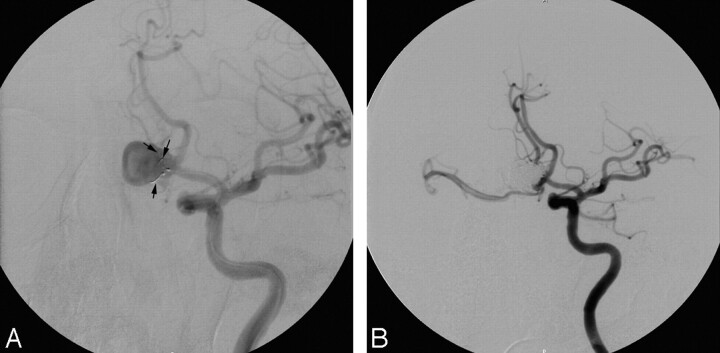
Results: TriSpan-assisted embolization was successful in 15/16 (93.8%) procedures, with complete occlusion in 2/16 (12.5%), near-complete occlusion in 10/16 (62.5%), and incomplete occlusion in 3/16 (18.75%). There were 6 (37.5%) intraprocedural complications: thrombus formation (n = 3), protrusion of a TriSpan loop in the parent artery (n = 1), TriSpan displacement in the aneurysm (n = 1), and tangling of a coil loop in the device (n = 1). Three patients died in the hospital (21.4%). Follow-up angiography or MR angiography was available in 8 (57.1%) patients and showed complete (n = 2), near-complete (n = 2), and incomplete occlusion (n = 4). Long-term clinical outcome was no (n = 4) or minor symptoms (n = 1) and moderate (n = 2), moderately severe (n = 2), or severe handicap (n = 2).
Conclusion: The use of the TriSpan device is feasible in the anterior circulation and can assist treatment of difficult wide-neck bifurcation aneurysms.
Figures

References
-
- Molyneux A, Kerr R, Stratton I, et al. International Subarachnoid Aneurysm Trial (ISAT) of neurosurgical clipping versus endovascular coiling in 2143 patients with ruptured intracranial aneurysms: a randomised trial. Lancet 2002;360:1267–74 - PubMed
Publication types
MeSH terms
LinkOut - more resources
Full Text Sources
Medical