


Remission of maternal depression and child symptoms among single mothers: a STAR*D-Child report
- PMID: 17934684
- PMCID: PMC2994601
- DOI: 10.1007/s00127-007-0262-4
Remission of maternal depression and child symptoms among single mothers: a STAR*D-Child report
Erratum in
- Soc Psychiatry Psychiatr Epidemiol. 2007 Dec;42(12):971
Abstract
Objective: Offspring of depressed parents are at increased risk for depressive and other disorders. We recently found that when depressed mothers reached full remission over 3 months of treatment, a significant improvement in the children's disorders occurred. Since only a third of the mothers remitted, factors related to maternal remission rates, and thereby child outcomes, were important. This report examined the relationship of the presence of a father in the household to maternal depression remission and child outcomes.
Method: Maternal depression was measured using the 17-item Hamilton Rating Scale for Depression (HRSD(17)); social functioning was assessed using the Social Adjustment Scale-Self Report (SAS-SR). Children (age 7-17) were assessed independently, blind to maternal outcome, using the Schedule for Affective Disorders and Schizophrenia for School-Age Children (K-SADS-PL) and the Child Global Assessment Scale (C-GAS).
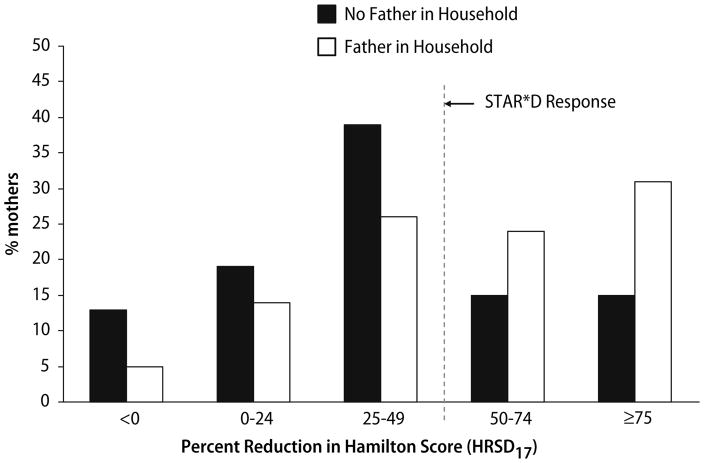
Results: Single mothers (n = 50), as compared to those in two-parent households (n = 61), were more likely to discontinue treatment (31% vs. 16%, P = 0.04), and less likely to remit if they remained in treatment (20% vs. 43%, P = 0.013). These differences remained significant after adjusting for socioeconomic status and potential confounders, but were partially explained by the mother's pre-treatment social functioning. The reduction in child diagnoses following maternal remission was greater in two-parent than in single-parent households, although a formal test of interaction between the odds ratios was not significant.
Conclusion: Single depressed mothers are more likely to drop out of treatment, and less likely to reach remission if they stay in treatment. This high-risk group requires vigorous treatment approaches.
Figures
References
-
- Agresti A. Categorical data analysis. 2. John Wiley & Sons, Inc; New York: 2002. p. 120.
-
- Ainsworth MS, Blehar MC, Waters E, Wall S. Patters of attachment: a psychological study of the strange situation. Erlbaum; Hillsdale: 1978.
-
- Bartholomew K, Horowitz LM. Attachment styles among young adults: a test of a four-category model. J Pers Soc Psychol. 1991;61(2):226–244. - PubMed
-
- Bifulco A, Kwon J, Jacobs C, Moran PM, Bunn A, Beer N. Adult attachment style as mediator between childhood neglect/abuse and adult depression and anxiety. Soc Psychiatry Psychiatr Epidemiol. 2006;41(10):796–805. - PubMed
-
- Bowlby J. Attachment and loss, vol. II: separation: anxiety and anger. Basic Book; New York: 1973.
Publication types
MeSH terms
Grants and funding
LinkOut - more resources
Full Text Sources
Research Materials
