. 2007 Dec;27(24):8824-33.
doi: 10.1128/MCB.00498-07. Epub 2007 Oct 15.

Postintegrative gene silencing within the Sleeping Beauty transposition system

Affiliations

Postintegrative gene silencing within the Sleeping Beauty transposition system

Brian S Garrison et al. Mol Cell Biol. 2007 Dec.

Abstract

The Sleeping Beauty (SB) transposon represents an important vehicle for in vivo gene delivery because it can efficiently and stably integrate into mammalian genomes. In this report, we examined transposon expression in human cells using a novel nonselective fluorescence-activated cell sorter-based method and discovered that SB integrates approximately 20 times more frequently than previously reported within systems that were dependent on transgene expression and likely subject to postintegrative gene silencing. Over time, phenotypic analysis of clonal integrants demonstrated that SB undergoes additional postintegrative gene silencing, which varied based on the promoter used for transgene expression. Molecular and biochemical studies suggested that transposon silencing was influenced by DNA methylation and histone deacetylation because both 5-aza-2'-deoxycytidine and trichostatin A partially rescued transgene silencing in clonal cell lines. Collectively, these data reveal the existence of a multicomponent postintegrative gene silencing network that efficiently targets invading transposon sequences for transcriptional silencing in mammalian cells.


Figures
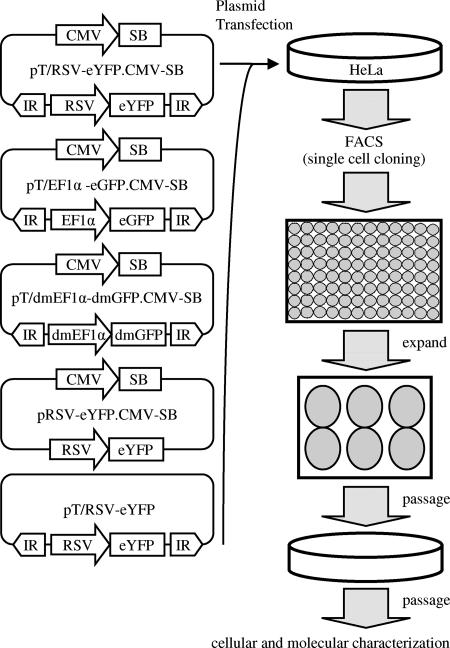
FIG. 1.
FIG. 1.
Experimental approach. HeLa cells were transfected with either pT/RSV-eYFP.CMV-SB, pT/EF1α-eGFP.CMV-SB, pT/dmEF1α-dmGFP.CMV-SB, pRSV-eYFP.CMV-SB (-IR control), or pT/RSV-eYFP (-SB control) and grown under normal conditions. After 48 to 72 h, eYFP-positive (or eGFP- or dmGFP-positive) cells were single-cell sorted (via FACS) into individual wells of 96-well plates and grown until colony formation. Colonies were picked and diluted into six-well plates and then established cell lines were maintained long term in 6-cm culture dishes. After >50 cell divisions, cell lines were characterized.
FIG. 2.
FIG. 2.
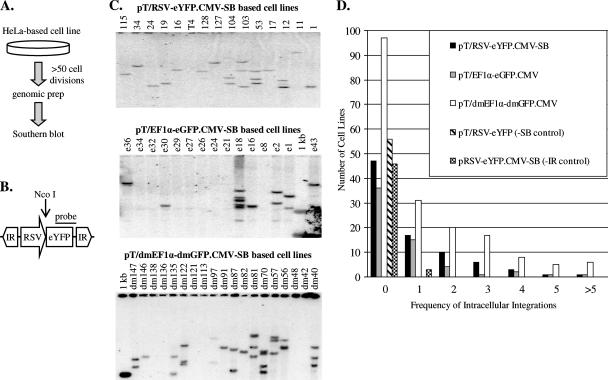
Characterization of SB-mediated integration events. (A) After growing the cells for over 50 cell divisions posttransfection, genomic DNA was isolated from each cell line for Southern blot analysis. (B) Genomic DNA was digested with NcoI and SpeI prior to gel electrophoresis. (C) Southern blot analysis was performed on each digested genomic preparation, using a reporter gene-specific probe. Representative Southern blots are shown for cell lines created from the constructs pT/RSV-eYFP.CMV-SB (top), pT/EF1α-eGFP.CMV-SB (middle), and pT/dmEF1α-dmGFP.CMV-SB (bottom). (D) The integration frequencies of the eYFP-, eGFP-, and dmGFP-containing transposons were determined by Southern blot analysis and plotted. The x axis depicts the frequency of intracellular integrations, which is the number of unique integrations within a cell line, while the y axis shows how many different cell lines contain a specific number of unique integrations.
FIG. 3.
FIG. 3.
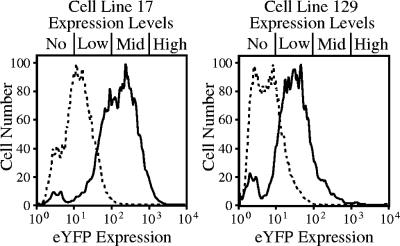
The site of integration regulates transgene expression. At 12 and 42 weeks posttransfection, cell lines were analyzed by flow cytometry and plotted in graphs containing predivided regions (no, low, mid, or high). The “no” regions contain cells in which the transposon's transgene does not express or has been silenced. The other regions contain cells that are positive for transgene expression.
FIG. 4.
FIG. 4.
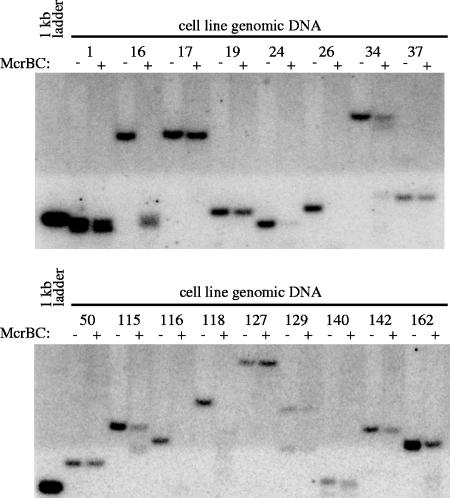
Analysis of DNA methylation via McrBC digestion. (A) Genomic DNA was isolated from each single-integration cell line created from pT/RSV-eYFP.CMV-SB and digested by NcoI and SpeI and then in the presence (+) or absence (−) of McrBC (which cleaves in the presence of CpG methylation). After digestion, the samples were examined via Southern blot analysis using a reporter-specific probe.
FIG. 5.
FIG. 5.
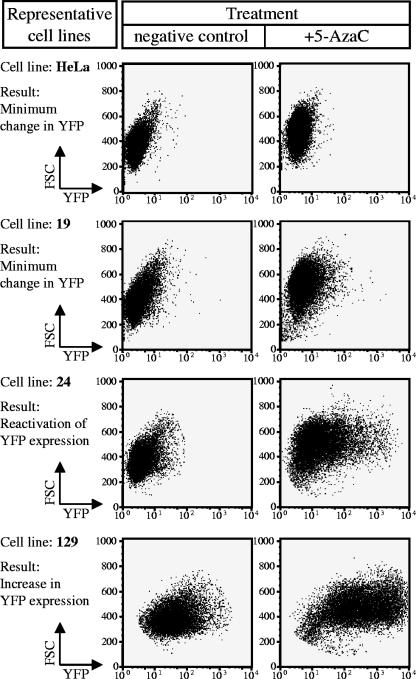
DNA methylation plays a role in transgene expression. The role of CpG dinucleotide methylation in transgene regulation was investigated by testing the single-integration cell lines (created from pT/RSV-eYFP.CMV-SB) with 5-AzaC, a methyltransferase inhibitor. Representative dot plots are shown for the three categories of cell line responses. The first category (represented by cell line 19) contains silenced cell lines which showed only a minimal response to 5-AzaC. The second category (represented by cell line 24) contains silenced cell lines that were reactivated in the presence of 5-AzaC. The third category (represented by cell line 129) contains transgene-expressing cell lines in which there was an increase in expression in the presence of 5-AzaC.
FIG. 6.
FIG. 6.
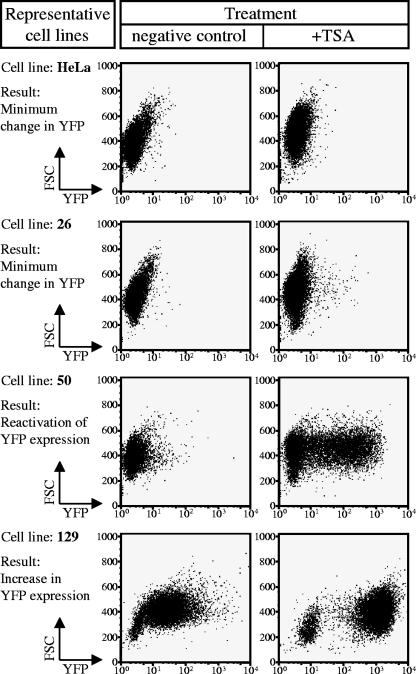
Histone deacetylation plays a role in transgene expression. The role of chromatin structure in transgene regulation was investigated by testing the single-integration cell lines (created from pT/RSV-eYFP.CMV-SB) with TSA, a deacetylase inhibitor. Representative dot plots are shown for the three categories of cell line responses. The first category (represented by cell line 26) contains silenced cell lines which showed only a minimal response to TSA. The second category (represented by cell line 50) contains silenced cell lines that were reactivated in the presence of TSA. The third category (represented by cell line 129) contains transgene-expressing cell lines in which there was an increase in expression in the presence of TSA.

References

    1. Baus, J., L. Liu, A. D. Heggestad, S. Sanz, and B. S. Fletcher. 2005. Hyperactive transposase mutants of the Sleeping Beauty transposon. Mol. Ther. 12:1148-1156. - PubMed
    1. Bourc'his, D., and T. H. Bestor. 2004. Meiotic catastrophe and retrotransposon reactivation in male germ cells lacking Dnmt3L. Nature 431:96-99. - PubMed
    1. Bushman, F., M. Lewinski, A. Ciuffi, S. Barr, J. Leipzig, S. Hannenhalli, and C. Hoffmann. 2005. Genome-wide analysis of retroviral DNA integration. Nat. Rev. Microbiol. 3:848-858. - PubMed
    1. Christman, J. K. 2002. 5-Azacytidine and 5-aza-2′-deoxycytidine as inhibitors of DNA methylation: mechanistic studies and their implications for cancer therapy. Oncogene 21:5483-5495. - PubMed
    1. Dalle, B., J. E. Rubin, O. Alkan, T. Sukonnik, P. Pasceri, S. Yao, R. Pawliuk, P. Leboulch, and J. Ellis. 2005. eGFP reporter genes silence LCR β-globin transgene expression via CpG dinucleotides. Mol. Ther. 11:591-599. - PubMed

Publication types

LinkOut - more resources