Developing asthma in childhood from exposure to secondhand tobacco smoke: insights from a meta-regression
- PMID: 17938726
- PMCID: PMC2022647
- DOI: 10.1289/ehp.10155
Developing asthma in childhood from exposure to secondhand tobacco smoke: insights from a meta-regression
Abstract
Objective: Studies have identified associations between household secondhand tobacco smoke (SHS) exposure and induction of childhood asthma. However, the true nature and strength of this association remains confounded in many studies, producing inconsistent evidence. To look for sources of potential bias and try to uncover consistent patterns of relative risk estimates (RRs), we conducted a meta-analysis of studies published between 1970 and 2005.
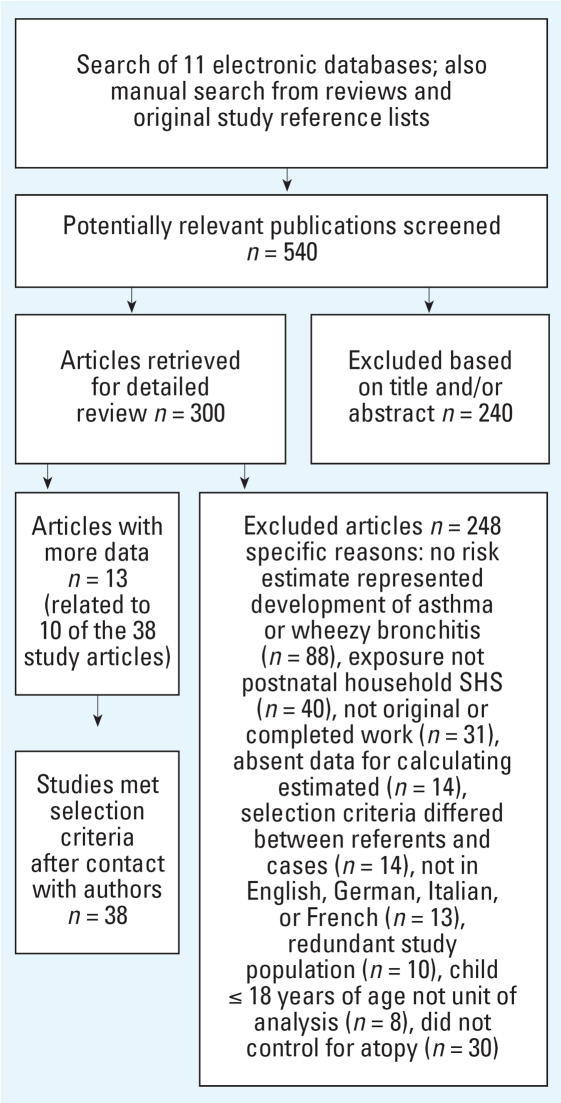
Data sources: Through an extensive literature search, we identified 38 epidemiologic studies of SHS exposure and the development of childhood asthma (that also controlled for atopy history) from 300 potentially relevant articles.
Data synthesis: We observed substantial heterogeneity within initial summary RRs of 1.48 [95% confidence interval (CI), 1.32-1.65], 1.25 (1.21-1.30), and 1.21 (1.08-1.36), for ever, current, and incident asthma, respectively. Lack of control for type of atopy history (familial or child) and child's own smoking status within studies and age category altered summary RRs in separate meta-regressions. After adjusting for these confounding characteristics, consistent patterns of association emerged between SHS exposure and childhood asthma induction. Our summary RR of 1.33 (95% CI, 1.14-1.56) from studies of incident asthma among older children (6-18 years of age) is 1.27 times the estimate from studies of younger children and higher than estimates reported in earlier meta-analyses.
Conclusions: This new finding indicates that exposure duration may be a more important factor in the induction of asthma than previously understood, and suggests that SHS could be a more fundamental and widespread cause of childhood asthma than some previous meta-analyses have indicated.
Keywords: ETS; SHS; childhood asthma; environmental tobacco smoke; meta-analysis; meta-regression; relative risk; secondhand tobacco smoke.
Republished in
-
Developing asthma in childhood from exposure to secondhand tobacco smoke: insights from a meta-regression.Cien Saude Colet. 2008 Jul-Aug;13(4):1313-25. doi: 10.1590/s1413-81232008000400028. Cien Saude Colet. 2008. PMID: 18813631 No abstract available.
References
-
- Aberg N, Hesselmar B, Aberg B, Eriksson B. Increase of asthma, allergic rhinitis and eczema in Swedish schoolchildren between 1979 and 1991. Clin Exp Allergy. 1995;25:815–819. - PubMed
-
- Aberkane T. Air Quality Monitoring Report 1997. Report U98(43) 1998. [accessed 18 May 2007]. Available: http://www.ecan.govt.nz/Plans+and+Reports/Air/Annual+Monitoring+Report/z....
-
- Agabiti N, Mallone S, Forastiere F, Corbo GM, Ferro S, Renzoni E, et al. The impact of parental smoking on asthma and wheezing. SIDRIA Collaborative Group. Studi Italiani sui Disturbi Respiratori nell’Infanzia e l’Ambiente. Epidemiology. 1999;10(6):692–698. - PubMed
-
- Al-Frayh A, Bener A, Al-Jawadi TQ. Prevalence of asthma among Saudi schoolchildren. Saudi Med J. 1992;13(6):521–524.
-
- Azizi BH, Zulkifli HI, Kasim S. Indoor air pollution and asthma in hospitalized children in a tropical environment. J Asthma. 1995;32(6):413–418. - PubMed
Publication types
MeSH terms
Substances
LinkOut - more resources
Full Text Sources
Medical