


Review
doi: 10.1016/j.cellimm.2007.03.009.
Epub 2007 Oct 17.
Ischemia-reperfusion and immediate T cell responses
Affiliations
- PMID: 17942086
- PMCID: PMC2211448
- DOI: 10.1016/j.cellimm.2007.03.009
Item in Clipboard
Review
Ischemia-reperfusion and immediate T cell responses
Cell Immunol.
2007 Jul.
Abstract
The pathogenesis of ischemia-reperfusion injury (IRI) is complex and not well understood. Inflammation plays an important role in IRI, with involvement of leukocytes, adhesion molecules, chemokines and cytokines. Emerging data suggest a role of T cells as mediators of IRI both in renal and extra-renal organs. Divergent roles of T cell subsets have also been elucidated, suggesting a more complicated role of T cells in the different phases of IRI. This review presents recent evidence from various animal models that advances our understanding of the role T cells play in IRI. These findings entertain the possibility of using immunotherapeutic agents for the prevention and treatment of IRI.
Figures
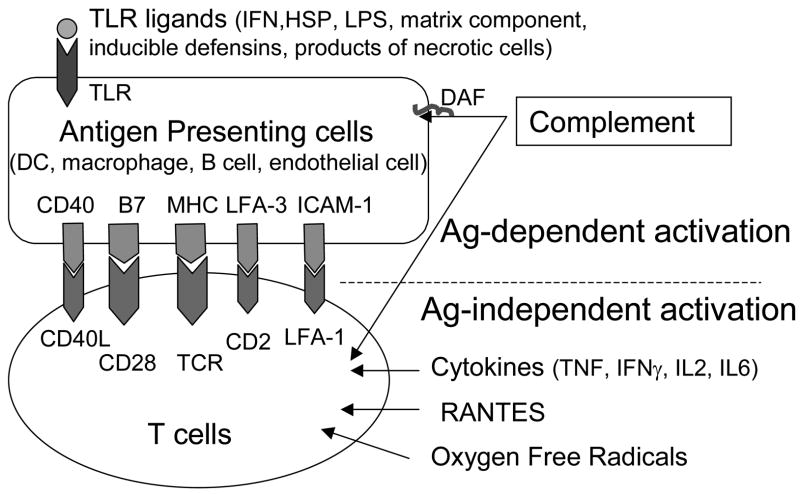
Two signals are provided by APCs to activate T cells, including antigen-specific signal received as a result of binding of the T cell receptor to peptide presented by MHC molecule, and the second signal provided by costimulatory molecules such as B7-1 (CD80), B7-2 (CD86) and CD40. T cells can also be directly activated through Ag-independent pathways by cytokines, RANTES and oxygen free radicals. Complement system serves both during innate immunity, as well as a mediator of adaptive immunity by directly activating APCs and T cells. In IRI, Ag-independent pathways play an important role in T cell activation. Moreover, several proteins induced by IRI, including HSP, matrix component, inducible defensins, products of necrotic cells, as well as cytokines can activate APCs through TLR contributing to the T cells proliferation. Dendritic cells, macrophages, B cells and endothelial cells are involved in Ag presentation to T cells.
References
-
- Tilney NL, Guttmann RD. Effects of initial ischemia/reperfusion injury on the transplanted kidney. Transplantation. 1997;64:945–947. - PubMed
-
- Rabb H. The T cell as a bridge between innate and adaptive immune systems: Implication for the kidney. Kidney Int. 2002;61:1935–1946. - PubMed
-
- Burne-Taney MJ, Rabb H. The role of adhesion molecules and T cells in ischemic renal injury. Curr Opin Nephrol Hypertens. 2003;12:85–90. - PubMed
-
- Kieran NE, Rabb H. Immune responses in kidney preservation and reperfusion injury. J Investig Med. 2004;52:310–314. - PubMed
-
- Friedewald JJ, Rabb H. Inflammatory cells in ischemic acute renal failure. Kidney Int. 2004;66:486–491. - PubMed
Publication types
MeSH terms
Substances
Grants and funding
LinkOut - more resources
Full Text Sources
Other Literature Sources
