


doi: 10.1128/JVI.01760-07.
Epub 2007 Oct 17.
Antiretroviral activity and Vif sensitivity of rhesus macaque APOBEC3 proteins
Affiliations
- PMID: 17942564
- PMCID: PMC2168863
- DOI: 10.1128/JVI.01760-07
Item in Clipboard
Antiretroviral activity and Vif sensitivity of rhesus macaque APOBEC3 proteins
J Virol.
2007 Dec.
Abstract
The inability of human immunodeficiency virus type 1(HIV-1) to replicate in rhesus macaque cells is in part due to the failure of HIV-1 Vif to counteract the restriction factor APOBEC3G. However, in this study we demonstrate that several rhesus macaque APOBEC3 (rhAPOBEC3) proteins are capable of inhibiting HIV-1 infectivity. There was considerable variation in the ability of a panel of Vif proteins to induce degradation of rhAPOBEC3 proteins, and mutations within HIV-1 Vif that render it capable of degrading rhAPOBEC3G did not confer activity against other antiviral rhAPOBEC3 proteins. These findings suggest that multiple APOBEC3 proteins can contribute to primate lentivirus species tropism.
Figures
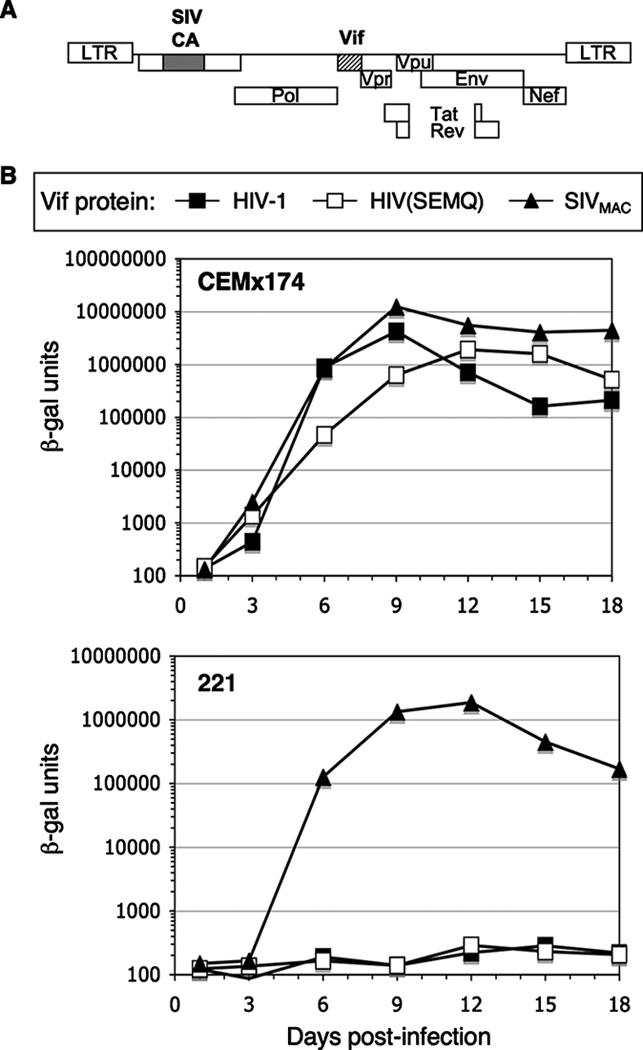
Replication of chimeric HIV-1-based viruses expressing different Vif proteins in human and rhesus macaque T cells. (A) Schematic representation of the viruses used in replication assays; wild-type HIV-1, HIV(SEMQ) mutant, and SIVMAC Vif proteins were expressed in the context of a replication-competent HIV-1-based chimeric virus expressing a SIVMAC capsid that was adapted to improve replication capacity in human and rhesus macaque cells (12). LTR, long terminal repeat. (B) Results of replication assays. Human CEMx174 and rhesus macaque 221 T cells were inoculated with equivalent infectious titers as measured on TZM cells (a human cell line expressing HIV-1 receptors and β-galactosidase under the control of the HIV-1 long terminal repeat). Infected cells were washed the day after being inoculated, and the supernatant was collected every 3 days and assayed for infectivity on TZM cells.
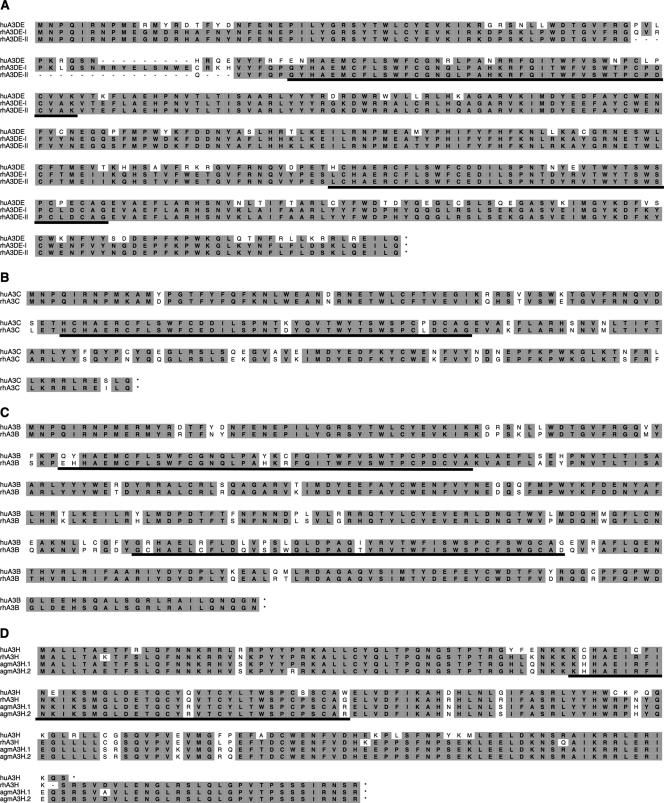
Amino acid alignment of human, rhesus macaque, and African green monkey APOBEC3 proteins. (A) Amino acid alignment of two variants of rhAPOBEC3DE (rhAPOBEC3DE-I [rhA3DE-I] and rhAPOBEC3DE [rhA3DE-II]) with huAPOBEC3DE (huA3DE). (B) Amino acid alignment of rhAPOBEC3C (rhA3C) with huAPOBEC3C (huAC3). (C) Amino acid alignment of rhAPOBEC3B (rhA3B) with huAPOBEC3B (huA3B). (D) Amino acid alignment of two variants of agmAPOBEC3H (agmAPOBEC3H.1 [agmA3H.1] and agmAPOBEC3H.2 [agmAcH.2]) with huAPOBEC3H (huA3H) and rhAPOBEC3H (rhA3H). The nucleotide deaminase zinc-binding motifs are underlined. Shading denotes amino acid homology.
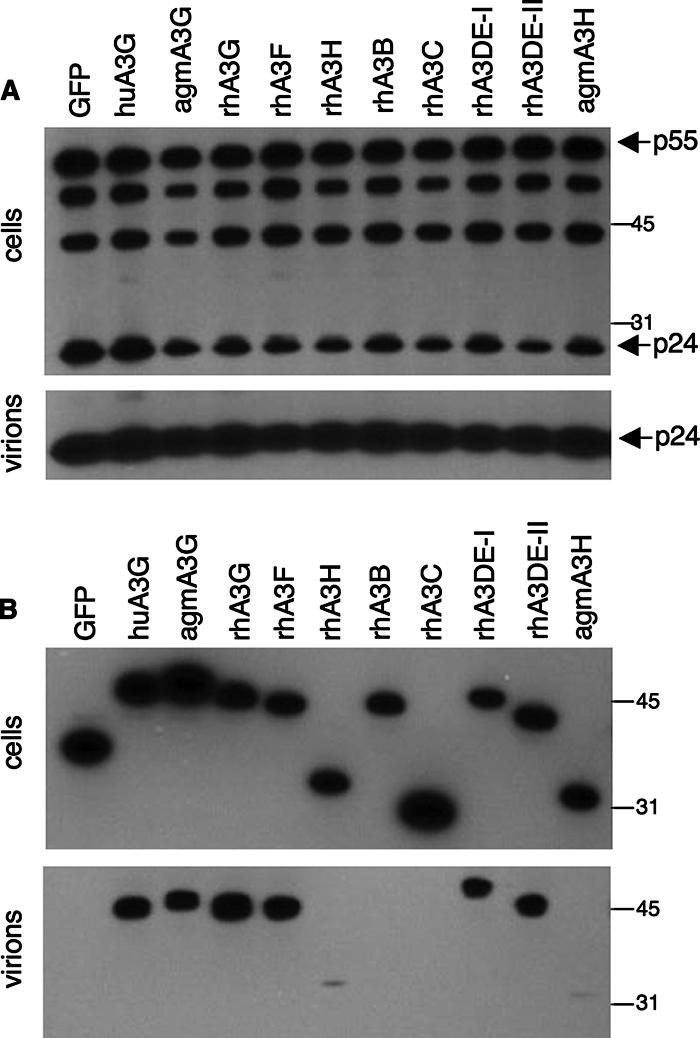
Expression and particle incorporation of APOBEC3 proteins. 293T cells (in 6-well plates) transfected with various myc-tagged APOBEC3 expression plasmids (900 ng per well) or a control myc-GFP expression plasmid together with an HIV-1 GagPol (450 ng per well) and a packageable genome (CSGW; 450 ng per well) were harvested 2 days posttransfection. Virions were purified by ultracentrifugation through a 20% sucrose cushion. Cell and virion lysates were analyzed by immunoblotting with an antibody against the HIV-1 capsid (A) or an antibody against the myc epitope (B). huA3G, huAPOBEC3G; agmA3G, agmAPOBEC3G; rhA3G, rhAPOBEC3G; rhA3F, rhAPOBEC3F; rhA3H, rhAPOBEC3H; rhA3B, rhAPOBEC3B; rhA3C, rhAPOBEC3C; rhA3DE-I, rhAPOBECDE-I; rhA3DE-II, rhAPOBECDE-II; agmA3H, agmAPOBEC3H.
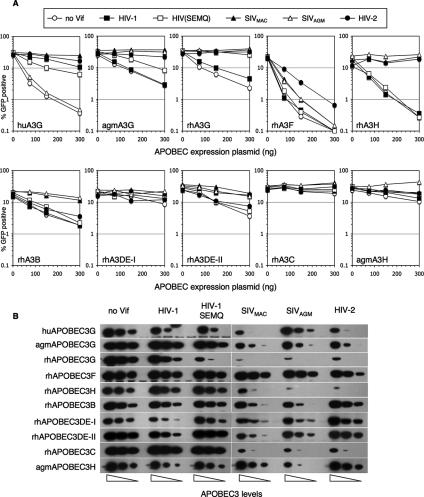
Inhibition of HIV-1 infectivity by APOBEC3 proteins and ability of Vif proteins to overcome inhibition. (A) Viral stocks were generated by cotransfecting 293T cells with increasing amounts of APOBEC3 expression plasmids (0, 75, 150, and 300 ng in a 24-well plate) and fixed amounts of HIV-1 GagPol (150 ng), HIV-1 GFP vector (150 ng), and VSV-G (100 ng) expression plasmids and Vif or a control (150 ng) expression plasmid. Infectivity was measured by using human CEMx174 T cells as target cells. Infected cells were enumerated by fluorescence-activated cell sorter analysis. Results representative of two experiments are shown. huA3G, huAPOBEC3G; agmA3G, agmAPOBEC3G; rhA3G, rhAPOBEC3G; rhA3F, rhAPOBEC3F; rhA3H, rhAPOBEC3H; rhA3B, rhAPOBEC3B; rhA3DE-I, rhAPOBECDE-I; rhA3DE-II, rhAPOBECDE-II; rhA3C, rhAPOBEC3C; agmA3H, agmAPOBEC3H. (B) Transfected 293T cells were lysed, and expression of each APOBEC3 protein in the absence or presence of the various Vif proteins, as indicated, was monitored by immunoblotting with an antibody against myc. Each group of three lanes represents cells transfected with decreasing amounts (300, 150, and 75 ng), from left to right, of each APOBEC3 expression plasmid.
References
-
- Alce, T. M., and W. Popik. 2004. APOBEC3G is incorporated into virus-like particles by a direct interaction with HIV-1 Gag nucleocapsid protein. J. Biol. Chem. 279:34083-34086. - PubMed
-
- Bieniasz, P. D. 2004. Intrinsic immunity: a front-line defense against viral attack. Nat. Immunol. 5:1109-1115. - PubMed
-
- Cen, S., F. Guo, M. Niu, J. Saadatmand, J. Deflassieux, and L. Kleiman. 2004. The interaction between HIV-1 Gag and APOBEC3G. J. Biol. Chem. 279:33177-33184. - PubMed
-
- Conticello, S. G., R. S. Harris, and M. S. Neuberger. 2003. The Vif protein of HIV triggers degradation of the human antiretroviral DNA deaminase APOBEC3G. Curr. Biol. 13:2009-2013. - PubMed
Publication types
MeSH terms
Substances
Grants and funding
LinkOut - more resources
Full Text Sources
