


Clonal expansion of immunoglobulin M+CD27+ B cells in HCV-associated mixed cryoglobulinemia
- PMID: 17942751
- PMCID: PMC2214737
- DOI: 10.1182/blood-2007-07-101717
Clonal expansion of immunoglobulin M+CD27+ B cells in HCV-associated mixed cryoglobulinemia
Abstract
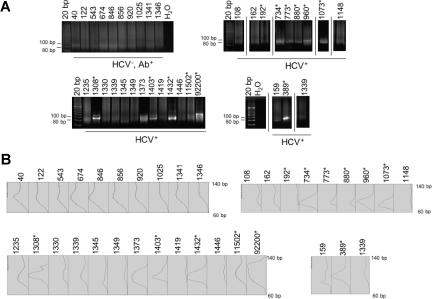
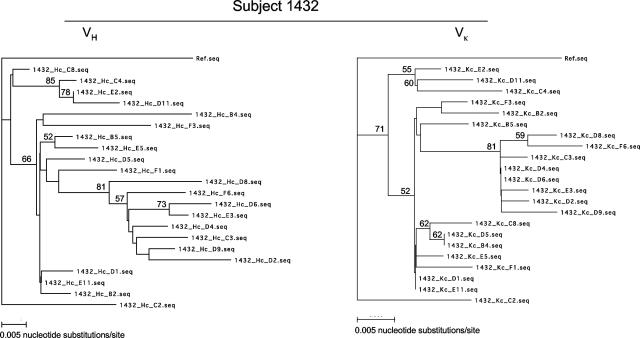
Hepatitis C virus (HCV) is associated with B-cell lymphoproliferative disorders such as mixed cryoglobulinemia (MC) and B-cell non-Hodgkin lymphoma (B-NHL). The pathogenesis of these disorders remains unclear, and it has been proposed that HCV drives the pro-liferation of B cells. Here we demonstrate that certain HCV(+)MC(+) subjects have clonal expansions of immunoglobulin M (IgM)(+)kappa(+)IgD(low/-)CD21(low)CD27(+) B cells. Using RT-PCR to amplify Ig from these singly sorted cells, we show that these predominantly rheumatoid factor-encoding V(H)1-69/J(H)4 and V(kappa)3-20 gene segment-restricted cells have low to moderate levels of somatic hypermutations. Ig sequence analysis suggests that antigen selection drives the generation of mutated clones. These findings lend further support to the notion that specific antigenic stimulation leads to B-cell proliferation in HCV MC and that chronic B-cell stimulation may set the stage for malignant transformation and the development of B-NHL. The finding that these hypermutated, marginal zone-like IgM(+)CD27(+) B cells are clonally expanded in certain subjects with MC offers insight into mechanisms of HCV-associated MC and B-cell malignancy. This study was registered at www.clinicaltrials.gov as NCT00219999.
Figures
References
-
- Keeffe EB. Liver transplantation: current status and novel approaches to liver replacement. Gastroenterology. 2001;120:749–762. - PubMed
-
- Di Bisceglie AM, McHutchison J, Rice CM. New therapeutic strategies for hepatitis C. Hepatology. 2002;35:224–231. - PubMed
-
- Agnello V, Chung RT, Kaplan LM. A role for hepatitis C virus infection in type II cryoglobulinemia. N Engl J Med. 1992;327:1490–1495. - PubMed
-
- Mayo MJ. Extrahepatic manifestations of hepatitis C infection. Am J Med Sci. 2003;325:135–148. - PubMed
Publication types
MeSH terms
Substances
Associated data
Grants and funding
LinkOut - more resources
Full Text Sources
Other Literature Sources
Medical
Research Materials
