


Interventions for the prevention and treatment of pes cavus
- PMID: 17943889
- PMCID: PMC8915727
- DOI: 10.1002/14651858.CD006154.pub2
Interventions for the prevention and treatment of pes cavus
Abstract
Background: People with pes cavus frequently suffer foot pain, which can lead to significant disability. Despite anecdotal reports, rigorous scientific investigation of this condition and how best to manage it is lacking.
Objectives: To assess the effects of interventions for the prevention and treatment of pes cavus.
Search strategy: We searched the Cochrane Neuromuscular Disease Group Trials Register (April 2007), MEDLINE (January 1966 to April 2007), EMBASE (January 1980 to April 2007), CINAHL (January 1982 to April 2007), AMED (January 1985 to April 2007), all EBM Reviews (January 1991 to April 2007), SPORTdiscuss (January 1830 to April 2007) and reference lists of articles. We also contacted known experts in the field to identify additional published or unpublished data.
Selection criteria: We included all randomised and quasi-randomised controlled trials of interventions for the treatment of pes cavus. We also included trials aimed at preventing or correcting the cavus foot deformity.
Data collection and analysis: Two authors independently selected papers, assessed trial quality and extracted data.
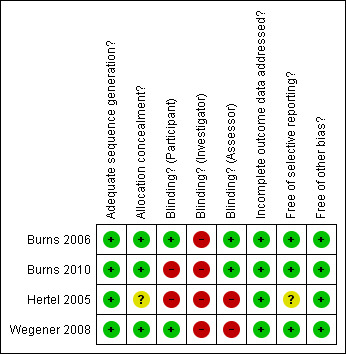
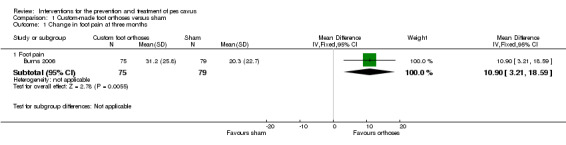
Main results: Only one trial (custom-made foot orthoses) fully met the inclusion criteria. Two additional cross-over trials (off-the-shelf foot orthoses and footwear) were also included. Both studies assessed secondary biomechanical outcomes less than three-months after randomisation. Data used in the three studies could not be pooled due to heterogeneity of diagnostic groups and outcome measures. The one trial that fully met the inclusion criteria investigated the treatment of cavus foot pain in 154 adults over a three month period. The trial showed a significant reduction in the level of foot pain, measured using the validated 100-point Foot Health Status Questionnaire, with custom-made foot orthoses versus sham orthoses (WMD 10.90; 95% CI 3.21 to 18.59). Furthermore, a significant improvement in foot function measured with the same questionnaire was reported with custom-made foot orthoses (WMD 11.00; 95% CI 3.35 to 18.65). There was also an increase in physical functioning of the Medical Outcomes Short Form - 36 (WMD 9.50; 95% CI 4.07 to 14.93). There was no difference in reported adverse events following the allocation of custom-made (9%) or sham foot orthoses (15%) (RR 0.61; 95% CI 0.26 to 1.48).
Authors' conclusions: In one randomised controlled trial, custom-made foot orthoses were significantly more beneficial than sham orthoses for treating chronic musculoskeletal foot pain associated with pes cavus in a variety of clinical populations. There is no evidence for any other type of intervention for the treatment or prevention of foot pain in people with a cavus foot type.
Conflict of interest statement
J. Burns, J. Crosbie and R. Ouvrier have been involved in studies that may be eligible for consideration in this review.
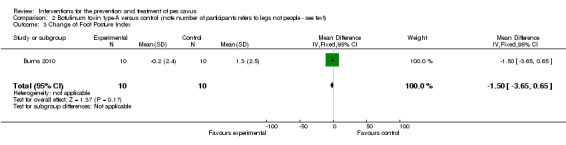
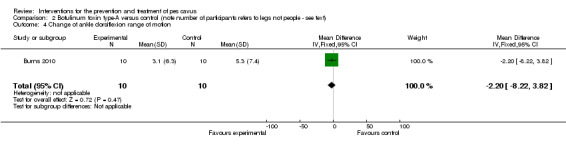
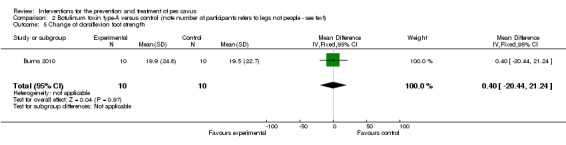
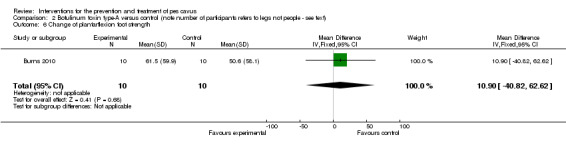
Figures
Update of
References
References to studies included in this review
Burns 2006 {published data only}
-
- Burns J, Crosbie J, Ouvrier R, Hunt A. Effective orthotic therapy for the painful cavus foot: a randomized controlled trial. Journal of the American Podiatric Medical Association 2006;96(3):205‐11. - PubMed
Burns 2010 {published and unpublished data}
-
- Burns J, Scheinberg A, Ryan MM, Rose KJ, Ouvrier RA. Randomized trial of botulinum toxin to prevent pes cavus progression in pediatric CMT1A. Muscle & Nerve 2010;42(2):262‐7. - PubMed
Hertel 2005 {published and unpublished data}
-
- Hertel J, Sloss BR, Earl JE. Effect of foot orthotics on quadriceps and gluteus medius electromyographic activity during selected exercises. Archives of Physical Medicine and Rehabilitation 2005;86(1):26‐30. - PubMed
Wegener 2008 {published and unpublished data}
-
- Wegener C, Burns J, Penkala S. Effect of neutral‐cushioned running shoes on plantar pressure loading and comfort in athletes with cavus feet: a crossover randomized controlled trial. American Journal of Sports Medicine 2008;36(11):2139‐46. - PubMed
References to studies excluded from this review
Bellomo 1982 {published data only}
-
- Bellomo F, Carannante G, Negretto R. Treatment of external pes cavus with long‐acting muscular stimulants. Minerva Ortopedica 1982;33(11):1107‐9.
Bus 2004 {published data only}
-
- Bus SA, Ulbrecht JS, Cavanagh PR. Pressure relief and load redistribution by custom‐made insoles in diabetic patients with neuropathy and foot deformity. Clinical Biomechanics 2004;19(6):629‐38. - PubMed
Butler 2005 {unpublished data only}
-
- Butler RJ. Interaction of arch type and footwear on running mechanics. Interaction of arch type and footwear on running mechanics PhD Thesis. Delaware: University of Delaware, 2005.
Butler 2006 {published data only}
-
- Butler RJ, Davis IS, Hamill J. Interaction of arch type and footwear on running mechanics. American Journal of Sports Medicine 2006;Dec; 34(12):1998‐2005. - PubMed
Butler 2007 {published data only}
-
- Butler RJ, Hamill J, Davis I. Effect of footwear on high and low arched runners' mechanics during a prolonged run. Gait & Posture 2007;26(2):219‐25. - PubMed
Kavros 2005 {published data only}
-
- Kavros SJ. The efficacy of a pneumatic compression device in the treatment of plantar fasciitis. Journal of Applied Biomechanics 2005;21(4):404‐13. - PubMed
Knapik 2010 {published data only}
-
- Knapik JJ, Brosch LC, Venuto M, Swedler DI, Bullock SH, Gaines LS, et al. Effect on injuries of assigning shoes based on foot shape in air force basic training. American Journal of Preventive Medicine 2010;38(1 Suppl):S197‐211. - PubMed
Molloy 2009 {published data only}
-
- Molloy JM, Christie DS, Teyhen DS, Yeykal NS, Tragord BS, Neal MS, et al. Effect of running shoe type on the distribution and magnitude of plantar pressures in individuals with low‐ or high‐arched feet. Journal of the American Podiatric Medical Association 2009;99(4):330‐8. - PubMed
Mubarak 2009 {published data only}
-
- Mubarak SJ, Valin SE. Osteotomies of the foot for cavus deformities in children. Journal of PediatricOrthopaedics 2009;29(3):294‐9. - PubMed
Olmsted 2004 {published data only}
-
- Olmsted LC, Hertel J. Influence of foot type and orthotics on static and dynamic control. Journal of Sports Rehabilitation 2004;13:54‐6.
Simkin 1989 {published data only}
-
- Simkin A, Leichter I, Giladi M, Stein M, Milgrom C. Combined effect of foot arch structure and an orthotic device on stress fractures. Foot and Ankle International 1989;10(1):25‐9. - PubMed
Additional references
Aktas 2000
-
- Aktas S, Sussman MD. The radiological analysis of pes cavus deformity in Charcot Marie Tooth disease. Journal of Pediatric Orthopedics 2000;9(2):137‐40. - PubMed
Badlissi 2005
-
- Badlissi F, Dunn JE, Link CL, Keysor JJ, McKinlay JB, Felson DT. Foot musculoskeletal disorders, pain, and foot‐related functional limitation in older persons. Journal of American Geriatric Society 2005;53(6):1029‐33. - PubMed
Barrie 2001
-
- Barrie JL, McLoughlin C, Robem N, Nuttal R, Lishman J, Wardle F, et al. Ankle instability in pes cavus. Journal of Bone and Joint Surgery (British Volume) 2001;83‐B(Suppl 3):339.
Bennett 1998
-
- Bennett PJ, Patterson C, Wearing S, Baglioni T. Development and validation of a questionnaire designed to measure foot‐health status. Journal of the American Podiatric Association 1998;88(9):419‐28. - PubMed
Burns 2005a
-
- Burns J, Crosbie J, Hunt A, Ouvrier R. The effect of pes cavus on foot pain and plantar pressure. Clinical Biomechanics 2005;20(9):877‐82. - PubMed
Burns 2005b
-
- Burns J, Redmond A, Crosbie J, Ouvrier R. Quantification of muscle strength and imbalance in neurogenic pes cavus, compared to health controls, using hand‐held dynamometry. Foot and Ankle International 2005;26(7):540‐4. - PubMed
Carroll 1999
-
- Carroll KL, Shea KG, Stevens PM. Posttraumatic cavovarus deformity of the foot. Journal of Pediatric Orthopedics 1999;19(1):39‐41. - PubMed
Dahle 1991
-
- Dahle LK, Mueller M, Delitto A, Diamond JE. Visual assessment of foot type and relationship of foot type to lower extremity injury. Journal of Orthopaedic and Sports Physical Therapy 1991;14(2):70‐4. - PubMed
Dickson 1939
-
- Dickson FD, Diveley RL. Functional disorders of the foot. Second Edition. Philadelphia: J.B. Lippincott Company, 1939.
Fortin 2002
-
- Fortin PT, Guettler J, Manoli A. Idiopathic cavovarus and lateral ankle instability: recognition and treatment implications relating to ankle arthritis. Foot and Ankle International 2002;23(11):1031‐7. - PubMed
Giannini 2002
-
- Giannini S, Ceccarelli F, Benedetti MG, Faldini C, Grandi G. Surgical treatment of adult idiopathic cavus foot with plantar fasciotomy, naviculocuneiform arthrodesis, and cuboid osteotomy. A review of thirty‐nine cases. Journal of Bone and Joint Surgery (American Volume) 2002;84‐A(Suppl 2):62‐9. - PubMed
Helliwell 1995
-
- Helliwell TR, Tynan M, Hayward M, Klenerman L, Whitehouse G, Edwards RH. The pathology of the lower leg muscles in pure forefoot pes cavus. Acta Neuropathologica 1995;89(6):552‐9. - PubMed
Hennig 1995
-
- Hennig EM, Milani TL. In‐shoe pressure distribution for running in various types of footwear. Journal of Applied Biomechanics 1995;11(3):299‐310.
Horne 1984
-
- Horne G. Pes cavovarus following ankle fracture. A case report. Clinical Orthopaedics and Related Research 1984;184:249‐50. - PubMed
Korpelainen 2001
-
- Korpelainen R, Orava S, Karpakka J, Siira P, Hulkko A. Risk factors for recurrent stress fractures in athletes. American Journal of Sports Medicine 2001;29(3):304‐10. - PubMed
Manoli 2005
-
- Manoli A 2nd, Graham B. The subtle cavus foot, "the underpronator," a review. Foot and Ankle International 2005;26(3):256‐63. - PubMed
Pandey 2002
-
- Pandey S. Neglected clubfoot. The Foot 2002;12(3):123‐41.
Perry 1995
-
- Perry JE, Ulbrecht JS, Derr JA, Cavanagh PR. The use of running shoes to reduce plantar pressures in patients who have diabetes. The Journal of Bone and Joint Surgery 1995;77(12):1819‐28. - PubMed
Redmond 2000
-
- Redmond A, Lumb PS, Landorf K. Effect of cast and noncast foot orthoses on plantar pressure and force during normal gait. Journal of the American Podiatric Medical Association 2000;90(9):441‐9. - PubMed
Redmond 2006
-
- Redmond AC, Crosbie J, Ouvrier RA. Development and validation of a novel rating system for scoring standing foot posture: the FootPosture Index. Clinical Biomechechanics 2006;21:89‐98. - PubMed
Reilly 2006
-
- Reilly KA, Barker KL, Shamley D, Sandall S. Influence of foot characteristics on the site of lower limb osteoarthritis. Foot and Ankle International 2006;27(3):206‐11. - PubMed
Sachithanandam 1995
-
- Sachithanandam V, Joseph B. The influence of footwear on the prevalence of flat foot. A survey of 1846 skeletally mature persons. Journal of Bone and Joint Surgery (British Volume) 1995;77(2):254‐7. - PubMed
Statler 2005
-
- Statler TK, Tullis BL. Pes cavus. Journal of the American Podiatric Medical Association 2005;95(1):42‐52. - PubMed
Williams 2001
-
- Williams DS, 3rd, McClay IS, Hamill J. Arch structure and injury patterns in runners. Clinical Biomechanics 2001;16(4):341‐7. - PubMed
Wines 2005
-
- Wines AP, Chen D, Lynch B, Stephens MM. Foot deformities in children with hereditary motor and sensory neuropathy. Journal of Pediatric Orthopedics 2005;25(2):241‐4. - PubMed
Publication types
MeSH terms
LinkOut - more resources
Full Text Sources
Medical
Miscellaneous
