. 2007 Nov 14;26(22):4646-56.
doi: 10.1038/sj.emboj.7601887. Epub 2007 Oct 18.

Regulation of histone modification and cryptic transcription by the Bur1 and Paf1 complexes

Affiliations

Regulation of histone modification and cryptic transcription by the Bur1 and Paf1 complexes

Yaya Chu et al. EMBO J. .

Abstract

The Bur1-Bur2 and Paf1 complexes function during transcription elongation and affect histone modifications. Here we describe new roles for Bur1-Bur2 and the Paf1 complex. We find that histone H3 K36 tri-methylation requires specific components of the Paf1 complex and that K36 tri-methylation is more strongly affected at the 5' ends of genes in paf1delta and bur2delta strains in parallel with increased acetylation of histones H3 and H4. Interestingly, the 5' increase in histone acetylation is independent of K36 methylation, and therefore is mechanistically distinct from the methylation-driven deacetylation that occurs at the 3' ends of genes. Finally, Bur1-Bur2 and the Paf1 complex have a second methylation-independent function, since bur2delta set2delta and paf1delta set2delta double mutants display enhanced histone acetylation at the 3' ends of genes and increased cryptic transcription initiation. These findings identify new functions for the Paf1 and Bur1-Bur2 complexes, provide evidence that histone modifications at the 5' and 3' ends of coding regions are regulated by distinct mechanisms, and reveal that the Bur1-Bur2 and Paf1 complexes repress cryptic transcription through a Set2-independent pathway.


Figures
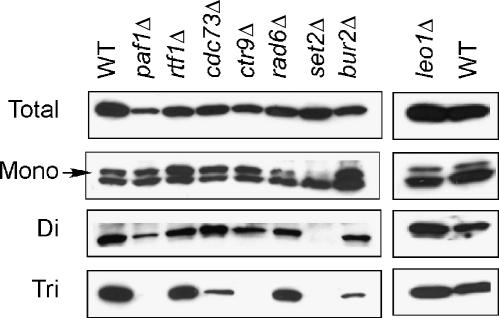
Figure 1
Figure 1
A subset of Paf1 complex mutations selectively affect histone H3 K36 tri-methylation. Whole-cell extracts were prepared from yeast strains with the genotypes shown at the top, and western blots were performed using antibodies specific for total H3, mono-, di-, or tri-methylated K36. The arrow indicates the position of mono-methylated H3 migrating slightly above a background band.
Figure 2
Figure 2
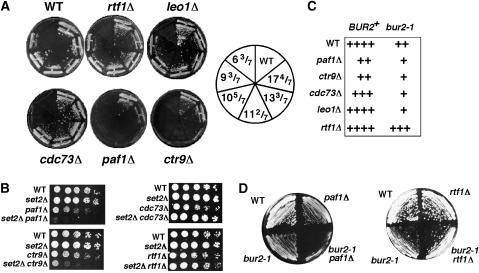
Paf1 complex mutations interact genetically with CTD truncations, a bur2 mutation, and set2Δ. (A) The growth phenotypes of strains containing deletions of Paf1 complex subunits and truncations of the pol II CTD. The numbers in the diagram on the right indicate the number of CTD repeats remaining. Strains were constructed by a plasmid shuffle approach and grown on 5FOA medium for 4 days at 30°C. (B) set2Δ causes synthetic sickness selectively with paf1Δ and ctr9Δ. Five-fold serial dilutions of the strains listed were spotted onto YPD plates and photographed after 3–4 days of growth at 30°C. (C) Summary of the growth phenotypes of double mutants between bur2-1 and deletions of the Paf1 complex subunits. (D) Strains with the indicated genotypes were streaked onto a YPD plate and grown at 30°C for 3 days.
Figure 3
Figure 3
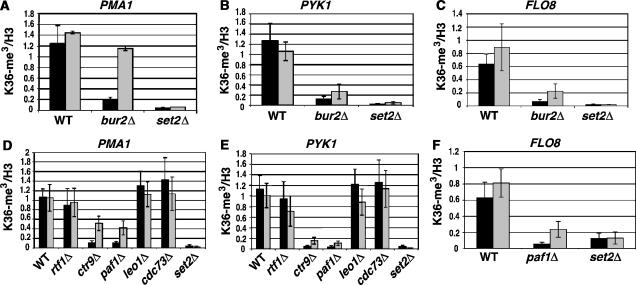
Histone H3 K36 tri-methylation levels at specific genes in bur2Δ and Paf1 complex mutants. (AC) Total histone H3 or histone H3 tri-methylated at K36 was immunoprecipitated from extracts of formaldehyde-treated wild type, bur2Δ, and set2Δ strains. Levels of tri-methylated K36 or total H3 were assessed at the 5′ (black bars) and 3′ ends (gray bars) of the PMA1 (A), PYK1 (B), and FLO8 (C) coding regions by ChIPs. (DF) ChIPs of total histone H3 and H3 tri-methylated at K36 were performed in Paf1 complex deletion strains. Enrichment of tri-methyl K36 was measured at the 5′ (black bars) and 3′ (gray bars) ends of PMA1 (D), PYK1 (E), and FLO8 (F). Tri-methyl K36 levels were normalized to total H3 levels. Standard error is provided for values representing three experiments.
Figure 4
Figure 4
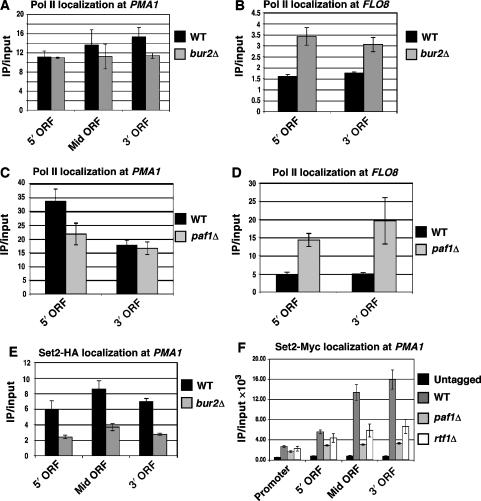
Pol II and Set2 occupancy in bur2Δ and paf1Δ mutant strains. (AD) 8WG16 antibody was incubated with chromatin samples to test the total pol II level at PMA1 and FLO8 from wild-type and bur2Δ strains (A, B) and from wild-type and paf1Δ strains (C, D). (E, F) ChIP assays measuring the recruitment of tagged Set2 to the promoter, 5′ ORF, Mid ORF and 3′ ORF of PMA1 in bur2Δ, paf1Δ and rtf1Δ strains. Standard error is provided for values representing three experiments.
Figure 5
Figure 5
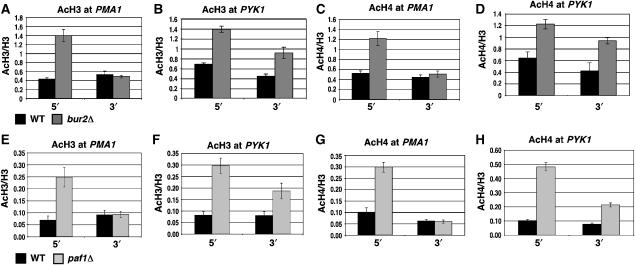
bur2Δ and paf1Δ affect histone acetylation at the 5′ regions of ORFs. (AD) ChIP analysis of wild type and bur2Δ strains using antibodies against acetylated histones H3 and H4. Levels of H3 acetylation and H4 acetylation were assessed at the 5′ and 3′ ends of PMA1 (A, C) and PYK1 (B, D). (EH) ChIP analysis of wild type and paf1Δ strains using antibodies against acetylated histones H3 and H4 at the 5′ and 3′ ends of PMA1 (E, G) and PYK1 (F, H). Standard error is provided for values representing three experiments.
Figure 6
Figure 6
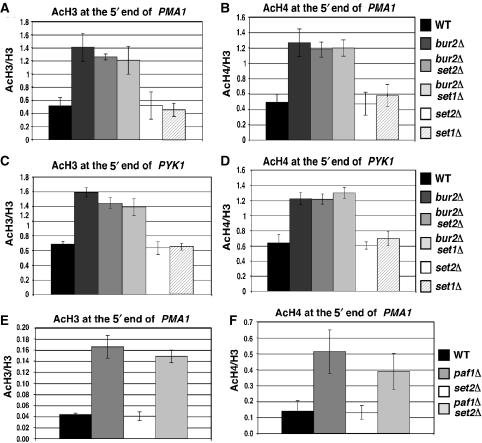
Increased acetylation at the 5′ end is independent of histone methylation in bur2Δ and paf1Δ strains. (AD) ChIP analysis with antibodies against acetylated histones H3 and H4 in wild type, bur2Δ, bur2Δ set2Δ, bur2Δ set1Δ, set1Δ, and set2Δ strains. Levels of H3 acetylation and H4 acetylation were assessed at the 5′ ends of PMA1 (A, B) and PYK1 (C, D). (E, F) ChIP analysis of acetylated histone H3 and H4 in wild type, paf1Δ, paf1Δ set2Δ, and set2Δ strains at the 5′ end of PMA1 (E, F). Standard error is provided for values representing three experiments.
Figure 7
Figure 7
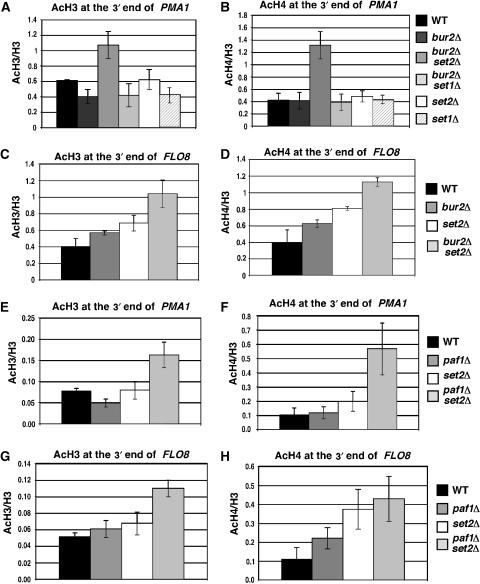
Bur2 and Paf1 have redundant roles with Set2 in controlling histone acetylation at the 3′ end of ORFs. (AD) ChIP analysis with antibodies against acetylated histones H3 and H4 in wild type, bur2Δ, bur2Δ set2Δ, bur2Δ set1Δ set1Δ, and set2Δ strains. Levels of H3 acetylation and H4 acetylation were assessed at the 3′ ends of PMA1 (A, B) and FLO8 (C, D). (EH) ChIP analysis of acetylated histone H3 and H4 in wild type, paf1Δ, paf1Δ set2Δ, and set2Δ strains at the 3′ ends of PMA1 (E, F) and FLO8 (G, H). Standard error is provided for values representing three experiments.
Figure 8
Figure 8
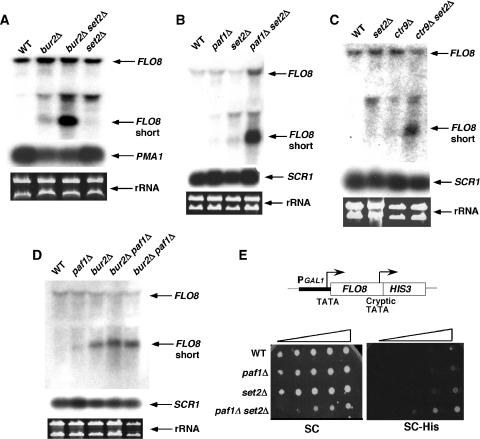
The Bur1 and Paf1 complexes are redundant with Set2 for repressing cryptic transcription. (AD) Northern blot analysis of total RNA prepared from the indicated strains. Filters were probed with sequences complementary to the 3′ region of FLO8 (+1672/+2399), PMA1 (+168/+2290), or SCR1. Ethidium bromide-stained gels showing the levels of ribosomal RNA serve as additional loading controls. The full-length and short cryptic transcript signals for FLO8 are indicated. (E) Strains with the indicated genotypes were tested for effects on an integrated pGAL1FLO8-HIS3 reporter gene (Prather et al, 2005). Ten-fold serial dilutions were spotted onto SC and SC-His plates and plates were incubated at 30°C for 3 days. His+ growth is indicative of transcription from the internal FLO8 promoter.

References

    1. Ausubel FA, Brent R, Kingston RE, Moore DD, Seidman JG, Smith JA, Struhl K (1997) Current Protocols in Molecular Biology. New York: John Wiley & Sons
    1. Bannister AJ, Schneider R, Myers FA, Thorne AW, Crane-Robinson C, Kouzarides T (2005) Spatial distribution of di- and tri-methyl lysine 36 of histone H3 at active genes. J Biol Chem 280: 17732–17736 - PubMed
    1. Biswas D, Dutta-Biswas R, Mitra D, Shibata Y, Strahl BD, Formosa T, Stillman DJ (2006) Opposing roles for Set2 and yFACT in regulating TBP binding at promoters. EMBO J 25: 4479–4489 - PMC - PubMed
    1. Carrozza MJ, Li B, Florens L, Suganuma T, Swanson SK, Lee KK, Shia WJ, Anderson S, Yates J, Washburn MP, Workman JL (2005) Histone H3 methylation by Set2 directs deacetylation of coding regions by Rpd3S to suppress spurious intragenic transcription. Cell 123: 581–592 - PubMed
    1. Chu Y, Sutton A, Sternglanz R, Prelich G (2006) The Bur1 cyclin-dependent protein kinase is required for the normal pattern of histone methylation by Set2. Mol Cell Biol 26: 3029–3038 - PMC - PubMed

Publication types

MeSH terms