


Broken hearts, woolly hair, and tattered skin: when desmosomal adhesion goes awry
- PMID: 17951043
- PMCID: PMC4296313
- DOI: 10.1016/j.ceb.2007.08.001
Broken hearts, woolly hair, and tattered skin: when desmosomal adhesion goes awry
Abstract
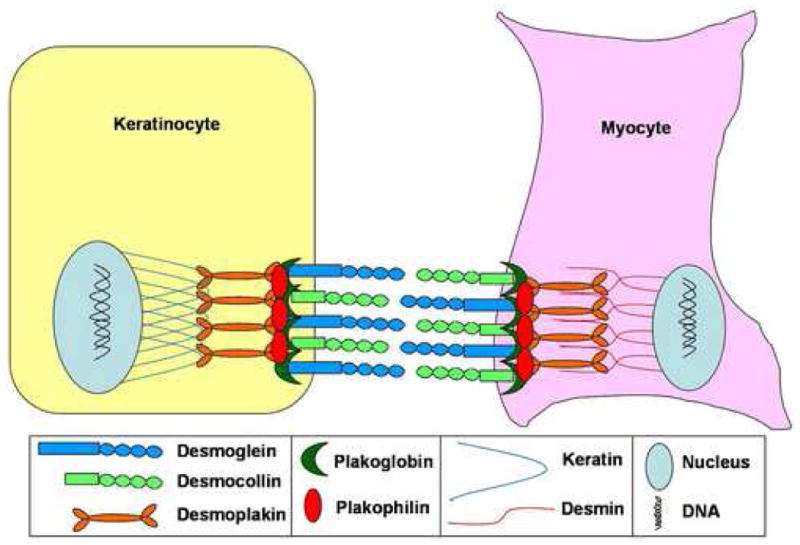
Desmosomal cadherins constitute the adhesive core of desmosomes. Different desmosomal cadherins are differentially expressed in a tissue-specific as well as differentiation-dependent manner. The skin and the heart are two examples of tissues whose vital functions require the ability to endure mechanical stress, and therefore, rely on the integrity of desmosomal adhesion. When this adhesion is compromised via mutations in genes encoding desmosomal cadherins or associated plaque proteins, both tissues can suffer the consequences. Open questions revolve around whether the resulting phenotypes are solely because of physical disruption of cell adhesion or whether these events are coupled with signaling mechanisms that influence many additional cellular processes. In this review, we focus on new developments in desmosomal adhesion with an emphasis on the skin, hair, and heart.
Conflict of interest statement
The authors declare no conflict of interest.
Figures
References
-
- Dusek RL, Godsel LM, Green KJ. Discriminating roles of desmosomal cadherins: beyond desmosomal adhesion. J Dermatol Sci. 2007;45:7–21. - PubMed
-
- McGrath JA. Inherited disorders of desmosomes. Australas J Dermatol. 2005;46:221–229. - PubMed
-
- Kljuic A, Bazzi H, Sundberg JP, Martinez-Mir A, O'Shaughnessy R, Mahoney MG, Levy M, Montagutelli X, Ahmad W, Aita VM, et al. Desmoglein 4 in hair follicle differentiation and epidermal adhesion: evidence from inherited hypotrichosis and acquired pemphigus vulgaris. Cell. 2003;113:249–260. This report highlights the power of comparative genomics between humans and mice affected with a similar phenotype of hypotrichosis. It is the first report of Dsg4 mutations causing LAH in humans and lah hair in mice. - PubMed
Publication types
MeSH terms
Substances
Grants and funding
LinkOut - more resources
Full Text Sources
