Review
. 2007 Nov;8(11):1159-64.
doi: 10.1038/ni1519.

Immunopathology of highly virulent pathogens: insights from Ebola virus

Affiliations
Review

Immunopathology of highly virulent pathogens: insights from Ebola virus

Carisa A Zampieri et al. Nat Immunol. 2007 Nov.

Abstract

Ebola virus is a highly virulent pathogen capable of inducing a frequently lethal hemorrhagic fever syndrome. Accumulating evidence indicates that the virus actively subverts both innate and adaptive immune responses and triggers harmful inflammatory responses as it inflicts direct tissue damage. The host immune system is ultimately overwhelmed by a combination of inflammatory factors and virus-induced cell damage, particularly in the liver and vasculature, often leading to death from septic shock. We summarize the mechanisms of immune dysregulation and virus-mediated cell damage in Ebola virus-infected patients. Future approaches to prevention and treatment of infection will be guided by answers to unresolved questions about interspecies transmission, molecular mechanisms of pathogenesis, and protective adaptive and innate immune responses to Ebola virus.


Figures
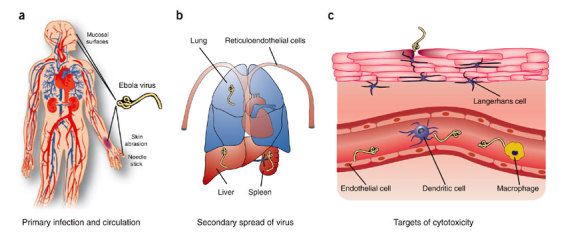
Figure 1
Figure 1. Infection, spread and target cell destruction by Ebola virus.
(a) Ebola virus (yellow) infects subjects through contact with body fluid or secretions from an infected patient and is distributed through the circulation. Entry can occur through abrasions in the skin during patient care, burial rituals and possibly contact with infected bushmeat, or across mucosal surfaces. Accidental needle stick is the primary route of occupational exposure. (b) Early targets of replication are reticuloendothelial cells, with high replication in several cell types within the lungs, liver and spleen. (c) Dendritic cells, macrophages and endothelium appear to be susceptible to cytopathic effects of Ebola virus gene products in vitro and possibly in vivo through disruption of cellular signaling pathways affected by virus binding, phagocytic uptake or both. Indirect damage may also be inflicted by circulating factors such as tumor necrosis factor and nitric oxide.

References

    1. Bowen ET, et al. Viral haemorrhagic fever in southern Sudan and northern Zaire. Preliminary studies on the aetiological agent. Lancet. 1977;1:571–573. doi: 10.1016/S0140-6736(77)92001-3. - DOI - PubMed
    1. Johnson KM, Lange JV, Webb PA, Murphy FA. Isolation and partial characterisation of a new virus causing acute haemorrhagic fever in Zaire. Lancet. 1977;1:569–571. doi: 10.1016/S0140-6736(77)92000-1. - DOI - PubMed
    1. Leroy EM, et al. Fruit bats as reservoirs of Ebola virus. Nature. 2005;438:575–576. doi: 10.1038/438575a. - DOI - PubMed
    1. Zaki SR, Goldsmith CS. Pathologic features of filovirus infections in humans. Curr. Top. Microbiol. Immunol. 1999;235:97–116. - PubMed
    1. Bwaka MA, et al. Ebola hemorrhagic fever in Kikwit, Democratic Republic of the Congo: clinical observations in 103 patients. J. Infect. Dis. 1999;179(suppl. 1):S1–S7. doi: 10.1086/514308. - DOI - PubMed
