


doi: 10.3201/eid1308.061416.
Migrating birds and tickborne encephalitis virus
Affiliations
- PMID: 17953095
- PMCID: PMC2828075
- DOI: 10.3201/eid1308.061416
Item in Clipboard
Migrating birds and tickborne encephalitis virus
Emerg Infect Dis.
2007 Aug.
Abstract
During spring and autumn 2001, we screened 13,260 migrating birds at Ottenby Bird Observatory, Sweden, and found 3.4% were infested with ticks. Four birds, each a different passerine species, carried tickborne encephalitis virus (TBEV)-infected ticks (Ixodes ricinus). Migrating birds may play a role in the geographic dispersal of TBEV-infected ticks.
Figures
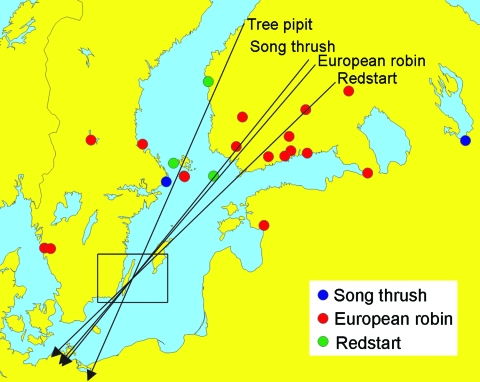
Autumn migration directions (arrows) of tree pipits (Anthus trivialis), robins (Erithacus rubecula), redstarts (Phoenicurus phoenicurus), and song thrushes (Turdus philomelos) banded in southeastern Sweden (area indicated by a square) and recovered within 60 days. Directions: Tree pipit, 203.6º, mean vector length = 0.993, n = 10; robin, 220.5º, mean vector length = 0.928, n = 293; redstart, 225.9º, mean vector length = 0.975, n = 52; and song thrush, 218.8º, mean vector length = 0.947, n = 117. Recovery sites of birds banded in southeastern Sweden and reported from areas north of the banding sites in a following year are also shown as indicated in the legend (no recovery from breeding areas is available for tree pipit).
References
-
- Ecker M, Allison SL, Meixner T, Heinz FX. Sequence analysis and genetic classification of tick-borne encephalitis viruses from Europe and Asia. J Gen Virol. 1999;80:179–85. - PubMed
-
- Monath TP, Heinz FX. Flaviviruses. In: Fields BN, Knipe DM, Howley PM, editors. Fields virology, 3rd ed. Philadelphia: Lippincot-Raven Publishers; 1996. p. 961–1034.
-
- Schrader C, Süss J. A nested RT-PCR for detection of tick-borne encephalitis virus (TBEV) in ticks in natural foci. Zentralbl Bakteriol. 1999;289:319–28. - PubMed
Publication types
MeSH terms
LinkOut - more resources
Full Text Sources