


DSM-IV conduct disorder criteria as predictors of antisocial personality disorder
- PMID: 17954138
- PMCID: PMC2764329
- DOI: 10.1016/j.comppsych.2007.04.009
DSM-IV conduct disorder criteria as predictors of antisocial personality disorder
Abstract
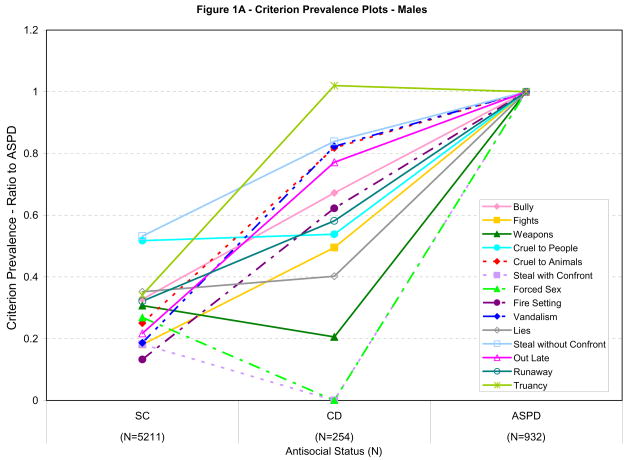
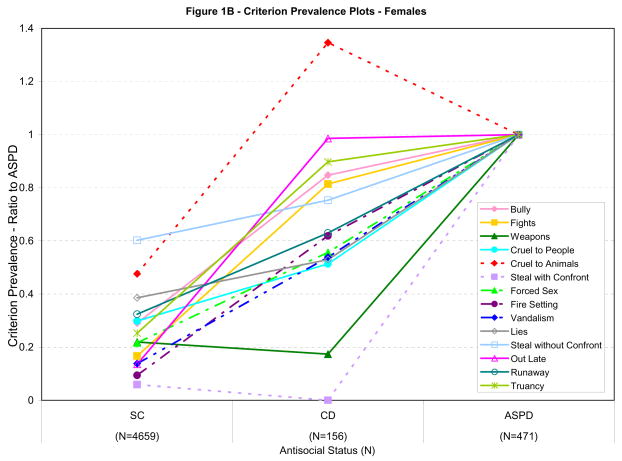
Conduct disorder (CD) is a disorder of childhood and adolescence defined by rule-breaking, aggressive, and destructive behaviors. For some individuals, CD signals the beginning of a lifelong persistent pattern of antisocial behavior (antisocial personality disorder [ASPD]), whereas for other people, these behaviors either desist or persist at a subclinical level. It has generally been accepted that about 40% of individuals with CD persist. This study examined the rate of persistence of Diagnostic and Statistical Manual of Mental Disorders, Fourth Edition (DSM-IV) CD into ASPD and the utility of individual DSM-IV CD symptom criteria for predicting this progression. We used the nationally representative sample from the National Epidemiologic Survey on Alcohol and Related Conditions (NESARC). Approximately 75% of those with CD also met criteria for ASPD. Individual CD criteria differentially predicted severity and persistence of antisocial behavior with victim-oriented, aggressive behaviors generally being more predictive of persistence. Contrary to previous estimates, progression from CD to ASPD was the norm and not the exception in this sample. Relationships between individual DSM-IV CD symptom criteria and persistent antisocial outcomes are discussed. These findings may be relevant to the development of DSM-V.
Figures
References
-
- Robins LN. Deviant children grown up. Baltimore: Williams & Wilkins; 1966.
-
- Eaves LJ, Silberg JL, Hewitt JK, Rutter M, Meyer JM, Neale MC, et al. Analyzing twin resemblance in multisymptom data: genetic applications of a latent class model for symptoms of conduct disorder in juvenile boys. Behav Genet. 1993;23(1):5–19. - PubMed
-
- Farrington DP, Wikstrom P-OH. Criminal careers in London and Stockholm: A cross-national comparative study. In: Weitekamp EGM, Kerner HJ, editors. Cross-national longitudinal research on human development and criminal behavior. Netherlands: Kluwer Academic Publishers; 1994. pp. 65–89.
-
- Farrington DP, Loeber R, Elliot DS, Hawkins DJ, Kandel DB, Klein MW, et al. Advancing knowledge about the onset of delinquency and crime. In: Lahey B, Kazdin A, editors. Advances in clinical child psychology. New York: Plenum Press; 1990. pp. 231–342.
-
- Brooner RK, Schmidt CW, Felch LJ, Bigelow GE. Antisocial behavior of intravenous drug abusers: implications for diagnosis of antisocial personality disorder. Am J Psychiatry. 1992 Apr;149(4):482–7. - PubMed
Publication types
MeSH terms
Grants and funding
LinkOut - more resources
Full Text Sources
Miscellaneous
