The global impact of income inequality on health by age: an observational study
- PMID: 17954512
- PMCID: PMC2043415
- DOI: 10.1136/bmj.39349.507315.DE
The global impact of income inequality on health by age: an observational study
Abstract
Objectives: To explore whether the apparent impact of income inequality on health, which has been shown for wealthier nations, is replicated worldwide, and whether the impact varies by age.
Design: Observational study.
Setting: 126 countries of the world for which complete data on income inequality and mortality by age and sex were available around the year 2002 (including 94.4% of world human population).
Data sources: Data on mortality were from the World Health Organization and income data were taken from the annual reports of the United Nations Development Programme.
Main outcome measures: Mortality in 5-year age bands for each sex by income inequality and income level.
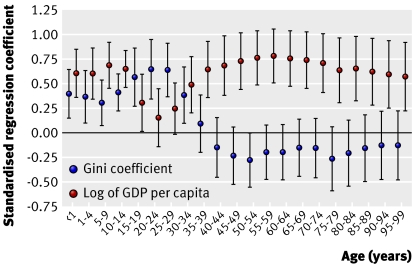
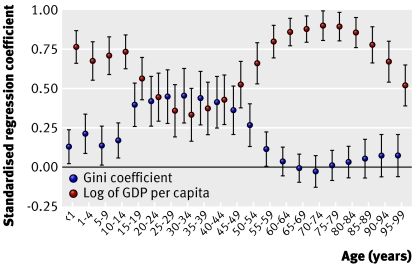
Results: At ages 15-29 and 25-39 variations in income inequality seem more closely correlated with mortality worldwide than do variations in material wealth. This relation is especially strong among the poorest countries in Africa. Mortality is higher for a given level of overall income in more unequal nations.
Conclusions: Income inequality seems to have an influence worldwide, especially for younger adults. Social inequality seems to have a universal negative impact on health.
Conflict of interest statement
Competing interests: All authors are in their 30s and are currently seeking the “bubble reputation” (
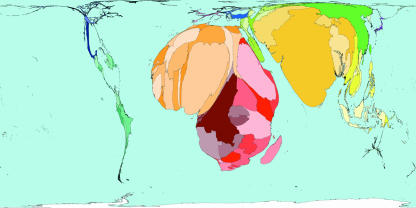
Figures
Comment in
-
Equitable access to health care.BMJ. 2007 Oct 27;335(7625):833-4. doi: 10.1136/bmj.39371.586076.80. Epub 2007 Oct 22. BMJ. 2007. PMID: 17954517 Free PMC article.
References
-
- Hales S, Howden-Chapman P, Salmond C, Woodward A, Mackenbach J. National infant mortality rates in relation to gross national product and distribution of income. Lancet 1999;354:2047. - PubMed
-
- Lynch J, Smith GD, Hillemeier M, Shaw M, Raghunathan T, Kaplan G. Income inequality, the psychosocial environment, and health: comparisons of wealthy nations. Lancet 2001;358:194-200. - PubMed
Publication types
MeSH terms
LinkOut - more resources
Full Text Sources