


A guide to modern statistical analysis of immunological data
- PMID: 17963513
- PMCID: PMC2234437
- DOI: 10.1186/1471-2172-8-27
A guide to modern statistical analysis of immunological data
Abstract
Background: The number of subjects that can be recruited in immunological studies and the number of immunological parameters that can be measured has increased rapidly over the past decade and is likely to continue to expand. Large and complex immunological datasets can now be used to investigate complex scientific questions, but to make the most of the potential in such data and to get the right answers sophisticated statistical approaches are necessary. Such approaches are used in many other scientific disciplines, but immunological studies on the whole still use simple statistical techniques for data analysis.
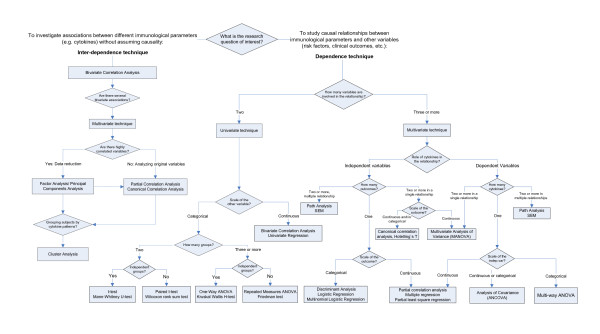
Results: The paper provides an overview of the range of statistical methods that can be used to answer different immunological study questions. We discuss specific aspects of immunological studies and give examples of typical scientific questions related to immunological data. We review classical bivariate and multivariate statistical techniques (factor analysis, cluster analysis, discriminant analysis) and more advanced methods aimed to explore causal relationships (path analysis/structural equation modelling) and illustrate their application to immunological data. We show the main features of each method, the type of study question they can answer, the type of data they can be applied to, the assumptions required for each method and the software that can be used.
Conclusion: This paper will help the immunologist to choose the correct statistical approach for a particular research question.
Figures
References
-
- Hollander M, Wolfe DA. Nonparametric Statistical Methods. 2. Wiley; 1999.
Publication types
MeSH terms
Substances
Grants and funding
LinkOut - more resources
Full Text Sources
Miscellaneous
