Comparative Study
. 2007 Dec;152(8):1185-95.
doi: 10.1038/sj.bjp.0707518. Epub 2007 Oct 29.

Antagonism of thromboxane receptors by diclofenac and lumiracoxib

Affiliations
Comparative Study

Antagonism of thromboxane receptors by diclofenac and lumiracoxib

E Selg et al. Br J Pharmacol. 2007 Dec.

Erratum in

  • Br J Pharmacol. 2008 Apr;153(8):1763. Ambrosio, E [corrected to Ambrosio, M]

Abstract

Background and purpose: Non-steroidal anti-inflammatory drugs (NSAIDs) are analgesic and anti-inflammatory by virtue of inhibition of the cyclooxygenase (COX) reaction that initiates biosynthesis of prostaglandins. Findings in a pulmonary pharmacology project gave rise to the hypothesis that certain members of the NSAID class might also be antagonists of the thromboxane (TP) receptor.

Experimental approach: Functional responses due to activation of the TP receptor were studied in isolated airway and vascular smooth muscle preparations from guinea pigs and rats as well as in human platelets. Receptor binding and activation of the TP receptor was studied in HEK293 cells.

Key results: Diclofenac concentration-dependently and selectively inhibited the contraction responses to TP receptor agonists such as prostaglandin D2 and U-46619 in the tested smooth muscle preparations and the aggregation of human platelets. The competitive antagonism of the TP receptor was confirmed by binding studies and at the level of signal transduction. The selective COX-2 inhibitor lumiracoxib shared this activity profile, whereas a number of standard NSAIDs and other selective COX-2 inhibitors did not.

Conclusions and implications: Diclofenac and lumiracoxib, in addition to being COX unselective and highly COX-2 selective inhibitors, respectively, displayed a previously unknown pharmacological activity, namely TP receptor antagonism. Development of COX-2 selective inhibitors with dual activity as potent TP antagonists may lead to coxibs with improved cardiovascular safety, as the TP receptor mediates cardiovascular effects of thromboxane A2 and isoprostanes.


Figures
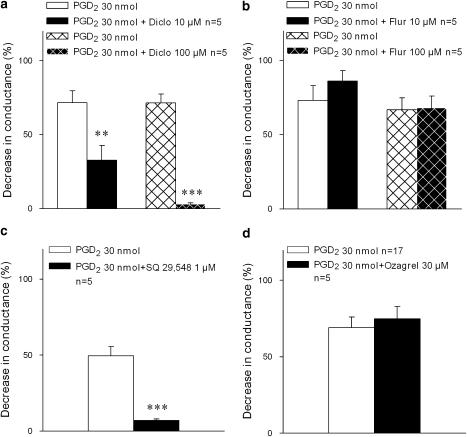
Figure 1
Figure 1
Antagonism by diclofenac of PGD2-induced bronchoconstriction in isolated perfused and ventilated guinea pig lungs. Bronchoconstriction induced by a single dose of PGD2, administered intravascularly to the isolated, perfused and ventilated guinea pig lungs; effect of pretreatment with COX inhibitors, (a) diclofenac (Diclo) or (b) flurbiprofen (Flur) with the selective TP receptor antagonist SQ 29548 (c) or with the TX synthase inhibitor ozagrel (d). Bronchoconstriction (mean±s.e.) is expressed as percent decrease in airway conductance related to baseline. **P<0.01; ***P<0.001. COX, cyclooxygenase; PGD2, prostaglandin D2; s.e., standard error.
Figure 2
Figure 2
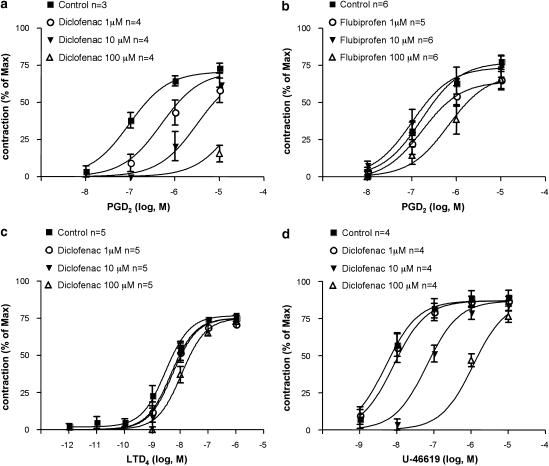
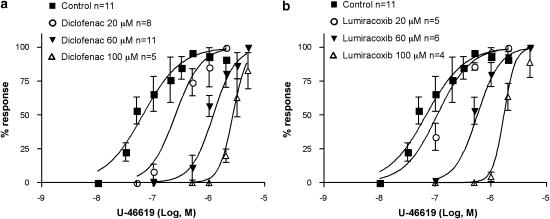
Antagonism by diclofenac of guinea pig airway smooth-muscle contractions induced by PGD2 and the TX mimetic U-46619. Contractions induced by challenges with cumulatively increasing concentrations of PGD2 in guinea pig tracheal rings, pretreated with 10 μM flurbiprofen, (a) effect of diclofenac (pA2=6.7±0.28 s.e.) and (b) lack of effect of flurbiprofen; (c) lack of the effect of diclofenac on airway smooth-muscle contractions induced by challenges with cumulatively increasing concentrations of leukotriene D4 in guinea pig tracheal rings pretreated with 10 μM flurbiprofen. (d) Effect of diclofenac (pA2=5.83±0.16 s.e.) on airway smooth-muscle contractions evoked by challenges with cumulatively increasing the concentrations of the selective TP receptor agonist U-46619 in guinea pig tracheal rings pretreated with 10 μM flurbiprofen. Airway smooth-muscle contractions (mean±s.e.) are expressed as percent of a maximal contraction induced with 40 mM KCl at the end of the experiments. LTD4, leukotriene D4; PGD2, prostaglandin D2; s.e., standard error.
Figure 3
Figure 3
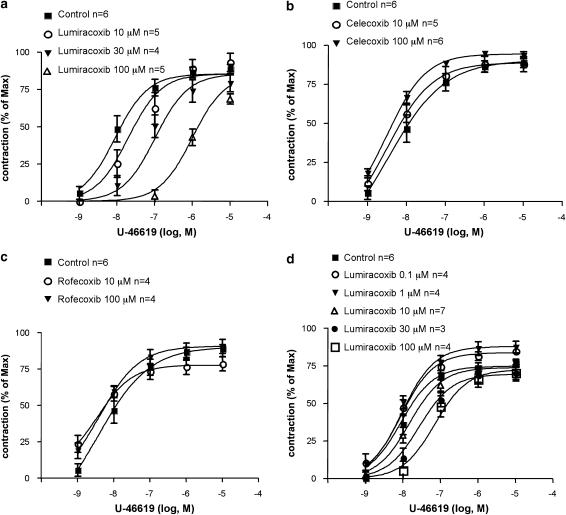
Antagonism by lumiracoxib of guinea pig airway smooth-muscle contractions induced by the TX mimetic U-46619. (ac) Contractions induced by challenges with cumulatively increasing concentrations of U-46619 in guinea pig tracheal rings pretreated with 10 μM flurbiprofen; (a) effect of lumiracoxib (pA2=5.05±0.11 s.e.). Lack of inhibitory effect of two other selective COX-2 inhibitors, celecoxib(b) and rofecoxib (c). (d) Contractions induced by challenges with cumulatively increasing concentrations of U-46619 in na¿ve (untreated) guinea pig tracheal rings; effect of lumiracoxib (pA2=4.8±0.13 s.e.). Airway smooth-muscle contractions (mean±s.e.) are expressed as percent of a maximal contraction induced with 40 mM KCl at the end of the experiments. COX-2, cyclooxygenase 2; s.e., standard error.
Figure 4
Figure 4
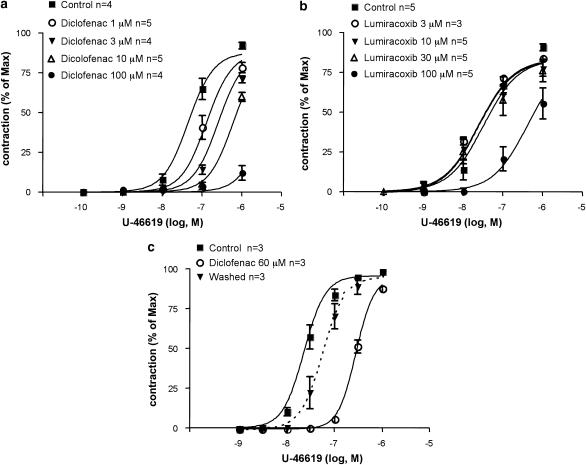
Antagonism by diclofenac and lumiracoxib of guinea pig and rat vascular smooth-muscle contractions induced by the TX mimetic U-46619. Contractions of vascular smooth muscle induced by challenges with cumulatively increasing concentrations of U-46619 in guinea pig (ab) and rat (c) aortic rings pretreated with 10 μM indomethacin; (a) effect of diclofenac (pA2=6.33±0.11 s.e.) and (b) lumiracoxib (pA2=4.4±0.10 s.e.); (c) contractions of rat aortic rings challenged with cumulatively increasing concentrations of U-46619 in the absence (EC50=25 nM±8 % CV) or the presence (EC50=285 nM±8 % CV) of 60 μM diclofenac. Partial reversibility of the effect of diclofenac after drug removal by change of media (U-46619, EC50=57 nM±9 % CV). Vascular smooth-muscle contractions (mean±s.e.) are expressed as percent of a maximal contraction induced with 40 mM KCl at the end of the experiments. CV, coefficient of variation; s.e., standard error.
Figure 5
Figure 5
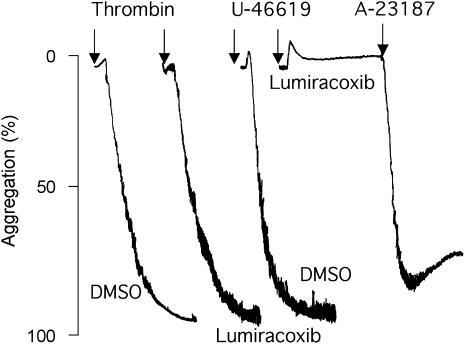
Representative experiments of aggregation of human aspirin-treated platelets (see Methods). Challenge with thrombin in the presence of solvent (DMSO) or lumiracoxib (60 μM) (left panel). Challenge with U-46619 in the presence of DMSO or lumiracoxib (60 μM). After response to U-46619 was blocked by lumiracoxib, the preparation responded to ionophore (3 μM) (right panel). DMSO, dimethylsulphoxide.
Figure 6
Figure 6
Antagonism by diclofenac and lumiracoxib of platelet aggregation induced by the TX mimetic U-46619. Aggregation of washed human platelets induced by challenges with increasing concentrations of the TX analogue U-46619; (a) effect of diclofenac (pA2=4.97±0.09 s.e.) and (b) lumiracoxib (pA2=4.60±0.06 s.e.). Gaddum–Schild analysis indicated a Schild slope of 1.6 for diclofenac and 2.3 for lumiracoxib, statistically different from 1, indicating that the effect of diclofenac and lumiracoxib cannot be defined as a pure competitive receptor antagonism. Blood was collected in the presence of 1 mM acetylsalicylic acid. Platelet aggregation (mean) is expressed as percent of a maximal aggregation induced with U-46619 (0.5–1 μM). s.e., standard error.
Figure 7
Figure 7
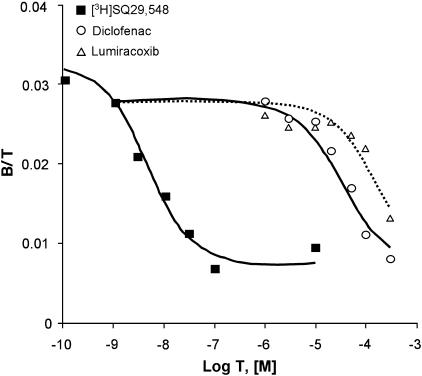
Equilibrium binding of [3H]SQ 29548 in HEK293 transiently expressing human TPα receptor. Mixed-type binding curve of SQ 29548 was generated using 0.1–1 nM [3H]SQ 29548 (saturation part of the curve) and 3 nM–10 μM of the homologous ligand (Kd=4.47 nM±36 % CV) (competition part of the curve). Heterologous competition curves were performed using 1 nM [3H]SQ 29548 and 1–300 μM of diclofenac (Ki=26.5 μM±29 % CV) or lumiracoxib (Ki=122 μM±33 % CV). Binding is expressed as the ratio of bound ligand concentration over total ligand concentration, (B/T, dimensionless), vs the logarithm of total ligand concentration (log T). B (in M) is the sum of ‘hot', ‘cold' and nonspecific binding; T (in M) is the sum of ‘hot' and ‘cold' ligand incubated. Experiments, performed in duplicate, and were analysed simultaneously with LIGAND. CV, coefficient of variation; HEK293, human embryonic kidney cell line 293.

References

    1. Audoly LP, Rocca B, Fabre JE, Koller BH, Thomas D, Loeb AL, et al. Cardiovascular responses to the isoprostanes iPF(2alpha)-III and iPE(2)-III are mediated via the thromboxane A(2) receptor in vivo. Circulation. 2000;101:2833–2840. - PubMed
    1. Bombardier C, Laine L, Reicin A, Shapiro D, Burgos-Vargas R, Davis B, et al. Comparison of upper gastrointestinal toxicity of rofecoxib and naproxen in patients with rheumatoid arthritis. VIGOR Study Group. N Engl J Med. 2000;343:1520–1528. - PubMed
    1. Born GV, Cross MJ. The aggregation of blood platelets. J Physiol. 1963;168:178–195. - PMC - PubMed
    1. Bresalier RS, Sandler RS, Quan H, Bolognese JA, Oxenius B, Horgan K, et al. Cardiovascular events associated with rofecoxib in a colorectal adenoma chemoprevention trial. N Engl J Med. 2005;352:1092–1102. - PubMed
    1. Capra V, Habib A, Accomazzo MR, Ravasi S, Citro S, Levy-Toledano S, et al. Thromboxane prostanoid receptor in human airway smooth muscle cells: a relevant role in proliferation. Eur J Pharmacol. 2003;474:149–159. - PubMed

Publication types

MeSH terms