


A brief opportunity to run does not function as a reinforcer for mice selected for high daily wheel-running rates
- PMID: 17970415
- PMCID: PMC1986434
- DOI: 10.1901/jeab.2007.62-06
A brief opportunity to run does not function as a reinforcer for mice selected for high daily wheel-running rates
Abstract
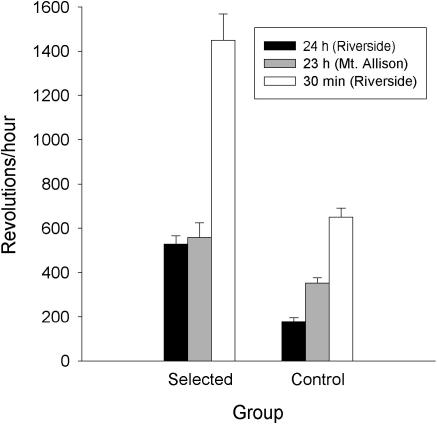
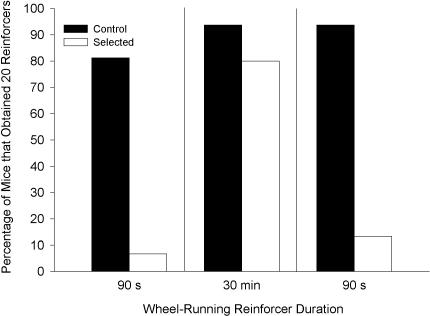
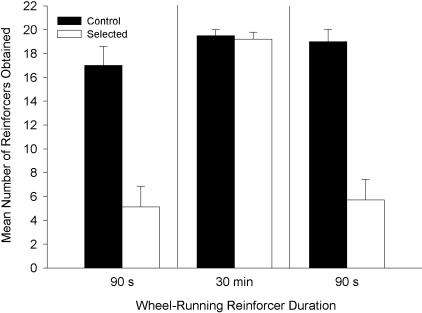
Mice from replicate lines, selectively bred based on high daily wheel-running rates, run more total revolutions and at higher average speeds than do mice from nonselected control lines. Based on this difference it was assumed that selected mice would find the opportunity to run in a wheel a more efficacious consequence. To assess this assumption within an operant paradigm, mice must be trained to make a response to produce the opportunity to run as a consequence. In the present study an autoshaping procedure was used to compare the acquisition of lever pressing reinforced by the opportunity to run for a brief opportunity (i.e., 90 s) between selected and control mice and then, using an operant procedure, the effect of the duration of the opportunity to run on lever pressing was assessed by varying reinforcer duration over values of 90 s, 30 min, and 90 s. The reinforcement schedule was a ratio schedule (FR 1 or VR 3). Results from the autoshaping phase showed that more control mice met a criterion of responses on 50% of trials. During the operant phase, when reinforcer duration was 90 s, almost all control, but few selected mice completed a session of 20 reinforcers; however, when reinforcer duration was increased to 30 min almost all selected and control mice completed a session of 20 reinforcers. Taken together, these results suggest that selective breeding based on wheel-running rates over 24 hr may have altered the motivational system in a way that reduces the reinforcing value of shorter running durations. The implications of this finding for these mice as a model for attention deficit hyperactivity disorder (ADHD) are discussed. It also is proposed that there may be an inherent trade-off in the motivational system for activities of short versus long duration.
Figures
Similar articles
-
Effect of sucrose availability and pre-running on the intrinsic value of wheel running as an operant and a reinforcing consequence.Behav Processes. 2014 Mar;103:35-42. doi: 10.1016/j.beproc.2013.11.010. Epub 2013 Dec 1. Behav Processes. 2014. PMID: 24295809
-
Effect of amphetamine dose on wheel-running functioning as reinforcement or operant behavior on a multiple schedule of reinforcement.Behav Pharmacol. 2019 Oct;30(7):588-595. doi: 10.1097/FBP.0000000000000493. Behav Pharmacol. 2019. PMID: 31206370
-
Running and responding reinforced by the opportunity to run: effect of reinforcer duration.J Exp Anal Behav. 1997 May;67(3):337-51. doi: 10.1901/jeab.1997.67-337. J Exp Anal Behav. 1997. PMID: 9163938 Free PMC article.
-
Effect of sucrose availability on wheel-running as an operant and as a reinforcing consequence on a multiple schedule: Additive effects of extrinsic and automatic reinforcement.Behav Processes. 2015 Jul;116:1-7. doi: 10.1016/j.beproc.2015.04.011. Epub 2015 Apr 25. Behav Processes. 2015. PMID: 25921837
-
Comparing extinction and contrast effects for operant wheel running and lever pressing on a multiple schedule.Behav Processes. 2024 Feb;215:104991. doi: 10.1016/j.beproc.2024.104991. Epub 2024 Jan 20. Behav Processes. 2024. PMID: 38253111
Cited by
-
Genetic approaches in comparative and evolutionary physiology.Am J Physiol Regul Integr Comp Physiol. 2015 Aug 1;309(3):R197-214. doi: 10.1152/ajpregu.00100.2015. Epub 2015 Jun 3. Am J Physiol Regul Integr Comp Physiol. 2015. PMID: 26041111 Free PMC article. Review.
-
Stimulus-food pairings produce stimulus-directed touch-screen responding in cynomolgus monkeys (macaca fascicularis) with or without a positive response contingency.J Exp Anal Behav. 2009 Jul;92(1):41-55. doi: 10.1901/jeab.2009.92-41. J Exp Anal Behav. 2009. PMID: 20119521 Free PMC article.
-
Physical Activity Modulates Common Neuroplasticity Substrates in Major Depressive and Bipolar Disorder.Neural Plast. 2017;2017:7014146. doi: 10.1155/2017/7014146. Epub 2017 Apr 26. Neural Plast. 2017. PMID: 28529805 Free PMC article. Review.
-
Dopaminergic dysregulation in mice selectively bred for excessive exercise or obesity.Behav Brain Res. 2010 Jul 11;210(2):155-63. doi: 10.1016/j.bbr.2010.02.016. Epub 2010 Feb 13. Behav Brain Res. 2010. PMID: 20156488 Free PMC article.
-
Oral antibiotics reduce voluntary exercise behavior in athletic mice.Behav Processes. 2022 Jun;199:104650. doi: 10.1016/j.beproc.2022.104650. Epub 2022 Apr 30. Behav Processes. 2022. PMID: 35504410 Free PMC article.
References
-
- Belke T.W. The effect of a change in body weight on running and responding reinforced by the opportunity to run. Psychological Record. 1996;46:421–433.
-
- Belke T.W. Responding for sucrose and wheel-running reinforcement: Effect of body weight manipulation. Behavioural Processes. 2004;65:189–199. - PubMed
-
- Belke T.W. Responding for sucrose and wheel-running reinforcement: Effect of prerunning. Behavioural Processes. 2006;71:1–7. - PubMed
Publication types
MeSH terms
LinkOut - more resources
Full Text Sources
Miscellaneous
