


Adult T-cell leukemia/lymphoma cells from blood and skin tumors express cytotoxic T lymphocyte-associated antigen-4 and Foxp3 but lack suppressor activity toward autologous CD8+ T cells
- PMID: 17970785
- PMCID: PMC11158631
- DOI: 10.1111/j.1349-7006.2007.00646.x
Adult T-cell leukemia/lymphoma cells from blood and skin tumors express cytotoxic T lymphocyte-associated antigen-4 and Foxp3 but lack suppressor activity toward autologous CD8+ T cells
Abstract
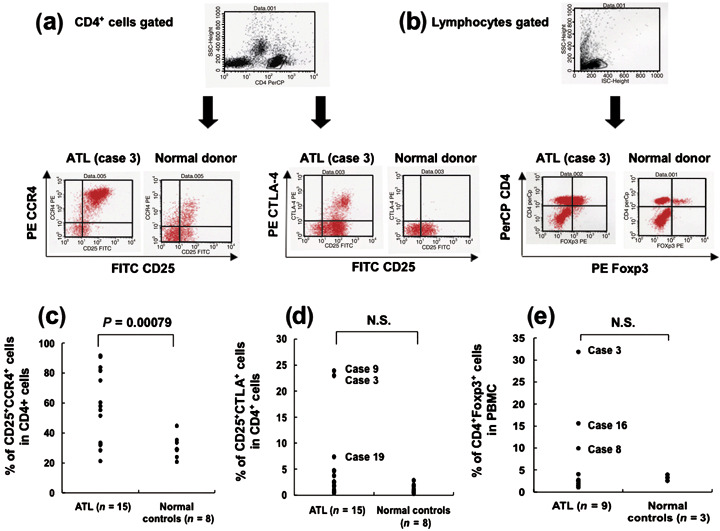
Adult T cell leukemia/lymphoma (ATL) cells share the CD4(+)CD25(+) phenotype with regulatory T (Treg) cells. However, it is still controversial whether ATL cells are Treg cells. The aim of the present study was to investigate the Treg nature of ATL cells obtained from peripheral blood and skin tumors in terms of their phenotype and function. By flow cytometry and immunohistochemistry, the expression of the Treg-associated molecule cytotoxic T lymphocyte-associated antigen (CTLA)-4 and Foxp3 was examined in freshly isolated circulating and skin-infiltrating tumor cells from 21 ATL patients with skin eruptions. The expression of CTLA-4 on freshly isolated circulating tumor cells was elevated in two of 15 patients, and Foxp3 was expressed intracytoplasmically at high levels in three of nine patients. In five of the patients examined, skin-infiltrating tumor cells bore variously elevated CTLA-4 with high Foxp3 expression. The potentiality of ATL cells as Treg cells was further addressed by stimulating ATL cells with anti-CD3/CD28 monoclonal antibodies and monitoring CTLA-4 expression. With the stimulation, even CTLA-4-low ATL cells expressed higher levels of CTLA-4 than normal CD4(+)CD25(+) cells. To study function, ATL cells isolated from blood and skin tumors were tested for their ability to suppress the proliferation of autologous CD8(+) T cells stimulated with allogeneic lymphocytes. Despite the expression of CTLA-4 and Foxp3, these tumors were incapable of suppressing the proliferation of autologous CD8(+) T cells. ATL cells are phenotypically Treg cells in at least some patients, but lack immunoregulatory functions, at least toward CD8(+) T cells.
Figures


References
-
- Uchiyama T, Yodoi J, Sagawa K, Takatsuki K, Uchino H. Adult T‐cell leukemia: clinical and hematologic features of 16 cases. Blood 1977; 50: 481–92. - PubMed
-
- Blattner WA. Human retroviruses: their role in cancer. Proc Assoc Am Physicians 1999; 111: 563–72. - PubMed
-
- Edlich RF, Arnette JA, Williams FM. Global epidemic of human T‐cell lymphotropic virus type‐I (HTLV‐I). J Emerg Med 2000; 18: 109–19. - PubMed
-
- Shimoyama M, Members of the Lymphoma Study Group (1984–87) . Diagnostic criteria and classification of clinical subtypes of adult T‐cell leukaemia‐lymphoma: a report from Lymphoma Study Group 1984–87. Br J Haematol 1991; 79: 428–37. - PubMed
Publication types
MeSH terms
Substances
LinkOut - more resources
Full Text Sources
Medical
Research Materials
