


Assessment of knowledge retention and the value of proctored ultrasound exams after the introduction of an emergency ultrasound curriculum
- PMID: 17971234
- PMCID: PMC2223143
- DOI: 10.1186/1472-6920-7-40
Assessment of knowledge retention and the value of proctored ultrasound exams after the introduction of an emergency ultrasound curriculum
Abstract
Background: Optimal training required for proficiency in bedside ultrasound is unknown. In addition, the value of proctored training is often assumed but has never been quantified.
Methods: To compare different training regimens for both attending physicians and first year residents (interns), a prospective study was undertaken to assess knowledge retention six months after an introductory ultrasound course. Eighteen emergency physicians and twelve emergency medicine interns were assessed before and 6 months after an introductory ultrasound course using a standardized, image-based ultrasound test. In addition, the twelve emergency medicine interns were randomized to a group which received additional proctored ultrasound hands-on instruction from qualified faculty or to a control group with no hands-on instruction to determine if proctored exam training impacts ultrasound knowledge. Paired and unpaired estimates of the median shift in test scores between groups were made with the Hodges-Lehmann extension of the Wilcoxon-Mann-Whitney test.
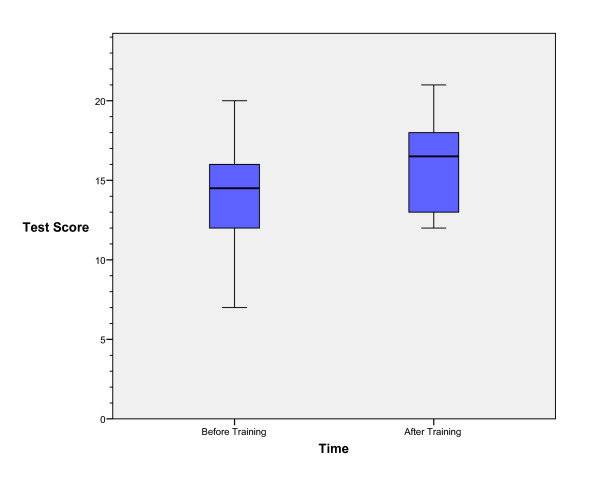
Results: Six months after the introductory course, test scores (out of a 24 point test) were a median of 2.0 (95% CI 1.0 to 3.0) points higher for residents in the control group, 5.0 (95% CI 3.0 to 6.0) points higher for residents in the proctored group, and 2.5 (95% CI 1.0 to 4.0) points higher for the faculty group. Residents randomized to undergo proctored ultrasound examinations exhibited a higher score improvement than their cohorts who were not with a median difference of 3.0 (95% CI 1.0 to 5.0) points.
Conclusion: We conclude that significant improvement in knowledge persists six months after a standard introductory ultrasound course, and incorporating proctored ultrasound training into an emergency ultrasound curriculum may yield even higher knowledge retention.
Figures


References
Publication types
MeSH terms
LinkOut - more resources
Full Text Sources
