The Veterans Health Administration and military sexual trauma
- PMID: 17971558
- PMCID: PMC2089100
- DOI: 10.2105/AJPH.2006.092999
The Veterans Health Administration and military sexual trauma
Abstract
Objectives: We examined the utility of the Veterans Health Administration (VHA) universal screening program for military sexual violence.
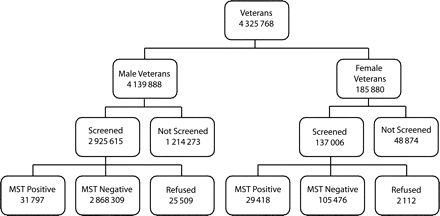
Methods: We analyzed VHA administrative data for 185,880 women and 4139888 men who were veteran outpatients and were treated in VHA health care settings nationwide during 2003.
Results: Screening was completed for 70% of patients. Positive screens were associated with greater odds of virtually all categories of mental health comorbidities, including posttraumatic stress disorder (adjusted odds ratio [AOR]=8.83; 99% confidence interval [CI] = 8.34, 9.35 for women; AOR = 3.00; 99% CI = 2.89, 3.12 for men). Associations with medical comorbidities (e.g., chronic pulmonary disease, liver disease, and for women, weight conditions) were also observed. Significant gender differences emerged.
Conclusions: The VHA policies regarding military sexual trauma represent a uniquely comprehensive health care response to sexual trauma. Results attest to the feasibility of universal screening, which yields clinically significant information with particular relevance to mental health and behavioral health treatment. Women's health literature regarding sexual trauma will be particularly important to inform health care services for both male and female veterans.
Figures
References
-
- Lipari RN, Lancaster AR. Armed Forces 2002 Sexual Harassment Survey. Arlington, Va: Defense Manpower Data Center; 2003.
-
- Vogt DS, Pless AP, King LA, King DW. Deployment stressors, gender, and mental health outcomes among Gulf War I veterans. J Trauma Stress. 2005; 18(2):115–127. - PubMed
-
- Kessler RC, Sonnega A, Bromet E, Hughes M, Nelson CB. Posttraumatic stress disorder in the National Comorbidity Survey. Arch Gen Psych. 1995;52: 1048–1060. - PubMed
-
- Wolfe J, Sharkansky EJ, Read JP, Dawson R, Martin JA, Ouimette PC. Sexual harassment and assault as predictors of PTSD symptomatology among US female Persian Gulf War military personnel. J Interpers Viol. 1998;13(1):40–57.
-
- Kang H, Dalager N, Mahan C, Ishii E. The role of sexual assault on the risk of PTSD among Gulf War veterans. Ann Epidemiol. 2005;15(3):191–195. - PubMed
Publication types
MeSH terms
LinkOut - more resources
Full Text Sources
Medical