


Analysis of post-operative pain patterns following total lumbar disc replacement: results from fluoroscopically guided spine infiltrations
- PMID: 17972116
- PMCID: PMC2365532
- DOI: 10.1007/s00586-007-0519-3
Analysis of post-operative pain patterns following total lumbar disc replacement: results from fluoroscopically guided spine infiltrations
Abstract
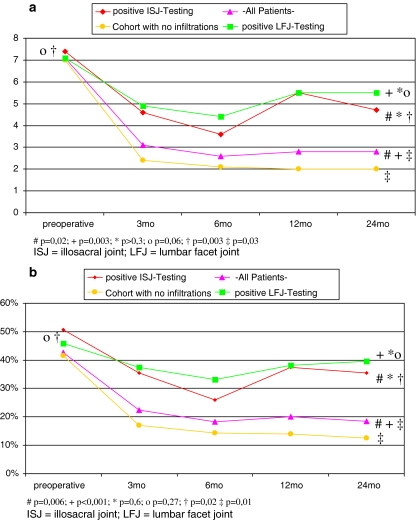
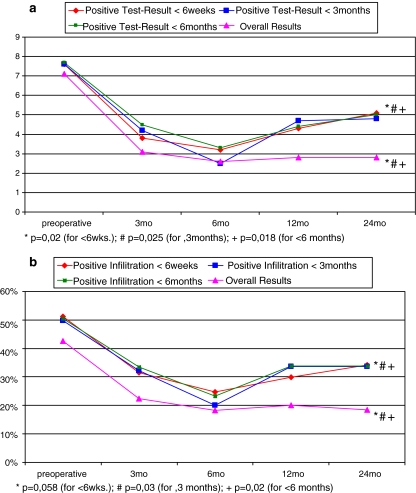
Although a variety of biomechanical laboratory investigations and radiological studies have highlighted the potential problems associated with total lumbar disc replacement (TDR), no previous study has performed a systematic clinical failure analysis. The aim of this study was to identify the post-operative pain sources, establish the incidence of post-operative pain patterns and investigate the effect on post-operative outcome with the help of fluoroscopically guided spine infiltrations in patients from an ongoing prospective study with ProDisc II. Patients who reported unsatisfactory results at any of the FU-examinations received fluoroscopically guided spine infiltrations as part of a semi-invasive diagnostic and conservative treatment program. Pain sources were identified in patients with reproducible (> or =2x) significant (50-75%) or highly significant (75-100%) pain relief. Results were correlated with outcome parameters visual analogue scale (VAS), Oswestry disability index (ODI) and the subjective patient satisfaction rate. From a total of 175 operated patients with a mean follow-up (FU) of 29.3 months (range 12.2-74.9 months), n = 342 infiltrations were performed in n = 58 patients (33.1%) overall. Facet joint pain, predominantly at the index level (86.4%), was identified in n = 22 patients (12.6%). The sacroiliac joint was a similarly frequent cause of post-operative pain (n = 21, 12.0%). Pain from both structures influenced all outcome parameters negatively (P < 0.05). Patients with an early onset of pain (< or =6 months) were 2-5x higher at risk of developing persisting complaints and unsatisfactory outcome at later FU-stages in comparison to the entire study cohort (P < 0.05). The level of TDR significantly influenced post-operative outcome. Best results were achieved for the TDRs above the lumbosacral junction at L4/5 (incidence of posterior joint pain 14.8%). Inferior outcome and a significantly higher incidence of posterior joint pain were observed for TDR at L5/S1 (21.6%) and bisegmental TDR at L4/5/S1 (33.3%), respectively. Lumbar facet and/or ISJ-pain are a frequent and currently underestimated source of post-operative pain and the most common reasons for unsatisfactory results following TDR. Further failure-analysis studies are required and adequate salvage treatment options need to be established with respect to the underlying pathology of post-operative pain. The question as to whether or not TDR will reduce the incidence of posterior joint pain, which has been previously attributed to lumbar fusion procedures, remains unanswered. Additional studies will have to investigate whether TDR compromises the index-segment in an attempt to avoid adjacent segment degeneration.
Figures
Similar articles
-
Total lumbar disc replacement: different results for different levels.Spine (Phila Pa 1976). 2007 Apr 1;32(7):782-90. doi: 10.1097/01.brs.0000259071.64027.04. Spine (Phila Pa 1976). 2007. PMID: 17414914 Clinical Trial.
-
Mid- to long-term results of total lumbar disc replacement: a prospective analysis with 5- to 10-year follow-up.Spine J. 2014 Aug 1;14(8):1417-31. doi: 10.1016/j.spinee.2013.08.028. Epub 2014 Jan 18. Spine J. 2014. PMID: 24448028
-
Motion preservation following total lumbar disc replacement at the lumbosacral junction: a prospective long-term clinical and radiographic investigation.Spine J. 2018 Jan;18(1):72-80. doi: 10.1016/j.spinee.2017.06.035. Epub 2017 Jun 30. Spine J. 2018. PMID: 28673830 Clinical Trial.
-
Mid- to long-term results of total disc replacement for lumbar degenerative disc disease: a systematic review.J Orthop Surg Res. 2018 Dec 26;13(1):326. doi: 10.1186/s13018-018-1032-6. J Orthop Surg Res. 2018. PMID: 30585142 Free PMC article.
-
Stem fracture after total facet replacement in the lumbar spine: a report of two cases and review of the literature.Spine J. 2011 Jul;11(7):e15-9. doi: 10.1016/j.spinee.2011.06.002. Epub 2011 Jun 24. Spine J. 2011. PMID: 21703940 Review.
Cited by
-
Answer to the Letter to the Editor of Jianqiang Ni et al. concerning "Anterior stand-alone fusion revisited: a prospective clinical, X-ray and CT investigation" by Siepe C.J., et al. Eur Spine J (2014): DOI 10.1007/s00586-014-3642-y.Eur Spine J. 2015 Jun;24(6):1328-9. doi: 10.1007/s00586-015-3825-1. Epub 2015 Feb 28. Eur Spine J. 2015. PMID: 25724686 No abstract available.
-
Biomechanics of disc degeneration.Adv Orthop. 2012;2012:726210. doi: 10.1155/2012/726210. Epub 2012 Jun 17. Adv Orthop. 2012. PMID: 22745914 Free PMC article.
-
Chiropractic management of patients post-disc arthroplasty: eight case reports.Chiropr Osteopat. 2010 Apr 21;18:7. doi: 10.1186/1746-1340-18-7. Chiropr Osteopat. 2010. PMID: 20409327 Free PMC article.
-
Comparison of single-level L4-L5 versus L5-S1 lumbar disc replacement: results and prognostic factors.Eur Spine J. 2009 Jun;18 Suppl 1(Suppl 1):52-63. doi: 10.1007/s00586-009-0992-y. Epub 2009 Apr 29. Eur Spine J. 2009. PMID: 19404688 Free PMC article. Clinical Trial.
-
Circumferential dynamic stabilization of the lumbar spine: a biomechanical analysis.Eur Spine J. 2014 Nov;23(11):2330-9. doi: 10.1007/s00586-014-3286-y. Epub 2014 Apr 11. Eur Spine J. 2014. PMID: 24722881
References
-
- Bertagnoli R, Marnay T, Mayer HM (2003) The Prodisc book. Spine solutions GmbH, Tuttlingen
-
- Blumenthal S, McAfee PC, Guyer RD, Hochschuler SH, Geisler FH, Holt RT, Garcia R, Jr, Regan JJ, Ohnmeiss DD. A prospective, randomized, multicenter food and drug administration investigational device exemptions study of lumbar total disc replacement with the CHARITE artificial disc versus lumbar fusion: part I: evaluation of clinical outcomes. Spine. 2005;30:1565–1575. doi: 10.1097/01.brs.0000170587.32676.0e. - DOI - PubMed
MeSH terms
LinkOut - more resources
Full Text Sources
