Review
. 2008 Mar 1;586(5):1257-64.
doi: 10.1113/jphysiol.2007.145789. Epub 2007 Nov 1.

The output from human inspiratory motoneurone pools

Affiliations
Review

The output from human inspiratory motoneurone pools

Jane E Butler et al. J Physiol. .

Abstract

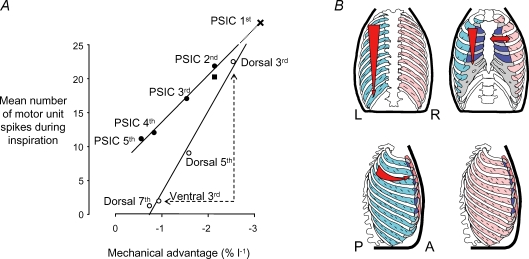
Survival requires adequate pulmonary ventilation which, in turn, depends on adequate contraction of muscles acting on the chest wall in the presence of a patent upper airway. Bulbospinal outputs projecting directly and indirectly to 'obligatory' respiratory motoneurone pools generate the required muscle contractions. Recent studies of the phasic inspiratory output of populations of single motor units to five muscles acting on the chest wall (including the diaphragm) reveal that the time of onset, the progressive recruitment, and the amount of motoneuronal drive (expressed as firing frequency) differ among the muscles. Tonic firing with an inspiratory modulation of firing rate is common in low intercostal spaces of the parasternal and external intercostal muscles but rare in the diaphragm. A new time and frequency plot has been developed to depict the behaviour of the motoneurone populations. The magnitude of inspiratory firing of motor unit populations is linearly correlated to the mechanical advantage of the intercostal muscle region at which the motor unit activity is recorded. This represents a 'neuromechanical' principle by which the CNS controls motoneuronal output according to mechanical advantage, presumably in addition to the Henneman's size principle of motoneurone recruitment. Studies of the genioglossus, an obligatory upper airway muscle that helps maintain airway patency, reveal that it receives simultaneous inspiratory, expiratory and tonic drives even during quiet breathing. There is much to be learned about the neural drive to pools of human inspiratory and expiratory muscles, not only during respiratory tasks but also in automatic and volitional tasks, and in diseases that alter the required drive.


Figures
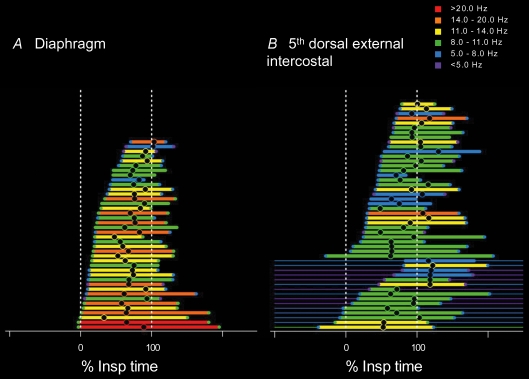
Figure 1
Figure 1. Time and frequency plot (TAFPLOT) of the discharge of motor units in two human inspiratory pump muscles
The firing time for each single motor unit recorded from the diaphragm (A) and the 5th dorsal external intercostal muscle (B) during quiet breathing, relative to the time of inspiration. For each unit, the thick horizontal line represents the time that the firing frequency increases in the inspiratory or expiratory phase of respiration. The thin horizontal line indicates tonic firing of the motor unit at other times. The units are ordered relative to their onset time. The colour of the thick horizontal line denotes the peak firing frequency (range 5–20 Hz; see colour scale). The onset and end firing frequencies are denoted by the coloured circles at the ends of the line. The time of the peak firing is indicated as a black circle. Data modified from Saboisky et al. (2007b) with permission of the American Physiological Society.
Figure 2
Figure 2. Neuromechanical matching in the human intercostal muscles
A, the mechanical advantage is plotted against the mean number of motor unit spikes during inspiration (i.e. neural drive) for different regions of the parasternal intercostals (•) and external intercostals (○). There is a strong linear relation between the mechanical advantage and neural drive for each muscle (r2= 0.99). The line for parasternal intercostals has been extrapolated to predict the mechanical advantage of the muscle fibres in the first space (marked as a cross). Note that the medial and lateral (marked as a square) portions of the 2nd parasternal intercostal muscle have a similar mechanical advantage. Note also that there is an appropriately low neural drive to the ventral portion of the 3rd external intercostals, which has a low mechanical advantage compared to the dorsal portion. This figure is modified from Gandevia et al. (2006). B, the gradients of mechanical advantage and inspiratory drive are shown schematically for the parasternal intercostals and the external intercostals. The letters L, R, P and A refer to left, right, posterior and anterior, respectively.
Figure 3
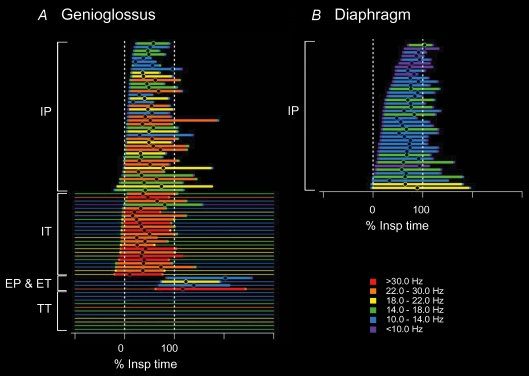
Figure 3. Time and frequency plot (TAFPLOT) of the discharge of motor units in the genioglossus and the diaphragm in humans
The firing time for populations of single motor units recorded in a group of subjects from the genioglossus, an upper airway muscle (A) and the diaphragm, a pump muscle (B) during quiet breathing, relative to the time of inspiration. For each unit, the thick horizontal line represents the time that the firing frequency increases in the inspiratory or expiratory phase of respiration. The thin horizontal line indicates tonic firing of the motor unit at other times. The units are ordered relative to time of the onset of their increased firing. Phasically firing units during inspiration (IP) are shown on top, followed below by tonically firing units that increased their discharge during inspiration (IT). Expiratory phasic and expiratory tonic units (EP and ET) are then shown followed by tonically firing units that did not increase their firing in time with respiration (TT). Data modified from Saboisky et al. (2007a, with permission of the American Physiological Society.

References

    1. Bailey EF, Fridel KW, Rice AD. Sleep/wake firing patterns of human genioglossus motor units. J Neurophysiol. 2007 in press. - PubMed
    1. Bellingham MC, Lipski J. Respiratory interneurons in the C5 segment of the spinal cord of the cat. Brain Res. 1990;533:141–146. - PubMed
    1. Butler JE, De Troyer A, Gandevia SC, Gorman RB, Hudson AL. Neuromechanical matching of central respiratory drive: a new principle of motor unit recruitment? Physiol News. 2007;67:22–24.
    1. Butler JE, McKenzie DK, Gandevia SC. Discharge frequencies of single motor units in human diaphragm and parasternal muscles in lying and standing. J Appl Physiol. 2001;90:147–154. - PubMed
    1. Colebatch JG, Adams L, Murphy K, Martin AJ, Lammertsma AA, Tochon-Danguy HJ, Clark JC, Friston KJ, Guz A. Regional cerebral blood flow during volitional breathing in man. J Physiol. 1991;443:91–103. - PMC - PubMed

Publication types

MeSH terms