


Steroid hormones act transsynaptically within the forebrain to regulate neuronal phenotype and song stereotypy
- PMID: 17978046
- PMCID: PMC6673362
- DOI: 10.1523/JNEUROSCI.3289-07.2007
Steroid hormones act transsynaptically within the forebrain to regulate neuronal phenotype and song stereotypy
Abstract
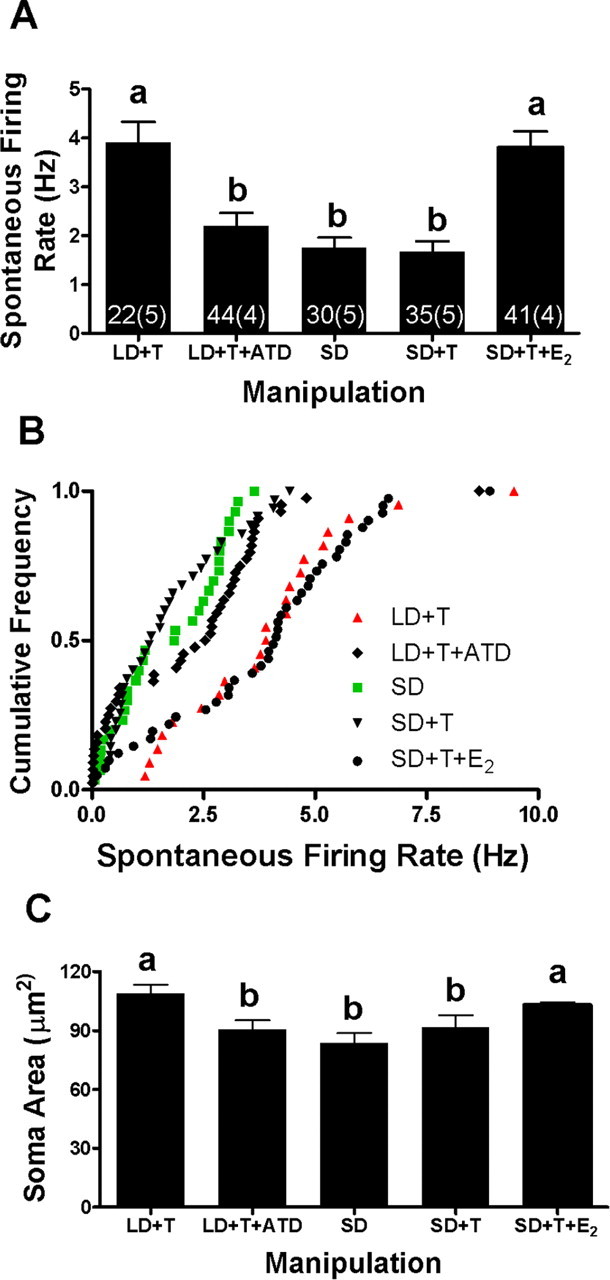
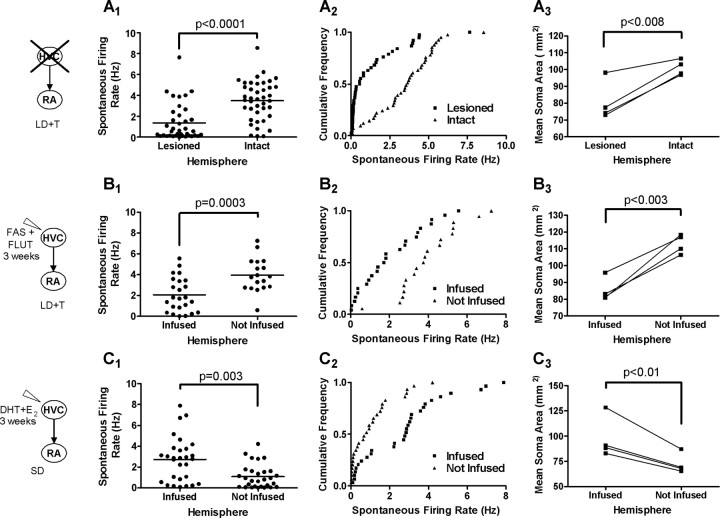
Steroid sex hormones induce dramatic seasonal changes in reproductive related behaviors and their underlying neural substrates in seasonally breeding vertebrates. For example, in adult white-crowned sparrows, increased Spring photoperiod raises circulating testosterone, causing morphological and electrophysiological changes in song-control nuclei, which modify song behavior for the breeding season. We investigated how photoperiod and steroid hormones induce these changes in morphology, electrophysiology, and behavior. Neurons in a song premotor nucleus, the robust nucleus of the arcopallium (RA), show increased intrinsic spontaneous firing rate and soma size when birds are in breeding condition. Using combinations of systemic and unilateral local intracerebral hormonal manipulations, we show that long-day photoperiod accelerates the effects of systemic testosterone on RA neurons via the estradiol-synthesizing enzyme aromatase (CYP19A1); these changes require inputs from the afferent song control nucleus HVC (used as a proper name) and steroid receptor activation within HVC; local coactivation of androgen and estrogen receptors (ARs and ERs, respectively) within HVC, but not RA, is sufficient to cause neuronal changes in RA; activation of ARs in RA is also permissive. Using bilateral local intracerebral hormone-receptor blockade, we found that ARs and ERs in the song-control nucleus HVC mediate systemic testosterone-induced changes in song stereotypy but not rate. This novel transsynaptic effect of gonadal steroids on activity and morphology of RA neurons is part of a concerted change in key premotor nuclei, enabling stereotyped song.
Figures




References
-
- Adret P, Margoliash D. Metabolic and neural activity in the song system nucleus robustus archistriatalis: effect of age and gender. J Comp Neurol. 2002;454:409–423. - PubMed
-
- Aguado F, Carmona MA, Pozas E, Aguiló A, Martínez-Guijarro FJ, Alcantara S, Borrell V, Yuste R, Ibañez CF, Soriano E. BDNF regulates spontaneous correlated activity at early developmental stages by increasing synaptogenesis and expression of the K+/Cl- co-transporter KCC2. Development. 2003;130:1267–1280. - PubMed
-
- Arnold AP, Nottebohm F, Pfaff DW. Hormone concentrating cells in vocal control and other areas of the brain of the zebra finch (Poephila guttata) J Comp Neurol. 1976;165:487–511. - PubMed
Publication types
MeSH terms
Substances
Grants and funding
LinkOut - more resources
Full Text Sources
