


Brain network dynamics during error commission
- PMID: 17979124
- PMCID: PMC2669663
- DOI: 10.1002/hbm.20478
Brain network dynamics during error commission
Abstract
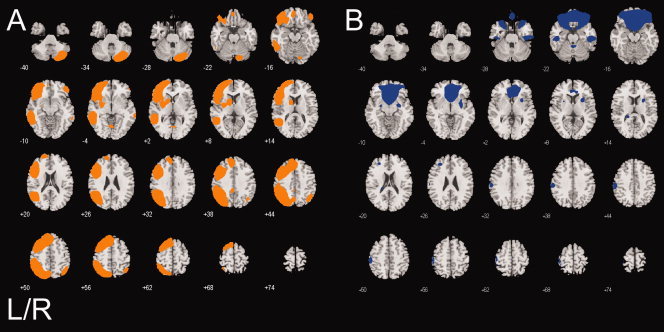
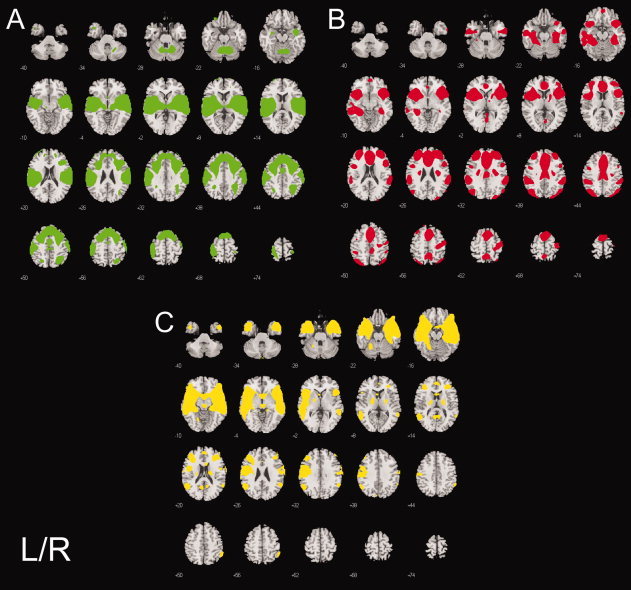
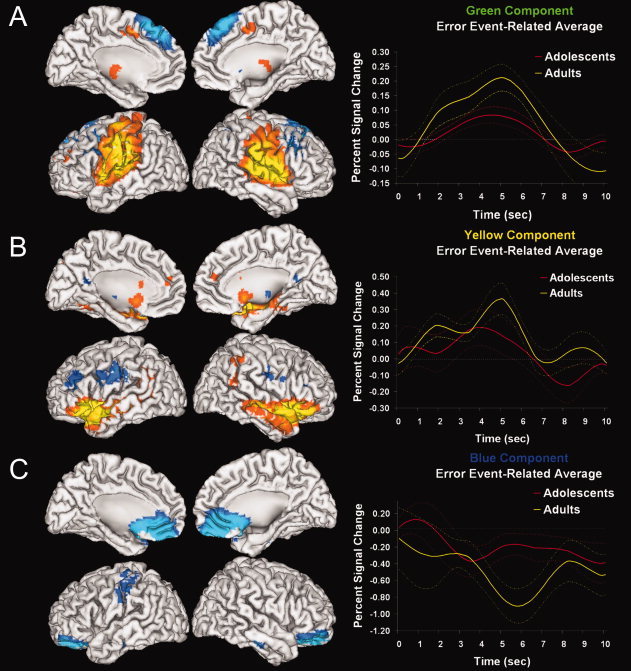
Previous studies suggest that the anterior cingulate and other prefrontal brain regions might form a functionally-integrated error detection network in the human brain. This study examined whole brain functional connectivity to both correct and incorrect button presses using independent component analysis (ICA) of functional magnetic resonance imaging (fMRI) data collected from 25 adolescent and 25 adult healthy participants (ages 11-37) performing a visual Go/No-Go task. Correct responses engaged a network comprising left lateral prefrontal cortex, left postcentral gyrus/inferior parietal lobule, striatum, and left cerebellum. In contrast, a similar network was uniquely engaged during errors, but this network was not integrated with activity in regions believed to be engaged for higher-order cognitive control over behavior. A medial/dorsolateral prefrontal-parietal neural network responded to all No-Go stimuli, but with significantly greater activity to errors. ICA analyses also identified a third error-related circuit comprised of anterior temporal lobe, limbic, and pregenual cingulate cortices, possibly representing an affective response to errors. There were developmental differences in error-processing activity within many of these neural circuits, typically reflecting greater hemodynamic activation in adults. These findings characterize the spatial structure of neural networks underlying error commission and identify neurobiological differences between adolescents and adults.
(c) 2007 Wiley-Liss, Inc.
Figures
References
-
- Ackermann H,Mathiak K,Ivry RB ( 2004): Temporal organization of “internal speech” as a basis for cerebellar modulation of cognitive functions. Behav Cogn Neurosci Rev 3: 14–22. - PubMed
-
- Bechtereva NP,Kropotov JD,Ponomarev VA,Etlinger SC ( 1990): In search of cerebral error detectors. Int J Psychophysiol 8: 261–273. - PubMed
-
- Bell AJ,Sejnowski TJ ( 1995): An information‐maximization approach to blind separation and blind deconvolution. Neural Comput 7: 1129–1159. - PubMed
-
- Bernstein PS,Scheffers MK,Coles MGH ( 1995): “Where did I go wrong?” A psychophysiological analysis of error detection. J Exp Psychol Hum Percept Perform 21: 1312–1322. - PubMed
-
- Booth JR,Burman DD,Meyer JR,Lei Z,Trommer BL,Davenport ND,Li W,Parrish TB,Gitelman DR,Mesulam MM ( 2003): Neural development of selective attention and response inhibition. Neuroimage 20: 737–751. - PubMed
Publication types
MeSH terms
Grants and funding
- 1 R01 MH070539-01/MH/NIMH NIH HHS/United States
- P50-AA12870/AA/NIAAA NIH HHS/United States
- 1 R01 MH071896-01/MH/NIMH NIH HHS/United States
- R01 AA015615/AA/NIAAA NIH HHS/United States
- R01 MH071896/MH/NIMH NIH HHS/United States
- R01 EB020407/EB/NIBIB NIH HHS/United States
- R01 MH085010/MH/NIMH NIH HHS/United States
- R01 EB005846/EB/NIBIB NIH HHS/United States
- R01 EB006841/EB/NIBIB NIH HHS/United States
- R01 MH070539/MH/NIMH NIH HHS/United States
- R01 EB000840/EB/NIBIB NIH HHS/United States
- K23/PHS HHS/United States
- R01 EB 000840/EB/NIBIB NIH HHS/United States
- R01 DA020709/DA/NIDA NIH HHS/United States
LinkOut - more resources
Full Text Sources
Medical
Miscellaneous
