


Review
doi: 10.1111/j.1600-065X.2007.00565.x.
'Yin-Yang' functions of transforming growth factor-beta and T regulatory cells in immune regulation
Affiliations
- PMID: 17979848
- PMCID: PMC2614905
- DOI: 10.1111/j.1600-065X.2007.00565.x
Item in Clipboard
Review
'Yin-Yang' functions of transforming growth factor-beta and T regulatory cells in immune regulation
Immunol Rev.
2007 Dec.
Abstract
Transforming growth factor-beta (TGF-beta) and forkhead box p3-expressing T-regulatory (Treg) cells are critical in maintaining self-tolerance and immune homeostasis. The immune suppressive functions of TGF-beta and Treg cells are widely acknowledged and extensively studied. Nonetheless, recent studies revealed the positive roles of TGF-beta and Treg cells in shaping the immune system and the inflammatory responses. This review discusses our and other's efforts in understanding the negative (Yin) as well as the positive (Yang) roles for TGF-beta and Treg cells in immune regulation.
Figures
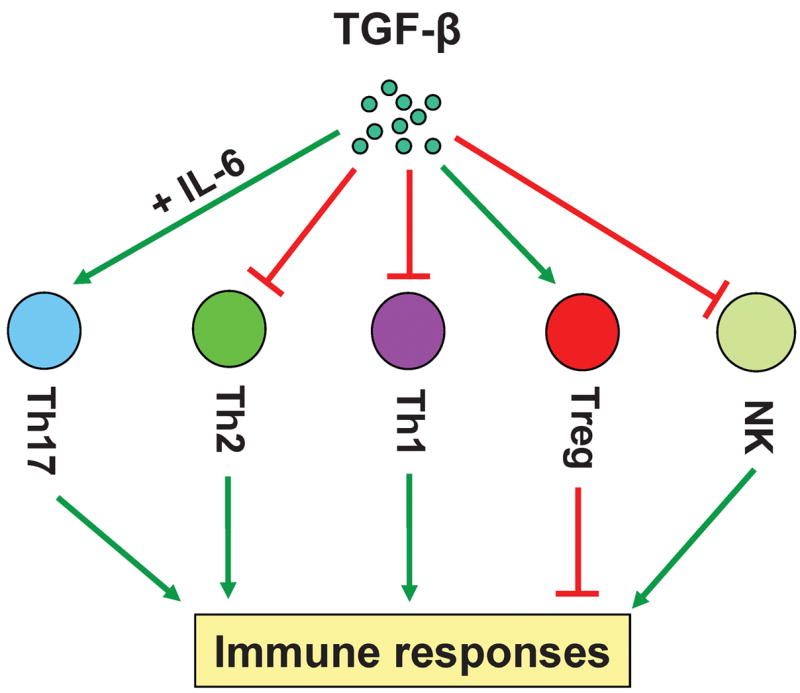
To inhibit immune responses, TGF-β suppresses the functions of Th1 and Th2 CD4+ effector cells and NK cells, and promotes the generation of Treg cells. To promote immune responses, TGF-β induces the generation of Th17 cells in combination with IL-6.
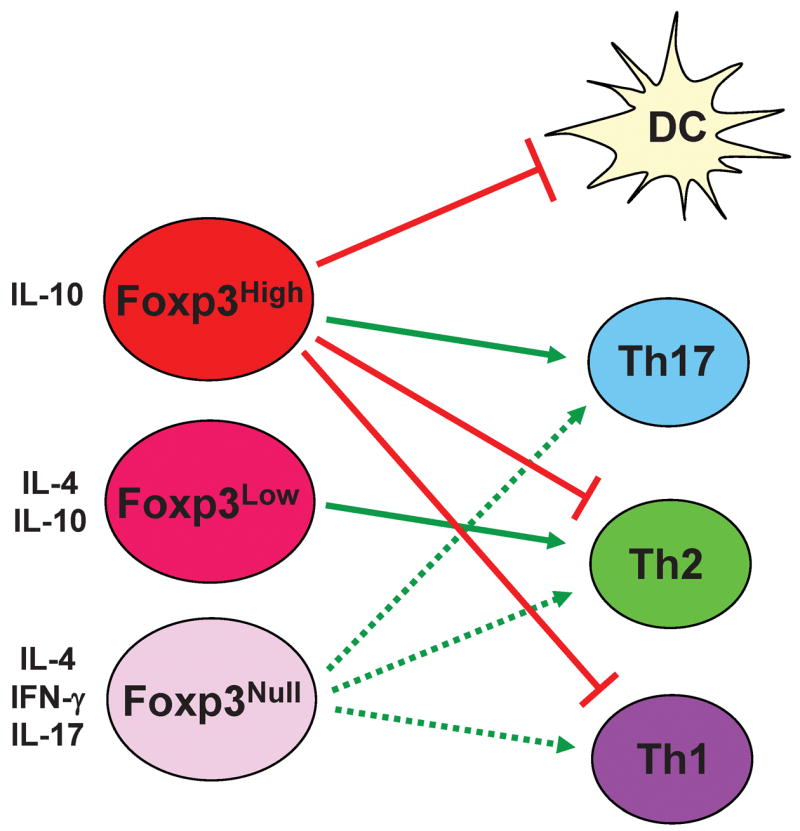
High levels of Foxp3 expression endow T-cell immune suppressive activities to suppress the function of effector T cells and DCs through cell contact-dependent and -independent mechanisms. T cells with high levels of Foxp3 expression promote Th17 cell differentiation, potentially through TGF-β. With decreasing Foxp3 expression, T cells can be converted into different types of effector T cells and direct the differentiation of conventional T cells towards different lineages.
References
-
- Gershon RK. A disquisition on suppressor T cells. Transplant Rev. 1975;26:170–185. - PubMed
-
- Blobe GC, Schiemann WP, Lodish HF. Role of transforming growth factor beta in human disease. N Engl J Med. 2000;342:1350–1358. - PubMed
-
- Chang H, Brown CW, Matzuk MM. Genetic analysis of the mammalian transforming growth factor-beta superfamily. Endocr Rev. 2002;23:787–823. - PubMed
-
- Govinden R, Bhoola KD. Genealogy, expression, and cellular function of transforming growth factor-beta. Pharmacol Ther. 2003;98:257–265. - PubMed
-
- Dubois CM, Laprise MH, Blanchette F, Gentry LE, Leduc R. Processing of transforming growth factor beta 1 precursor by human furin convertase. J Biol Chem. 1995;270:10618–10624. - PubMed
Publication types
MeSH terms
Substances
Grants and funding
LinkOut - more resources
Full Text Sources
Other Literature Sources
