


Estimated functional capacity predicts mortality in older adults
- PMID: 17979958
- PMCID: PMC3410432
- DOI: 10.1111/j.1532-5415.2007.01455.x
Estimated functional capacity predicts mortality in older adults
Abstract
Objectives: To examine associations between functional capacity estimated from cardiorespiratory fitness (CRF) and mortality risks in adults aged 60 and older.
Design: Prospective study, averaging 13.6 years follow-up.
Setting: Preventive medical clinic.
Participants: Four thousand sixty adults who completed preventive medical examinations between 1971 and 2001; 24.7% women, mean age+/-standard deviation 64.6+/-4.9, body mass index (BMI) 25.9+/-3.8 kg/m2.
Measurements: CRF was quantified as metabolic equivalents (METs) achieved during maximal treadmill exercise. The lowest 20% of the age- and sex-specific MET distribution was defined as having low CRF, the middle 40% moderate CRF, and the upper 40% high CRF. Cox regression was used to estimate death rates (per 1,000 person-years), hazard ratios (HRs), and their 95% confidence intervals (CIs).
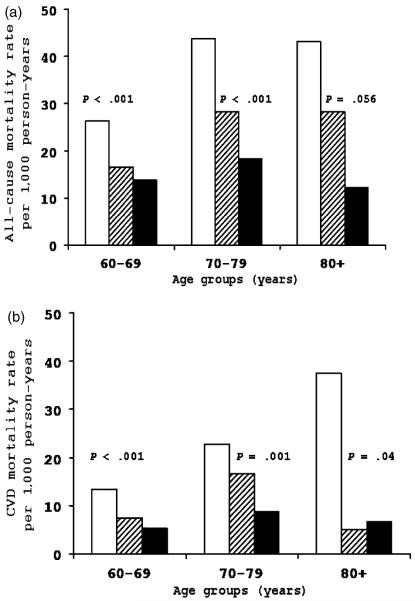
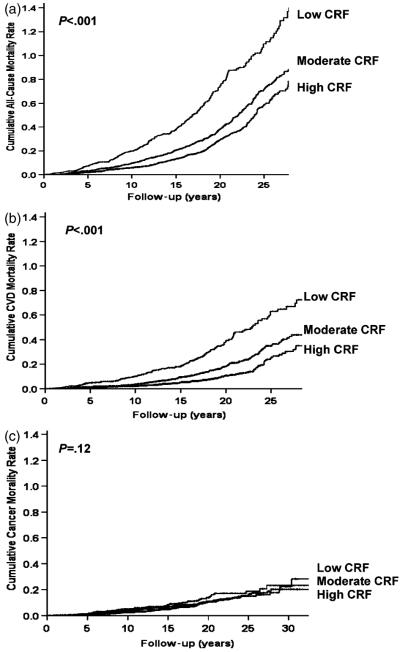
Results: Nine hundred eighty-nine deaths occurred during follow-up. Death rates adjusted for age, sex, and examination year were 30.9, 18.3, and 13.4 for all causes (P<.001); 15.9, 8.6, and 5.4 for cardiovascular disease (CVD) (P<.001); and 6.1, 4.9, and 4.2 for cancer (P=.04) for subjects with low, moderate, and high CRF, respectively. After adjusting for smoking, abnormal electrocardiograms at rest or while exercising, percentage of age-predicted maximal heart rate achieved during exercise testing, baseline medical conditions, BMI, hypercholesterolemia, and family CVD and cancer history, subjects with high CRF had notably lower mortality risk than those with low CRF from all causes (HR=0.59, 95% CI=0.47-0.74) and from CVD (HR=0.57, 95% CI=0.41-0.80).
Conclusion: CRF is an important independent predictor of death in older adults. The results add to the existing evidence that promoting physical activity in older adults provides substantial health benefits, even in the oldest old.
Figures
References
-
- Lurie N. Healthy people 2010: Setting the nation’s public health agenda. Acad Med. 2000;75:12–13. - PubMed
-
- Fleg JL, Morrell CH, Bos AG, et al. Accelerated longitudinal decline of aerobic capacity in healthy older adults. Circulation. 2005;112:674–682. - PubMed
-
- Hollenberg M, Yang J, Haight TJ, et al. Longitudinal changes in aerobic capacity: Implications for concepts of aging. J Gerontol A Biol Sci Med Sci. 2006;61A:M851–M858. - PubMed
-
- Hawkins S, Wiswell R. Rate and mechanism of maximal oxygen consumption decline with aging: Implications for exercise training. Sports Med. 2003;33:877–888. - PubMed
-
- Snader CE, Marwick TH, Pashkow FJ, et al. Importance of estimated functional capacity as a predictor of all-cause mortality among patients referred for exercise thallium single-photon emission computed tomography: Report of 3,400 patients from a single center. J Am Coll Cardiol. 1997;30:641–648. - PubMed
Publication types
MeSH terms
Grants and funding
LinkOut - more resources
Full Text Sources
Other Literature Sources
Medical
Miscellaneous
