


Identification of the functional role of peroxiredoxin 6 in the progression of breast cancer
- PMID: 17980029
- PMCID: PMC2246172
- DOI: 10.1186/bcr1789
Identification of the functional role of peroxiredoxin 6 in the progression of breast cancer
Erratum in
-
Correction to: Identification of the functional role of peroxiredoxin 6 in the progression of breast cancer.Breast Cancer Res. 2018 Jul 2;20(1):63. doi: 10.1186/s13058-018-0984-0. Breast Cancer Res. 2018. PMID: 29966525 Free PMC article.
Abstract
Introduction: The molecular mechanisms involved in breast cancer metastasis still remain unclear to date. In our previous study, differential expression of peroxiredoxin 6 was found between the highly metastatic MDA-MB-435HM cells and their parental counterparts, MDA-MB-435 cells. In this study, we investigated the effects of peroxiredoxin 6 on the proliferation and metastatic potential of human breast cancer cells and their potential mechanism.
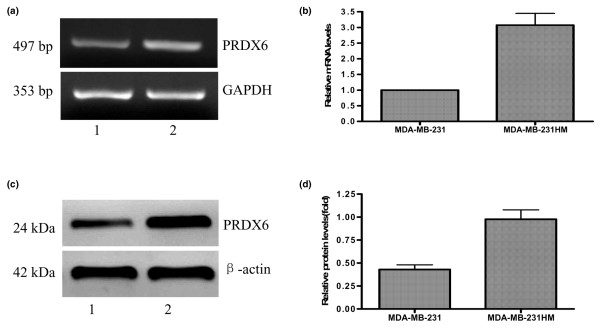
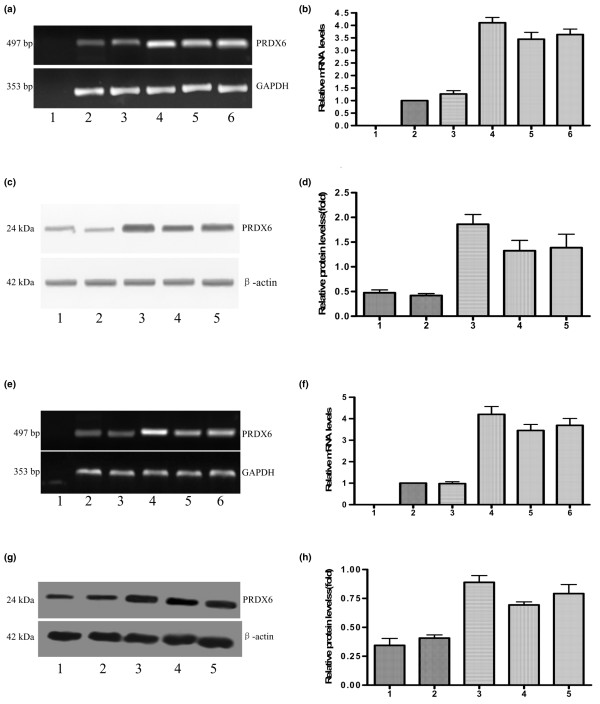
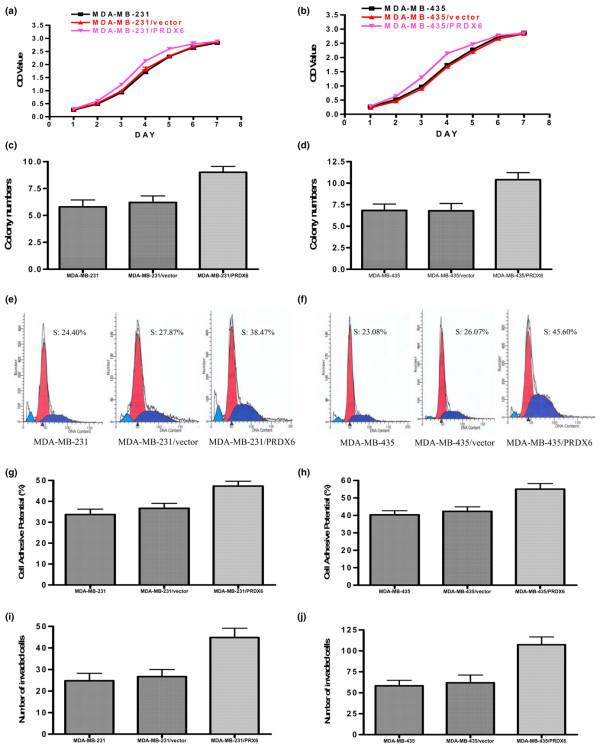
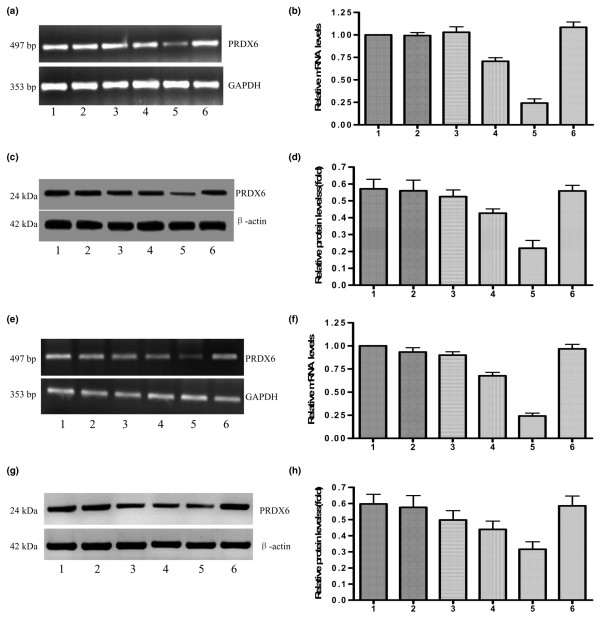
Methods: Expression of peroxiredoxin 6 in the highly metastatic MDA-MB-231HM cells was investigated by RT-PCR, real-time PCR and western blot. A recombinant expression plasmid of the human peroxiredoxin 6 gene was constructed and transfected into MDA-MB-231 and MDA-MB-435 cells. The effects of peroxiredoxin 6 on the proliferation and invasion of MDA-MB-231 and MDA-MB-435 cells were investigated by the Cell Counting Kit-8 method, colony-formation assay, adhesion assay, flow cytometry and invasion assay in vitro. miRNA was used to downregulate the expression of peroxiredoxin 6. Genes related to the invasion and metastasis of cancer were determined by RT-PCR, real-time PCR and western blot. The tumorigenicity and spontaneously metastatic capability regulated by peroxiredoxin 6 were determined using an orthotopic xenograft tumor model in athymic mice.
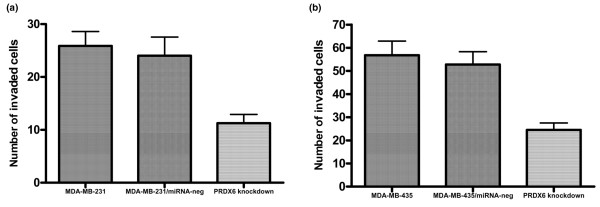
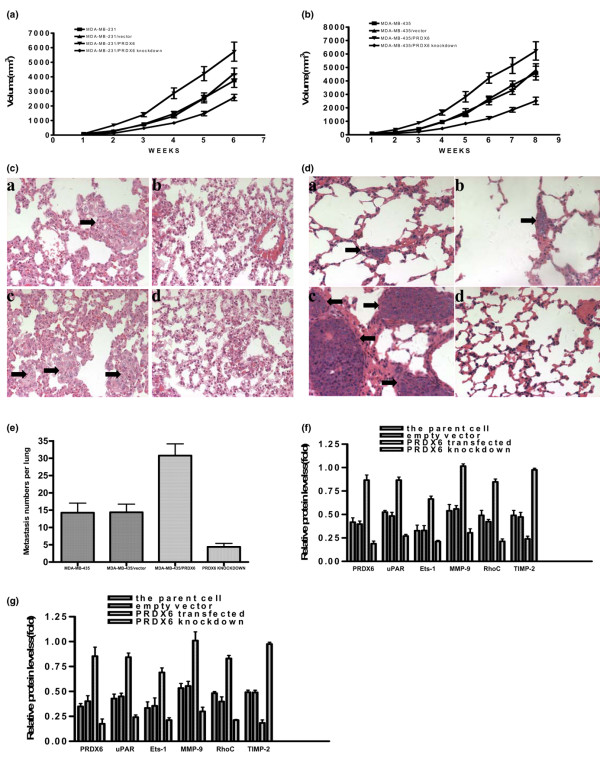
Results: Overexpression of peroxiredoxin 6 in MDA-MB-231HM cells compared with their parental counterparts was confirmed. Upregulation of peroxiredoxin 6 enhanced the in vitro proliferation and invasion of breast cancer cells. The enhancement was associated with decreasing levels of tissue inhibitor of matrix metalloproteinase (TIMP)-2 and increasing levels of the urokinase-type plasminogen activator receptor (uPAR), Ets-1 (E26 transformation-specific-1), matrix metalloproteinase (MMP)-9 and RhoC (ras homolog gene family, member C) expression. The results were further demonstrated by RNA interference experiments in vitro. In an in vivo study, we also demonstrated that peroxiredoxin 6-transfected breast cancer cells grew much faster and had more pulmonary metastases than control cells. By contrast, peroxiredoxin 6 knockdown breast cancer cells grew more slowly and had fewer pulmonary metastases. Effects similar to those of peroxiredoxin 6 on the uPAR, Ets-1, MMP-9, RhoC and TIMP-2 expression observed in in vitro studies were found in the in vivo study.
Conclusion: Overexpression of peroxiredoxin 6 leads to a more invasive phenotype and metastatic potential in human breast cancer, at least in part, through regulation of the levels of uPAR, Ets-1, MMP-9, RhoC and TIMP-2 expression.
Figures
References
-
- Jemal A, Siegel R, Ward E, Murray T, Xu J, Thun MJ. Cancer statistics, 2007. CA Cancer J Clin. 2007;57:43–66. - PubMed
-
- Li DQ, Wang L, Fei F, Hou YF, Luo JM, Zeng R, Wu J, Lu JS, Di GH, Ou ZL, et al. Identification of breast cancer metastasis-associated proteins in an isogenic tumor metastasis model using two-dimensional gel electrophoresis and liquid chromatography-ion trap-mass spectrometry. Proteomics. 2006;6:3352–3368. doi: 10.1002/pmic.200500617. - DOI - PubMed
-
- Nagase T, Miyajima N, Tanaka A, Sazuka T, Seki N, Sato S, Tabata S, Ishikawa K, Kawarabayasi Y, Kotani H, et al. Prediction of the coding sequences of unidentified human genes. III. The coding sequences of 40 new genes (KIAA0081-KIAA0120) deduced by analysis of cDNA clones from human cell line KG-1 (supplement) DNA Res. 1995;2:51–59. doi: 10.1093/dnares/2.1.51. - DOI - PubMed
-
- Kim TS, Sundaresh CS, Feinstein SI, Dodia C, Skach WR, Jain MK, Nagase T, Seki N, Ishikawa K, Nomura N, et al. Identification of a human cDNA clone for lysosomal type Ca2+-independent phospholipase A2 and properties of the expressed protein. J Biol Chem. 1997;272:2542–2550. doi: 10.1074/jbc.272.4.2542. - DOI - PubMed
Publication types
MeSH terms
Substances
LinkOut - more resources
Full Text Sources
Other Literature Sources
Medical
Research Materials
Miscellaneous
