Review
. 2008 Jan;1785(1):1-11.
doi: 10.1016/j.bbcan.2007.09.001. Epub 2007 Oct 12.

Declining cellular fitness with age promotes cancer initiation by selecting for adaptive oncogenic mutations

Affiliations
Review

Declining cellular fitness with age promotes cancer initiation by selecting for adaptive oncogenic mutations

Andriy Marusyk et al. Biochim Biophys Acta. 2008 Jan.

Abstract

Age is the single most important prognostic factor in the development of many cancers. The major reason for this age-dependence is thought to be the progressive accumulation of oncogenic mutations and epigenetic changes. Similarly, mutagens are thought to be carcinogenic primarily by engendering oncogenic mutations. Yet while the accumulation of heritable somatic changes is expected to augment the incidence of oncogenic mutations, a major effect of increased mutation load is reduced fitness. We propose that the fitness of progenitor cell compartments substantially impacts on the selective advantage conferred by particular mutations. We hypothesize that reduced cellular fitness within aged stem cell pools can select for adaptive oncogenic events and thereby promote the initiation of cancer. Thus, certain oncogenic mutations may be adaptive within aged but not young stem cell pools. We further argue that accumulating genetic alterations with age or mutagen exposure might promote cancer not only by causing oncogenic hits within cells but also by leading to eventual reduction in stem cell fitness, which then selects for oncogenic events. Therefore, initial stages of cancer development may not be limited by the incidence of initiating oncogenic changes, but instead by contexts of reduced cellular fitness that select for these changes.


Figures
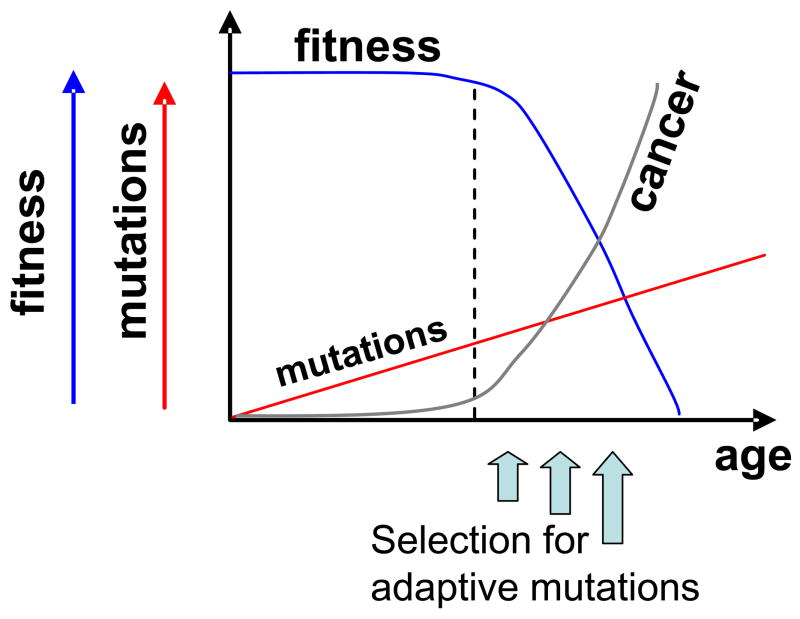
Figure 1
Figure 1. Adaptive Oncogenesis
In this model, conditions that reduce cellular fitness (such as aging or mutagen exposure) within progenitor cell pools select for adaptive mutations which can be oncogenic. When mutations and epigenetic changes accumulate to the point where the buffering capacity of the progenitor cell pool is exhausted (denoted by dotted line), the fitness of the population will begin to decline. Declining fitness will then increase selective pressure for adaptive oncogenic mutations that in turn promote cancer initiation. Note that the shape of the fitness curve is hypothetical and not based on data or mathematical modeling.
Figure 2
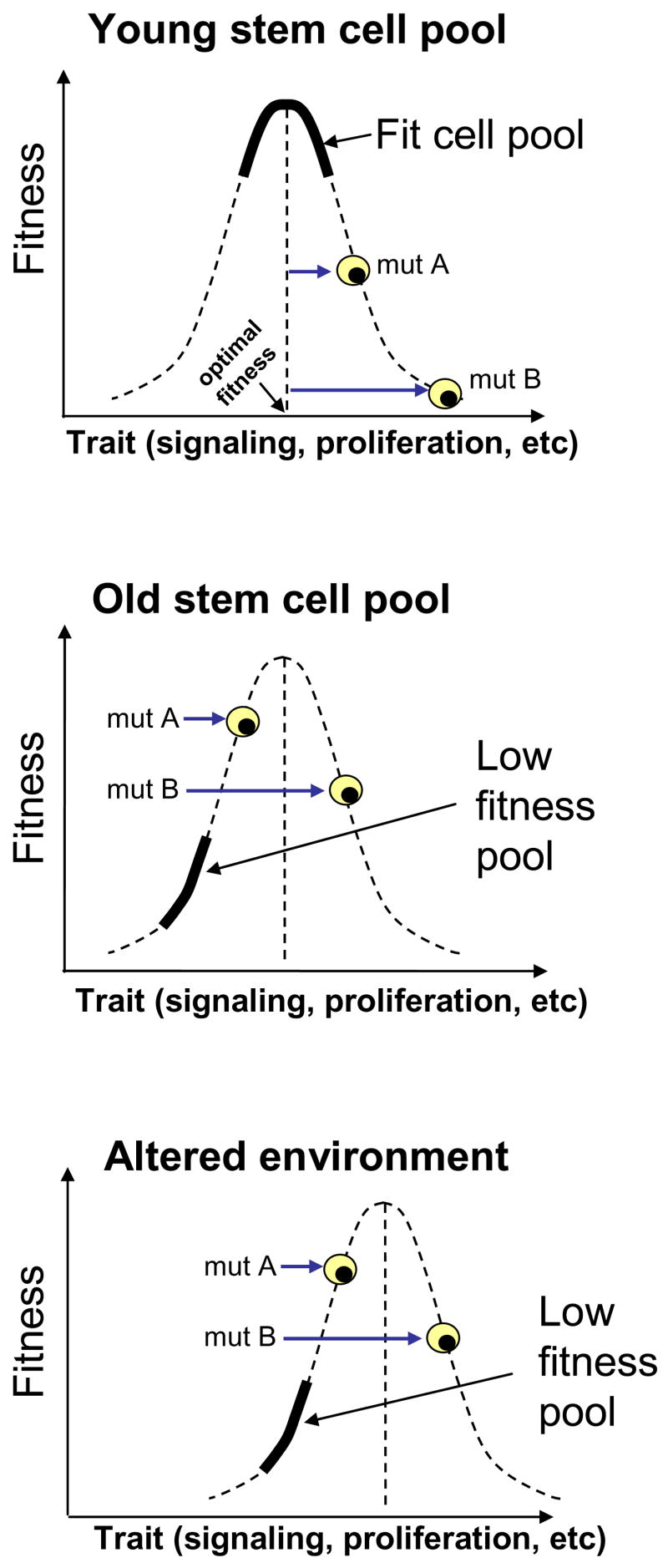
Figure 2. Stabilizing selection prevents oncogenesis in a fit stem cell pool, but can select for adaptive oncogenic mutations in a poorly fit pool
Top: A young, fit progenitor cell pool (solid curve) should possess traits that confer close to the optimal fitness for cellular maintenance in that pool. The dashed curve describes the relationship between trait and fitness. Oncogenic and non-oncogenic mutations that change the trait (mutations A and B) will tend to move the cell away from the optimum towards lower fitness. Middle: In contrast, the same oncogenic mutations in a low fitness pool may become adaptive, such as by promotion of signaling in a signaling deficient background. The low fitness pool is represented by a solid curve. In this example, the average trait value is reduced, and fitness is now limited by the trait level. In this low fitness pool, oncogenic mutations that increase the intensity of the trait become adaptive, leading to net improvement in fitness relative to the population average. Bottom: Likewise, following degradation of the stem cell environment (without necessarily directly damaging the stem cells), the relationship between trait and fitness is altered (dashed curve shifted right), and now the wild-type stem cell phenotype no longer confers optimal fitness, causing certain oncogenic mutations to become adaptive.
Figure 3
Figure 3. Changing mutation rates can alter cancer incidence by influencing fitness
Inherited or environmental conditions that increase mutation rates should accelerate fitness decline in progenitor cell populations, leading to more rapid and penetrant development of cancer (top right). On the other hand, reducing mutation rates should help maintain progenitor cell fitness, decreasing the selective pressure for adaptive mutations and cancer development (bottom right). Increasing mutation rates should also increase the chance of a cell acquiring an initiating oncogenic mutation, but we argue that clonal expansion of an initiated cell is usually limited by selection rather than oncogenic mutation.
Figure 4
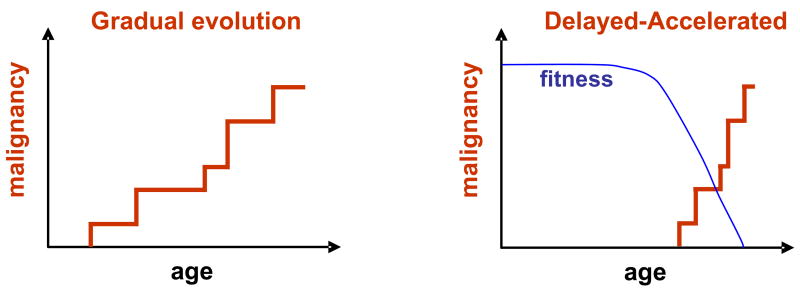
Figure 4. Contrasting the gradual and delayed-accelerated models of cancer evolution
Left: A simplistic interpretation of the prevailing view of cancer evolution as the gradual accumulation of rare oncogenic events over decades. Earlier exposure to carcinogens would increase the incidence of later cancers by providing initiating oncogenic mutations. Right: The delayed-accelerated model. A lifetime of accumulating genomic damage leads to the eventual reduction of stem cell fitness, providing selective pressure for adaptive oncogenic mutations. As selection does not occur until stem cell fitness has declined, cancer evolution occurs late in life and over a relatively short time period. Cancer may also rapidly evolve long after carcinogen exposure, facilitated by reduced fitness in stem cell pools set in motion by these genotoxic insults decades earlier. The delayed-accelerated model is analogous to the theory of Punctuated Equilibrium for species evolution championed by Eldredge and Gould [102].

References

    1. Nowell PC. The clonal evolution of tumor cell populations. Science. 1976;194:23–8. - PubMed
    1. Greaves M. Darwinian medicine: a case for cancer. Nat Rev Cancer. 2007;7:213–21. - PubMed
    1. Merlo LM, Pepper JW, Reid BJ, Maley CC. Cancer as an evolutionary and ecological process. Nat Rev Cancer. 2006;6:924–35. - PubMed
    1. Cairns J. Mutation selection and the natural history of cancer. Nature. 1975;255:197–200. - PubMed
    1. Balducci L, Beghe C. Cancer and age in the USA. Crit Rev Oncol Hematol. 2001;37:137–45. - PubMed

Publication types

Substances