Review
. 2008 Jan 1:13:2408-20.
doi: 10.2741/2854.

SNF1/AMPK pathways in yeast

Affiliations
Review

SNF1/AMPK pathways in yeast

Kristina Hedbacker et al. Front Biosci. .

Abstract

The SNF1/AMPK family of protein kinases is highly conserved in eukaryotes and is required for energy homeostasis in mammals, plants, and fungi. SNF1 protein kinase was initially identified by genetic analysis in the budding yeast Saccharomyces cerevisiae. SNF1 is required primarily for the adaptation of yeast cells to glucose limitation and for growth on carbon sources that are less preferred than glucose, but is also involved in responses to other environmental stresses. SNF1 regulates transcription of a large set of genes, modifies the activity of metabolic enzymes, and controls various nutrient-responsive cellular developmental processes. Like AMPK, SNF1 protein kinase is heterotrimeric. It is phosphorylated and activated by the upstream kinases Sak1, Tos3, and Elm1 and is inactivated by the Reg1-Glc7 protein phosphatase 1. Further regulation of SNF1 is achieved through autoinhibition and through control of its subcellular localization. Here we review the current understanding of SNF1 protein kinase pathways in Saccharomyces cerevisiae and other yeasts.


Figures
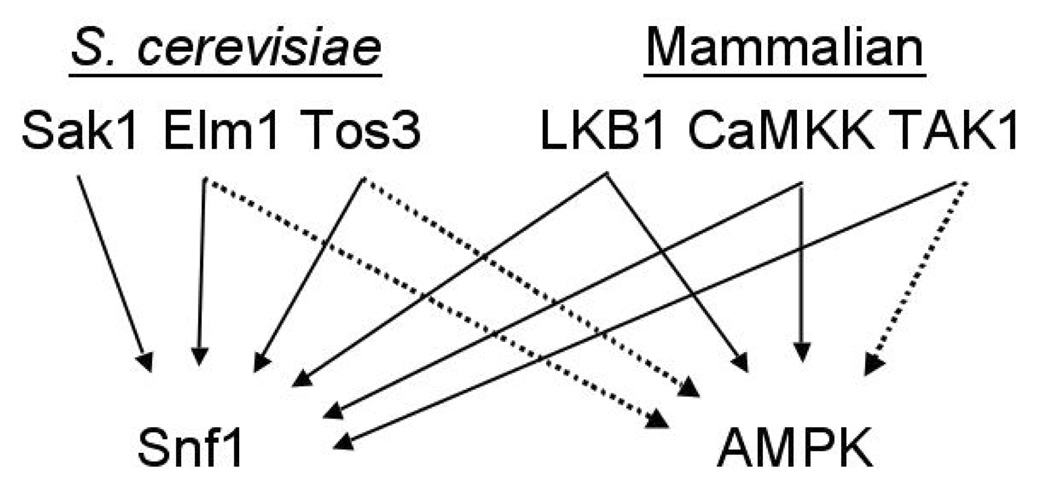
Figure 1
Figure 1
Conservation of SNF1/AMPK kinase cascades. Solid arrows indicate activation in vivo and in vitro. Dotted arrows indicate activation in vitro. Evidence suggests that TAK1 also activates AMPK in vivo (45, 127).
Figure 2
Figure 2
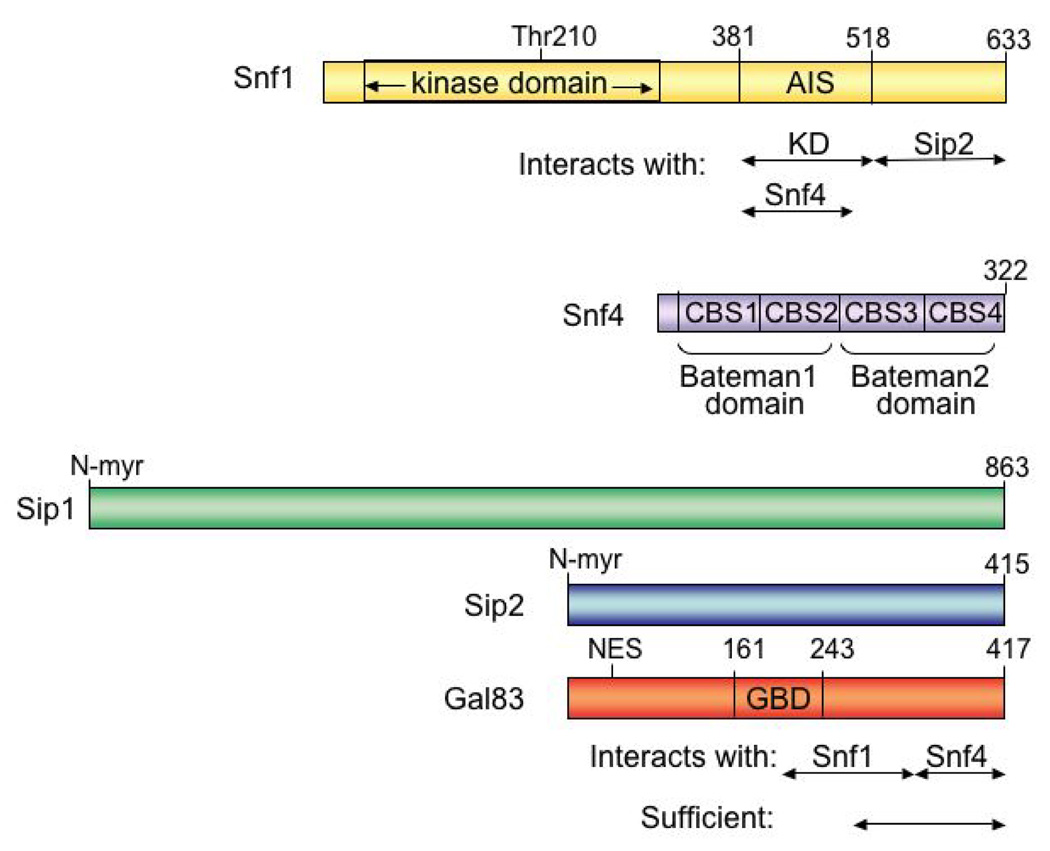
Structure of SNF1 subunits. Numbers, amino acid residues. Arrows, regions mapped by deletion analysis as sufficient for interaction with kinase domain (KD), Snf1, Snf4, or Sip2, as indicated. AIS, autoinhibitory sequence; CBS, cystathionine-beta-synthase repeat; N-myr, N-myristoylation consensus sequence; NES, nuclear export signal; GBD, glycogen binding domain.
Figure 3
Figure 3
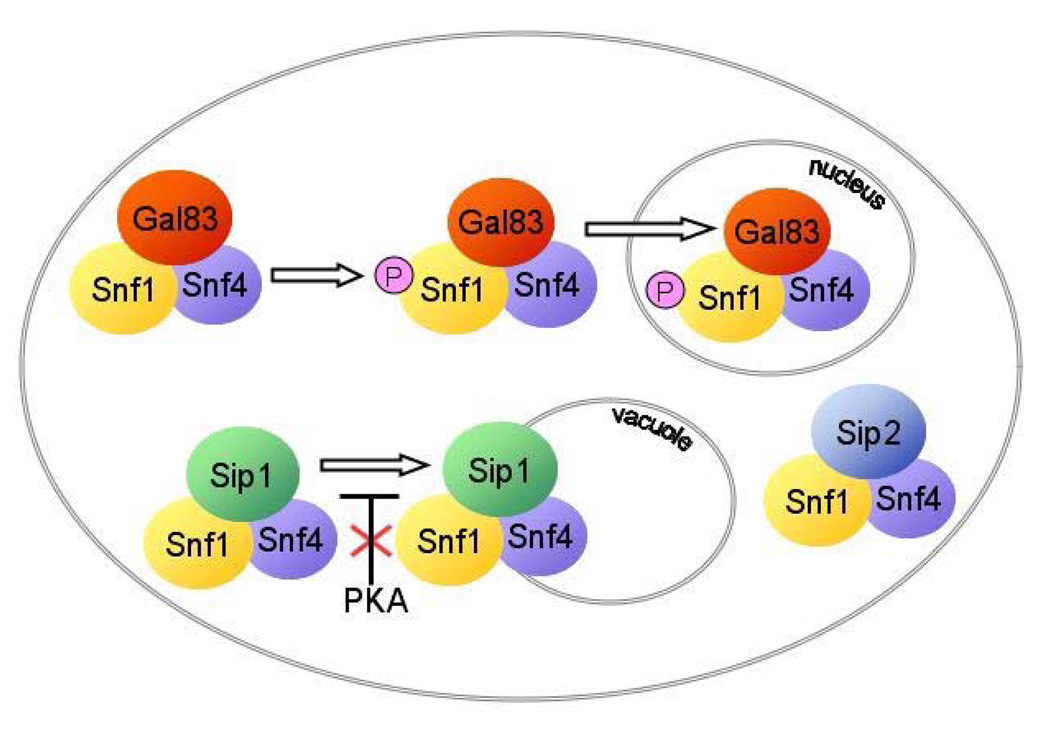
Relocalization of alternate forms of SNF1 in response to carbon stress. In conditions of high glucose, all three alternate SNF1 complexes are cytoplasmic. In response to carbon stress, PKA no longer inhibits the localization of Sip1 to the vacuolar membrane. Sip2 remains cytoplasmic. Relocalization of Snf1 protein kinase containing Gal83 to the nucleus in response to carbon stress requires phosphorylation (P) and activation of Snf1 and also a Snf1-independent stress signal that promotes nuclear localization of Gal83.
Figure 4
Figure 4
Mechanisms by which SNF1 regulates transcription of glucose-repressed genes. Yeast cells are depicted during growth in high glucose and after exposure to carbon stress. In high glucose, the repressor Mig1 is nuclear and represses transcription of many glucose-repressed genes (GENE) in conjunction with the corepressor Ssn6-Tup1. In response to carbon stress, SNF1 is phosphorylated (P) and moves into the nucleus. Sip4, a representative transcriptional activator, is phosphorylated and activates transcription of a subset of glucose-repressed genes. SNF1 phosphorylates Mig1, which alters its interaction with Ssn6-Tup1 to alleviate repression and promotes its nuclear export. SNF1 is also thought to modify chromatin (depicted by a single orange nucleosome) and affect the RNA polymerase II (Pol II) transcriptional apparatus.

References

    1. Carlson M, Osmond BC, Botstein D. Mutants of yeast defective in sucrose utilization. Genetics. 1981;98:25–40. - PMC - PubMed
    1. Carlson M, Botstein D. Two differentially regulated mRNAs with different 5' ends encode secreted and intracellular forms of yeast invertase. Cell. 1982;28:145–154. - PubMed
    1. Ciriacy M. Isolation and characterization of yeast mutants defective in intermediary carbon metabolism and in carbon catabolite derepression. Mol. Gen. Genet. 1977;154:213–220. - PubMed
    1. Zimmermann FK, Scheel I. Mutants of Saccharomyces cerevisiae resistant to carbon catabolite repression. Mol. Gen. Genet. 1977;154:75–82. - PubMed
    1. Celenza JL, Carlson M. Cloning and genetic mapping of SNF1, a gene required for expression of glucose-repressible genes in Saccharomyces cerevisiae. Mol. Cell. Biol. 1984;4:49–53. - PMC - PubMed

Publication types

MeSH terms

LinkOut - more resources