. 2007 Nov;19(11):3474-90.
doi: 10.1105/tpc.106.046011. Epub 2007 Nov 2.

Distinct light and clock modulation of cytosolic free Ca2+ oscillations and rhythmic CHLOROPHYLL A/B BINDING PROTEIN2 promoter activity in Arabidopsis

Affiliations

Distinct light and clock modulation of cytosolic free Ca2+ oscillations and rhythmic CHLOROPHYLL A/B BINDING PROTEIN2 promoter activity in Arabidopsis

Xiaodong Xu et al. Plant Cell. 2007 Nov.

Abstract

Plants have circadian oscillations in the concentration of cytosolic free calcium ([Ca(2+)](cyt)). To dissect the circadian Ca(2+)-signaling network, we monitored circadian [Ca(2+)](cyt) oscillations under various light/dark conditions (including different spectra) in Arabidopsis thaliana wild type and photoreceptor and circadian clock mutants. Both red and blue light regulate circadian oscillations of [Ca(2+)](cyt). Red light signaling is mediated by PHYTOCHROME B (PHYB). Blue light signaling occurs through the redundant action of CRYPTOCHROME1 (CRY1) and CRY2. Blue light also increases the basal level of [Ca(2+)](cyt), and this response requires PHYB, CRY1, and CRY2. Light input into the oscillator controlling [Ca(2+)](cyt) rhythms is gated by EARLY FLOWERING3. Signals generated in the dark also regulate the circadian behavior of [Ca(2+)](cyt). Oscillations of [Ca(2+)](cyt) and CHLOROPHYLL A/B BINDING PROTEIN2 (CAB2) promoter activity are dependent on the rhythmic expression of LATE ELONGATED HYPOCOTYL and CIRCADIAN CLOCK-ASSOCIATED1, but [Ca(2+)](cyt) and CAB2 promoter activity are uncoupled in the timing of cab1 (toc1-1) mutant but not in toc1-2. We suggest that the circadian oscillations of [Ca(2+)](cyt) and CAB2 promoter activity are regulated by distinct oscillators with similar components that are used in a different manner and that these oscillators may be located in different cell types in Arabidopsis.


Figures
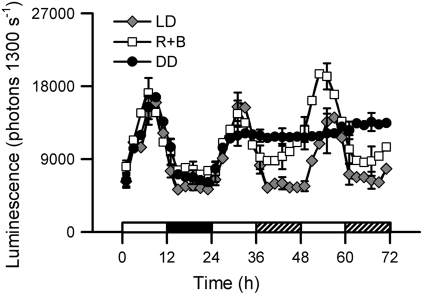
Figure 1.
Figure 1.
Light-Dependent Circadian [Ca2+]cyt Oscillations in Arabidopsis Seedlings. Seedlings were entrained in LD (60 μmol·m−2·s−1) for 10 d before release to constant R+B (100 μmol·m−2·s−1) and measured using photon-counting imaging. Aequorin luminescence rhythms from transgenic seedlings were recorded under LD (gray diamonds), R+B (white squares), and DD (black circles). The final LD cycle is shown. se bars are shown every 6 h (n = 4). Values are means of one representative experiment of at least four independent replicates with the same result. The white and black bars before 24 h indicate the light and dark periods of LD. Subsequently, white bars indicate subjective day and hatched bars indicate subjective night.
Figure 2.
Figure 2.
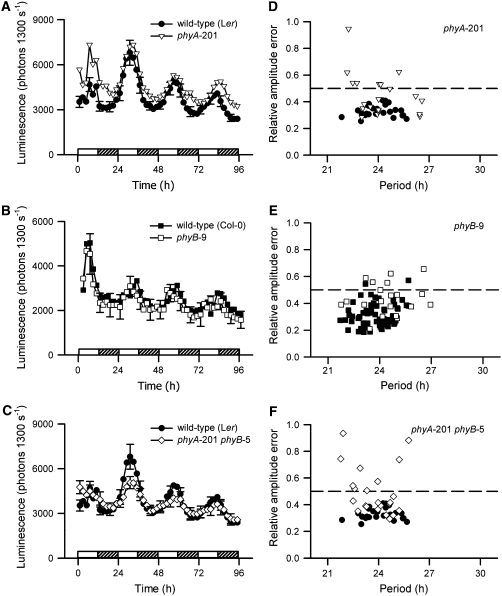
Phytochromes Are Required for Robust Circadian [Ca2+]cyt Oscillations. (A) to (C) Aequorin luminescence rhythms from phyA-201, phyB-9, and phyA-201 phyB-5 mutants were measured under R+B (100 μmol·m−2·s−1) using photon-counting imaging. Mean traces, representative of three independent experiments and at least two independent transformants, show aequorin luminescence in phyA-201 (A), phyB-9 (B), and phyA-201 phyB-5 double mutant (C) lines with Ler or Col-0 wild-type control. se bars are shown every 6 h (n = 4). Seedlings were entrained under L/D (60 μmol·m−2·s−1) for 10 d before transfer to R+B. Hatched bars at bottom represent subjective night. (D) to (F) Plots showing the FFT-NLLS analysis of luminescence rhythms. Each value indicates the analysis of one trace for Ler wild type (closed circles; n = 20), Col-0 wild type (closed squares; n = 44), phyA-201 mutant (open inverted triangles; n = 20), phyB-9 mutant (open squares; n = 20), and phyA-201 phyB-5 double mutant (open diamonds; n = 24). The dotted lines show RAE = 0.5.
Figure 3.
Figure 3.
Red Light Modulation of Circadian [Ca2+]cyt Oscillations. [Ca2+]cyt oscillations were recorded in the Ler wild-type background ([A]; n = 22), phyB-1 ([B]; n = 26), phyA-201 ([D]; n = 24), and the phyA-201 phyB-5 double mutant ([E]; n = 28) using photon-counting luminescence. Mean traces (n = 4) are representative of three independent experiments and at least two independent transformants. Seedlings were entrained under LD for 7 d before transfer to RR (gray bars; 40 μmol·m−2·s−1) for 3 d followed by 3 d in LL (white bars; 40 μmol·m−2·s−1). In (C), PHYB-ox lines (n = 28) containing 35S:AEQ were entrained under LD for 7 d before release to LL for 2.5 d followed by ∼2.5 d of RR (40 μmol·m−2·s−1 for all light conditions). Each value indicates the analysis of the mean trace for Ler wild type (closed circles), No-0 wild type (closed triangles), phyA-201 mutant (open inverted triangles), phyB-1 mutant (open squares), phyA-201 phyB-5 double mutant (open diamonds), and PHYB-ox (open circles).
Figure 4.
Figure 4.
Cryptochromes Are Required for Robust Circadian Oscillations of [Ca2+]cyt. (A) to (C) Aequorin luminescence rhythms from cry1, cry2-1, and cry1 cry2 mutants were measured under R+B (100 μmol·m−2·s−1) using photon-counting imaging. Mean traces, representative of three independent experiments and at least two independent transformants, show the aequorin luminescence in cry1 (A), cry2-1 (B), and cry1 cry2 double mutant (C) with Ler or Col-0 wild-type control. se bars are shown every 6 h (n = 4). Seedlings were entrained under LD for 10 d before transfer to R+B. Hatched bars at bottom represent subjective night. (D) to (F) Plots showing the FFT-NLLS analysis of the luminescence rhythms. Each value indicates the analysis of one trace for Ler wild type (closed circles; n = 24), Col-0 wild type (closed squares; n = 44), cry1 mutant (open inverted triangles; n = 11), cry2-1 mutant (open squares; n = 27), and cry1 cry2 double mutant (open diamonds; n = 24).
Figure 5.
Figure 5.
Blue Light Modulation of Circadian [Ca2+]cyt Oscillations. (A) to (F) Circadian [Ca2+]cyt oscillations were measured in Ler wild type ([A]; closed circles), Col-0 wild type ([B]; closed squares), cry1 ([C]; open inverted triangles), cry2-1 ([D]; open triangles), and cry1 cry2 double mutant ([F]; open diamonds) using photon-counting luminescence. Mean traces are representative of three independent experiments and at least two independent transformants. Seedlings were entrained under LD for 7 d before transfer to LL (white bars; 40 μmol·m−2·s−1 for all light conditions) for 2 d followed by 3 d in BB (dark gray bars) and 3 d in R+B (cross-hatched bars). In (E), Ler wild type was entrained under LD for 7 d before transfer to LL (white bar) followed by RR (light gray bar) and R+B (hatched bar; 40 μmol·m−2·s−1 for all light conditions). (G) and (H) PHYB-ox (open circles) and phyB-1 (open squares) mutants transgenic with 35S:AEQ were entrained under LD for 7 d before release to LL for 2 d followed by ∼3 d of BB and R+B (40 μmol·m−2·s−1 for all light conditions). n = 12 to 46 for LL and n = 20 to 23 for all other light conditions except cry1 cry2 in monochromatic light (n = 9) (F).
Figure 6.
Figure 6.
ELF3 Is Required to Maintain Circadian [Ca2+]cyt Oscillations. [Ca2+]cyt in elf3-1 (open squares) and Col-0 wild type (closed squares) was measured under R+B (100 μmol·m−2·s−1) (A), RR or BB (40 μmol·m−2·s−1 for both conditions) (B), and DD (C) using photon-counting luminescence (B) or photon-counting imaging ([A] and [C]). Seedlings were entrained under LD for 7 d before release to constant conditions. White bars indicate subjective day in R+B, light gray bars indicate RR, dark gray bars indicate BB, and black bars indicate DD. Hatched bars represent subjective night in R+B and subjective day in DD. se bars are shown every 6 h (n = 4). At least three replicates and three independent transformants were used for each experiment.
Figure 7.
Figure 7.
Circadian Ca2+ Oscillations Are Downstream of CCA1/LHY. Aequorin luminescence in CCA1-ox (A), cca1-1 (B), and LHY-ox (C) under LL (100 μmol·m−2·s−1) measured using photon-counting luminescence. se bars are shown every 6 h (n = 4). Mean traces are representative of three independent experiments and at least two independent transformants. Seedlings were entrained under LD for 7 d before transfer to LL. Hatched boxes indicate subjective night in LL. n > 40 for (A) to (C). In (D), plots show the FFT-NLLS analysis of rhythms in leaf movement. Each value indicates the analysis of one trace for Ws wild type (n = 16) and cca1-1 (n = 16). Plants were grown under LD for 7 d and then transferred to LL for 5 d for assessment of leaf movement rhythms as described by Michael et al. (2003). Closed squares, Col-0 wild type; closed triangles, Ws wild type; closed circles, Ler wild type; open diamonds, CCA1-ox; open circles, cca1-1; open triangles, LHY-ox.
Figure 8.
Figure 8.
toc1-1 Does Not Affect the Period of Circadian [Ca2+]cyt Oscillations. Luminescence of aequorin ([A] to [C]) and luciferase ([E] to [G]) was measured using photon-counting imaging from C24 wild type (black symbols), toc1-1 (white symbols), toc1-2 (light gray symbols), and ztl-1 (dark gray symbols) lines transformed with both 35S:AEQ and CAB2:luc transgenes. Seedlings were entrained in LD for 10 d before transfer to R+B (100 μmol·m−2·s−1 ). Measurements of aequorin (circles) and luciferase (inverted triangles) luminescence were made simultaneously using photon-counting imaging of sibling seedlings treated with luciferin and coelenterazine, respectively. se bars are shown every 6 h (n = 4). At least three replicates and three independent transformants were used for each experiment. (D) shows FFT-NLLS analysis of 35S:AEQ and CAB2:luc luminescence in C24 wild type, toc1-1, toc1-2, and ztl-1. The data are means ± sd from one experiment representative of at least seven independent replicates.

References

    1. Ahmad, M., and Cashmore, A.R. (1993). HY4 gene of A. thaliana encodes a protein with characteristics of a blue-light photoreceptor. Nature 366 162–166. - PubMed
    1. Alabadí, D., Oyama, T., Yanovsky, M.J., Harmon, F.G., Más, P., and Kay, S.A. (2001). Reciprocal regulation between TOC1 and LHY/CCA1 within the Arabidopsis circadian clock. Science 293 880–883. - PubMed
    1. Asher, G., and Schibler, U. (2006). A CLOCK-less clock. Trends Cell Biol. 16 547–549. - PubMed
    1. Babourina, O., Newman, I., and Shabala, S. (2002). Blue light-induced kinetics of H+ and Ca2+ fluxes in etiolated wild-type and phototropin-mutant Arabidopsis seedlings. Proc. Natl. Acad. Sci. USA 99 2433–2438. - PMC - PubMed
    1. Baum, G., Long, J.C., Jenkins, G.I., and Trewavas, A.J. (1999). Stimulation of the blue light phototropic receptor NPH1 causes a transient increase in cytosolic Ca2+. Proc. Natl. Acad. Sci. USA 96 13554–13559. - PMC - PubMed

Publication types

MeSH terms

Associated data