. 2007 Nov;3(11):e219.
doi: 10.1371/journal.pcbi.0030219. Epub 2007 Sep 26.

From endosymbiont to host-controlled organelle: the hijacking of mitochondrial protein synthesis and metabolism

Affiliations

From endosymbiont to host-controlled organelle: the hijacking of mitochondrial protein synthesis and metabolism

Toni Gabaldón et al. PLoS Comput Biol. 2007 Nov.

Abstract

Mitochondria are eukaryotic organelles that originated from the endosymbiosis of an alpha-proteobacterium. To gain insight into the evolution of the mitochondrial proteome as it proceeded through the transition from a free-living cell to a specialized organelle, we compared a reconstructed ancestral proteome of the mitochondrion with the proteomes of alpha-proteobacteria as well as with the mitochondrial proteomes in yeast and man. Overall, there has been a large turnover of the mitochondrial proteome during the evolution of mitochondria. Early in the evolution of the mitochondrion, proteins involved in cell envelope synthesis have virtually disappeared, whereas proteins involved in replication, transcription, cell division, transport, regulation, and signal transduction have been replaced by eukaryotic proteins. More than half of what remains from the mitochondrial ancestor in modern mitochondria corresponds to translation, including post-translational modifications, and to metabolic pathways that are directly, or indirectly, involved in energy conversion. Altogether, the results indicate that the eukaryotic host has hijacked the proto-mitochondrion, taking control of its protein synthesis and metabolism.


Conflict of interest statement

Competing interests. The authors have declared that no competing interests exist.

Figures

Figure 1
Figure 1. Relative Weights of the Functional Classes in the Proteomes
From left to right, Mesorhizobium loti, the proto-mitochondrion, yeast mitochondria, and human mitochondria. The colors in the bars indicate the origin of the proteins in that functional class for that given organism (yellow: alpha-proteobacterial origin. red: other origin). We used the NJ-set as a reference to calculate the fraction that is evolutionary-derived from the proto-mitochondrion. Functional classes are derived from COG [16]. Alpha-proteobacterial–derived proteins are a minority in all classes except Coenzyme biosynthesis; the energy production/conversion class is the most “alpha-proteobacterial–derived.”
Figure 2
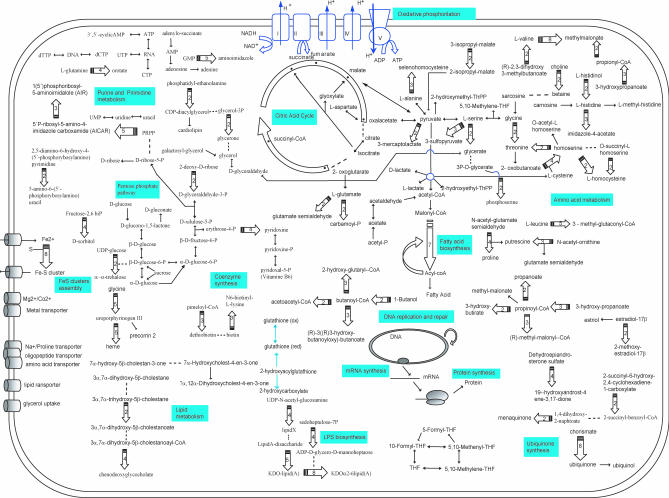
Figure 2. An Overview of Metabolism and Transport in the Proto-Mitochondrion
Metabolism and transport were deduced from the OGs present in the estimated proteome (see text). Boxes, arrows, and cylinders indicate pathways, enzymes, and transporters, respectively. Several consecutive steps can be condensed into a bigger arrow with a number indicating the steps included. Single missing steps connecting recovered pathways are indicated as dashed lines.
Figure 3
Figure 3. Reconstructed Human and Yeast Mitochondrial Metabolic Pathways
Human (left) and yeast (right) metabolic pathways were deduced from the function of the proteins compiled in the MitoProteome Dataset [25] and present in the yeast proteomics set [24], respectively. In order to facilitate the comparison of both metabolic pathways, pathways shared by the two species are depicted in the middle region of the figure, pathways at the extremes of the dashed lines are exclusive for human (left) or yeast (right) mitochondria. Color codes indicate whether the pathway was likely present in the proto-mitochondrion (blue) or has a different origin (red). Only those pathways with two or more consecutive steps are depicted. Symbols are as in Figure 2. All proteins are nuclear-encoded except for nad1–6 subunits of Complex I in human; the atp9 subunit of Complex V in yeast; and the Cob subunit in Complex III, cox1–3 subunits of Complex IV, and the atp6 and atp8 subunits from Complex V in both species.
Figure 4
Figure 4. Venn Diagram Representing the Overlap of the Three Considered Proteomes
The human mitochondrial proteome (green) [25], the yeast mitochondrial proteome (blue) [24], and the reconstructed proto-mitochondrial proteome (brown). For each proteome, the number of proteins in each fraction is indicated. The numbers of proteins in a single fraction vary because there are varying numbers of (in-)paralogs between the species within the same OG. Arrows from each fraction point to lists of biological process GO terms that are significantly enriched (bold) or specific to that fraction (see Materials and Methods). No significantly over-represented terms were found in the proto-mitochondrial–derived fractions of the mitochondrial proteome, likely due to the fact that most of their pathways (e.g., electron transport chain) also have components of eukaryotic origin.

References

    1. Scheffler IE. Mitochondria make a comeback. Adv Drug Deliv Rev. 2001;49:3–26. - PubMed
    1. Miller WL. Mitochondrial specificity of the early steps in steroidogenesis. J Steroid Biochem Mol Biol. 1995;55:607–616. - PubMed
    1. Lill R, Muhlenhoff U. Iron-sulfur-protein biogenesis in eukaryotes. Trends Biochem Sci. 2005;30:133–141. - PubMed
    1. Gray MW, Burger G, Lang BF. Mitochondrial evolution. Science. 1999;283:1476–1481. - PubMed
    1. Gabaldón T, Huynen MA. Shaping the mitochondrial proteome. Biochim Biophys Acta. 2004;1659:212–220. - PubMed

Publication types

LinkOut - more resources