


Review
doi: 10.1016/j.nic.2007.07.003.
Neuroimaging in posttraumatic stress disorder and other stress-related disorders
Affiliations
- PMID: 17983968
- PMCID: PMC2729089
- DOI: 10.1016/j.nic.2007.07.003
Item in Clipboard
Review
Neuroimaging in posttraumatic stress disorder and other stress-related disorders
Neuroimaging Clin N Am.
2007 Nov.
Abstract
Traumatic stress has a broad range of effects on the brain. Brain areas implicated in the stress response include the amygdala, the hippocampus, and the prefrontal cortex. Studies in patients who have posttraumatic stress disorder (PTSD) and other psychiatric disorders related to stress have replicated findings in animal studies by finding alterations in these brain areas. Brain regions implicated in PTSD also play an important role in memory function, highlighting the important interplay between memory and the traumatic stress response. Abnormalities in these brain areas are hypothesized to underlie symptoms of PTSD and other stress-related psychiatric disorders.
Figures
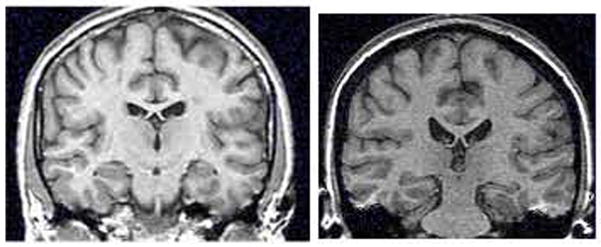
Hippocampal volume on MRI in PTSD. Smaller hippocampal volume in a representative patient with PTSD (right) relative to a non PTSD subject (left).
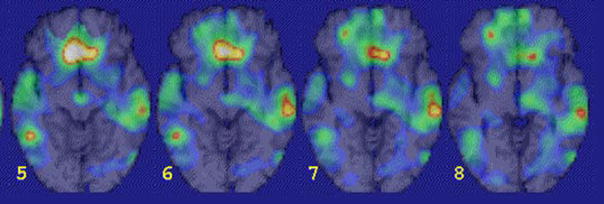
Medial prefrontal dysfunction in PTSD. There was a failure of medial prefrontal activation in a group of combat veterans with PTSD compared to combat veterans without PTSD during exposure to traumatic combat related slides and sounds (yellow area in prefrontal cortex)
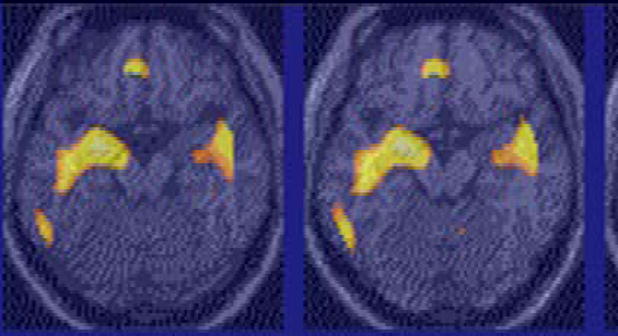
Amygdala activation during acquisition of fear learning in PTSD. There was an increase in amygdala activation during acquisition of conditioned fear learning in women with PTSD related to early childhood abuse. Yellow areas in the amygdala show areas of increased blood flow during acquisition of fear learning in the group of women with abuse-related PTSD as a group. Women with abuse-related PTSD had greater increases of amygdala activation during fear learning than women without PTSD.
References
-
- Franklin CL, Zimmerman M. Posttraumatic stress disorder and major depressive disorder: Investigating the role of overlapping symptoms in diagnostic comorbidity. J Nerv Ment Dis. 2001;189(8):548–551. - PubMed
-
- Prigerson HG, Maciejewski PK, Rosenheck RA. Combat trauma: Trauma with highest risk of delayed onset and unresolved posttraumatic stress disorder symptoms, unemployment, and abuse among men. J Nerv Ment Dis. 2001;189(2):99–108. - PubMed
-
- Kessler RC, Sonnega A, Bromet E, Hughes M, Nelson CB. Posttraumatic stress disorder in the national comorbidity survey. Arch Gen Psychiatry. 1995;52:1048–1060. - PubMed
-
- Bremner JD, Southwick SM, Darnell A, Charney DS. Chronic PTSD in Vietnam combat veterans: Course of illness and substance abuse. Am J Psychiatry. 1996;153:369–375. - PubMed
-
- Putnam FW, Guroff JJ, Silberman EK, Barban L, Post RM. The clinical phenomenology of multiple personality disorder: A review of 100 recent cases. J Clin Psychiatry. 1986;47:285–293. - PubMed
Publication types
MeSH terms
Grants and funding
LinkOut - more resources
Full Text Sources
Other Literature Sources
Medical
