. 2007 Nov 13;104(46):18043-8.
doi: 10.1073/pnas.0706349104. Epub 2007 Nov 1.

Efficient and verified simulation of a path ensemble for conformational change in a united-residue model of calmodulin

Affiliations

Efficient and verified simulation of a path ensemble for conformational change in a united-residue model of calmodulin

Bin W Zhang et al. Proc Natl Acad Sci U S A. .

Abstract

The computational sampling of rare, large-scale, conformational transitions in proteins is a well appreciated challenge-for which a number of potentially efficient path-sampling methodologies have been proposed. Here, we study a large-scale transition in a united-residue model of calmodulin using the "weighted ensemble" (WE) approach of Huber and Kim. Because of the model's relative simplicity, we are able to compare our results with brute-force simulations. The comparison indicates that the WE approach quantitatively reproduces the brute-force results, as assessed by considering (i) the reaction rate, (ii) the distribution of event durations, and (iii) structural distributions describing the heterogeneity of the paths. Importantly, the WE method is readily applied to more chemically accurate models, and by studying a series of lower temperatures, our results suggest that the WE method can increase efficiency by orders of magnitude in more challenging systems.


Conflict of interest statement

The authors declare no conflict of interest.

Figures
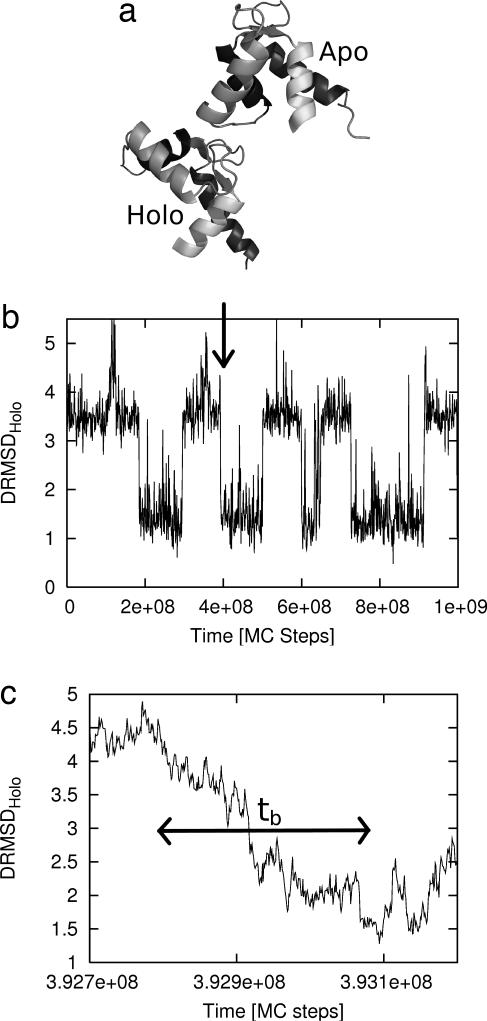
Fig. 1.
Fig. 1.
The N-terminal domain of calmodulin undergoes a large-scale structural change when it binds calcium. (a) The calcium-free Apo structure (1CFD) and the calcium-bound Holo structure (1CLL) are shown. (b) A sample trajectory from the simulation of the “double-native” Gō model of calmodulin exhibits several transition events, one of which is detailed in c. The approximate duration of the event tb is indicated by the arrow.
Fig. 2.
Fig. 2.
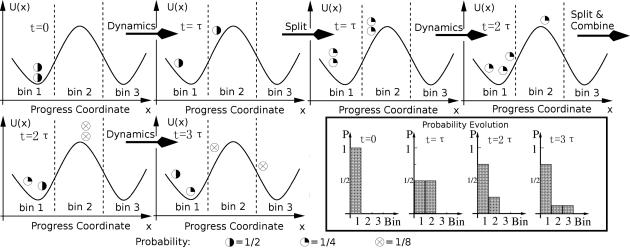
Schematic illustration of the WE method, using n = 3 bins and M = 2 simulations per bin following ref. . After initiating M trajectories, unbiased dynamics are simulated for a time τ, after which the locations (bins) are checked. Trajectories are split or combined to maintain M trajectories per bin, while preserving the correct probabilities in each bin. Dynamics are again initiated, and the process is repeated. The box at the lower right shows the corresponding evolution of the probability histogram.
Fig. 3.
Fig. 3.
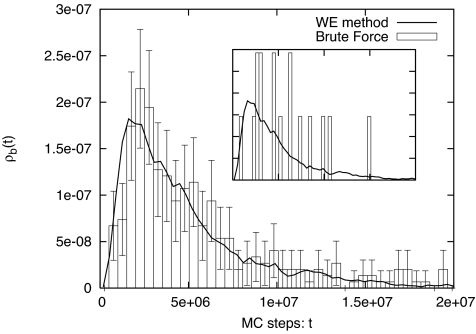
Distribution of transition event durations ρb(t) from WE and brute-force simulations. The event duration is the time interval between the last time a trajectory leaves the reactant state (DRMSDApo < 1.5 Å) and the first time it reaches the product state (DRMSDHolo < 1.5 Å) (see Fig. 1). (Inset) Results from the two methods using equal amounts of CPU time, ≈4 weeks, which is not sufficient for brute-force simulation to obtain a good statistical distribution.
Fig. 4.
Fig. 4.
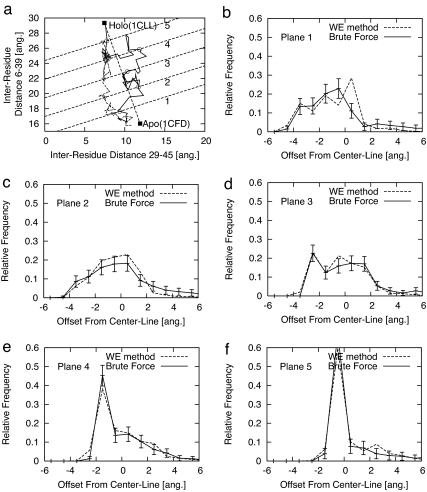
Structural distributions describing the heterogeneity of the path ensemble connecting the Apo and Holo states of calmodulin, based on both WE and brute-force simulations. a shows two sample Apo → Holo transitions, with open symbols indicating points at which the five parallel (dashed) “planes” are first crossed. Plots b–e show the ensemble-based distributions of the first crossing points of the paths on each of the five planes from a.

References

    1. Berg JM, Stryer L, Tymoczko JL. Biochemistry. 5th Ed. New York: Freeman; 2002.
    1. Elber R. Curr Opin Struct Biol. 2005;15:151–156. - PubMed
    1. Evenas J, Forsen S, Malmendal A, Akke M. J Mol Biol. 1999;289:603–617. - PubMed
    1. Spetzler D, York J, Daniel D, Fromme R, Lowry D, Frasch W. Biochemistry. 2006;45:3117–3124. - PMC - PubMed
    1. Pratt LR. J Chem Phys. 1986;85:5045–5048.

Publication types

LinkOut - more resources