. 2007 Nov 13;104(46):17927-30.
doi: 10.1073/pnas.0704882104. Epub 2007 Nov 1.

Self-recognition and self-selection in multicomponent supramolecular coordination networks on surfaces

Affiliations

Self-recognition and self-selection in multicomponent supramolecular coordination networks on surfaces

Alexander Langner et al. Proc Natl Acad Sci U S A. .

Abstract

Self-recognition, self-selection, and dynamic self-organization are of fundamental importance for the assembly of all supramolecular systems, but molecular-level information is not generally accessible. We present direct examples of these critical steps by using scanning tunneling microscopy to study mixtures of complementary organic ligands on a copper substrate. The ligands coordinate cooperatively with iron atoms to form well ordered arrays of rectangular multicomponent compartments whose size and shape can be deliberately tuned by selecting ligands of desired length from complementary ligand families. We demonstrate explicitly that highly ordered supramolecular arrays can be produced from redundant ligand mixtures by molecular self-recognition and -selection, enabled by efficient error correction and cooperativity, and show an example of failed self-selection due to error tolerance in the ligand mixture, leading to a disordered structure.


Conflict of interest statement

The authors declare no conflict of interest.

Figures
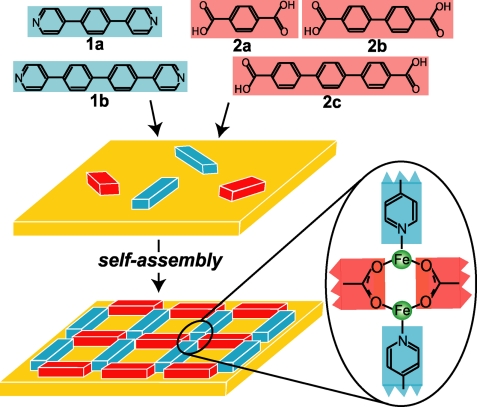
Fig. 1.
Fig. 1.
Complementary molecular ligands deposited with Fe atoms on Cu(100) self-assemble into regular rectangular arrays. Schematic illustration of molecules used in this study (top). Molecules and Fe atoms deposited to surface and annealed at 450 K to activate mobility for assembly. Also shown is a detail of local bonding arrangement at each node in the rectangular networks.
Fig. 2.
Fig. 2.
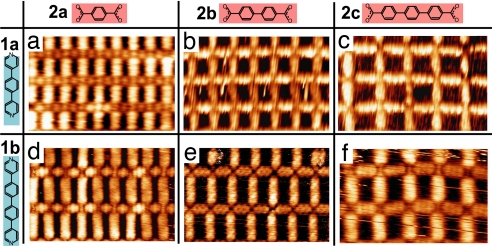
Steering the size and aspect ratio of rectangular molecular-scale compartments via the backbone length of the ligands in self-assembled iron coordination networks. STM images show six possible binary combinations [(Fe2)(1)2/2(2)2/2]n of bipyridine (ligands 1a and 1b) and bis-carboxylic acid (ligands 2a, 2b, and 2c) ligands. All images are 9.4 × 6.0 nm. Structure periodicity is 1.1 × 1.8 nm (a), 1.5 × 1.8 nm (b), 1.8 × 1.8 nm (c), 1.1 × 2.3 nm (d), 1.5 × 2.3 nm (e), and 1.8 × 2.3 nm (f).
Fig. 3.
Fig. 3.
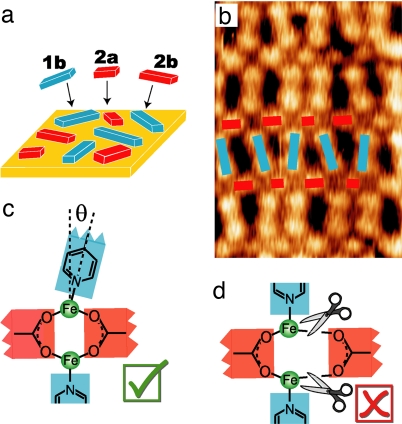
Distorted rectangular coordination network exhibiting structural error tolerance. (a) The ternary ligand combination 1b/2a/2b was codeposited with Fe on a Cu(100) surface. (b) STM image showing the structural disorder within the 2D coordination network. Image size is 6.9 × 9.6 nm. (c) Schematic representation of the local coordination structure at the nodes of the network, illustrating a distortion of the pyridyl–Fe bond angle to accommodate the random packing of ligands 2a and 2b. (c and d) This bond distortion (c) is favored compared with breaking the double C–Oformula imageFe bond (d), which would be necessary for self-selection and ordering of ligands 2a and 2b (blue, bipyridine ligand 1b; red, bis-carboxylates 2a or 2b; dashed lines to indicate tilting of ligand 1b by angle θ from perpendicular structure).
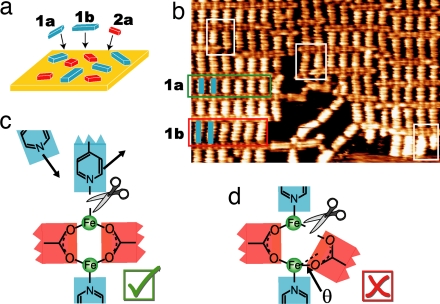
Fig. 4.
Fig. 4.
Highly ordered coordination networks generated by efficient ligand self-selection. (a) The ternary ligand combination 1a/1b/2a was codeposited with Fe on a Cu(100) surface. (b) STM image showing the local segregation of the mixture into highly ordered subdomains containing ligand 1a (green box) or 1b (red box). Additionally, several defects exhibiting coordination of neighboring bipyridine ligands of different lengths are highlighted (white boxes). Image size is 22 × 14 nm. (c) Schematic diagram of the reversible pyridyl–Fe bonding, the basis for active error correction by self-selection of ligands 1a and 1b into highly ordered subdomains. (d) Random packing would require breaking of one of the C–Oformula imageFe bonds and distortion of the other bond.

References

    1. Lehn JM. Proc Natl Acad Sci USA. 2002;99:4763–4768. - PMC - PubMed
    1. Seidel SR, Stang PJ. Acc Chem Res. 2002;35:972–983. - PubMed
    1. Caulder DL, Raymond KN. Acc Chem Res. 1999;32:975–982.
    1. Caulder DL, Raymond KN. Dalton Trans. 1999:1185–1200.
    1. Stang PJ, Olenyuk B. Acc Chem Res. 1997;30:502–518.

LinkOut - more resources